Exploring Community Volunteering Through a Career Development Lens
Show original YouTube description
Show transcript [en]
so it's 11 whenever you feel comfortable getting [Applause]
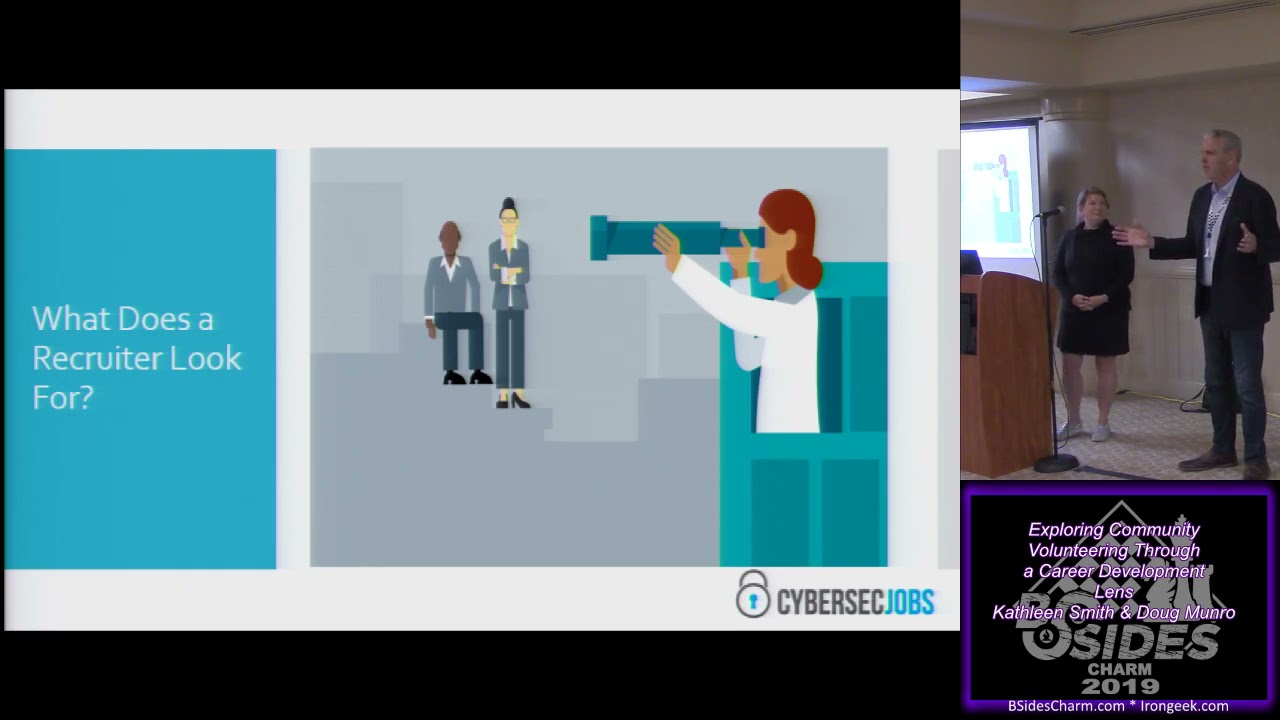
started great good morning everyone thank you so much for coming early sunday morning uh it was my specific request to have 11 o'clock i volunteer in the community a lot and that is what this conversation is about this morning unfortunately i have another commitment at 1 30 in northern virginia so that is why we are all talking at 11 o'clock on sunday morning so we are talking about careers and community volunteering and today i have someone that has volunteered with me a lot doug monroe doug is a director of recruiting vp of recruiting some of the companies that he has been with has been varus atd coal fire most recently with mag aerospace so we're talking about someone
with a wealth of experience not only in recruiting but also in being involved in the community i myself have been in this community about eight years i volunteer for about 16 different b-sides and women in cyber security groups in addition to that i direct the career track for three other b-sides and i'm on the staff for besides las vegas are on their higher ground so i might know a little bit about this community and volunteering and what it impacts on the careers and as i had been doing the volunteering i was observing several of my colleagues who were volunteering and then i was also noticing that they were gaining various different skills but in addition to those skills they
were progressing in their career they were moving on to higher and higher different positions they were able to take on things that were much more exciting and so i noticed that there was this parallel between community volunteering and development of career skills and the development of career goals so last year the company that i'm with cybersec jobs.com we actually did a survey of the community and asked people who were volunteering to answer some questions about their volunteering their employer support the things that they learned and we put this together in a results paper which we have right now so that's what we're going to talk about a little bit today so one of the things that we noticed
was that more than 50 of the volunteers in the survey gave eight or more hours of their time per month but i personally know so many volunteers who think that eight hours is a big number and they're not really reporting that correctly i would say that more people get between 16 and 20 hours a week and when we looked at the demographics of this study these were not people who were straight out of college these were people who were actually 10 to 20 years into their career had full-time jobs and also had families so it was very interesting to see these people who already have very full lives we're also taking on additional volunteering support
we also found that people tended to not only volunteer at one group but they took their skills and they applied them to other groups one thing we found about community volunteers is that they really have a difficulty saying no they really have a difficult time hearing that another group needs a.d support or registration help and they would quickly say oh well i do that for this other group i'll quickly do it for years as well thus we see a lot of burnout in this community we asked many of the volunteers what were the skills that they learned while they were doing community volunteering and one thing that you will hear a lot in any of the studies that talk about
soft skills that talk about skills needed for your career advancement they're always talk about the soft skills they always talk about those skills that we really don't have a certification process for we don't really have a class for these are things that need to be learned on the job and these are the skills that people said that they learned from community volunteering teamwork organization planning and most importantly communication what was fascinating to me i was really glad to see this is that a lot of people were very upfront with the fact of how stressful volunteering was it wasn't only that it was the anxiety of doing a good job there was physical stress there was all of this stress about i
need to get it all done i need to take care of my family i need to get my job done but they all said it was fulfilling they all said that this was something that they would continue to do because they found the personal fulfillment in the community volunteering that they didn't necessarily see in their jobs and that is what a lot of us are sort of striving for i hear frequently people saying my corporate job is eating my soul i need to find something else my recommendation is always do more volunteering if you need something that feeds your soul really go and do volunteering rather than expecting that from your job because that is a high order for an
employer to fill that job of personal fulfillment that is your responsibility so when you're looking at community volunteering there are a lot of things that you really need to ask questions of yourself because too many times people will do community volunteering without doing sort of the analysis of is this something that's going to provide me benefit or is this something that's going to totally burn me out so one is are you going to have time you know are you going to have that 8 to 16 hours a month to do it are you going to have the time for the conference calls at 10 o'clock at night or the all-day meeting to do the agenda
planning really looking at your time do you have the skills now you don't have to have specific skills skills to go in and do volunteering but understand where you're good and skills and where there are skills that you need to have do you know do you have the resources to be involved do you have child care do you have you know transportation a lot of people think that they can only do volunteering if they can drive to a con when there are many organizations matt durin in the back of the room is one who works with me on besides las vegas 90 of our time is online so being you know precluded from being part
of a staff of an organization that's maybe across the country you only need to go there once but all of the pre-planning all of the organization all of the communication happens online and ahead of time also are you going to be able to involve your employer and this is something that you know i want doug to sort of chime in on what would you do how would you recommend someone involve their employer if you're going to be doing volunteering just make them aware go up through your chain of command let them know what you're thinking about what you'd like to participate in in some cases what you'll find is that your employer would want to like to
participate as well and they might go as far as sponsorship uh but certainly from an employer's perspective you volunteering at an event like this for example it just indicates a passion for work it indicates an interest in the community a desire to be a part of something bigger than just your individual day-to-day work and so approaching your employer just letting them know this is a conference i'd like to volunteer in this is what i'd like to do for them that's enough just make them aware and then we'll be talking more later about the different layers of that we can get into presenting participating competitions things of that nature but uh just letting your employer know i
have not ever worked for an employer to get excited about the fact that people working for them were doing something and you might very well get some financial support for the organization uh only good things and also realize that just like any project you get involved in more than likely you're going to find out that it takes you know more time to do than you thought and being flexible also if it becomes too much being honest with yourself and going to the leadership of the organization and saying look this is much more than i thought it was going to be i either need help or we need to find a replacement because too many stories
have happened in the con community where someone didn't think the job would take as much time as it did it did they did a poor job which burned their reputation and then at the end you know the organization is sort of left-handed you know what am i going to do next also who to work for a lot of us are talking about con involvement but you might want to say that there is you know something associated with your your child's school there's something associated with your church there's something else it doesn't necessarily have to be one of the conferences while this is something that a lot of us are involved in it is something that you want to find
personal fulfillment with it's also something that you're going to have time to do so it may be you know as simple as being the treasurer of your school group or you know boy scouts or something some way that you're being able to get back into the community or are you trying to increase your network so that you can expand your professional network there may be key people you want to work with there have been several groups where i wanted to work alongside of maybe jack daniel or you know banshee or somebody who was part of the national scene and i worked my way up to make sure that i had an opportunity to work with
them because i found them very inspiring for myself are you trying to gain new skills a lot of us go to volunteering and like i'll go and i'll say i'm really good at marketing or organizing events but there are certain skills that i need and i need sort of a playground to play with it i'll go in and i'll say i don't know a lot about instagram or facebook i want to be that lead person because i want to teach myself how to gain those skills and be able to be a benefit to the organization and then finally are you that person that can provide critical skills a lot of organizations are full of passion and they're full of
grassroots energy but they don't know about organization they don't know about tax payments they don't know about going out and getting sponsorship they don't know about specific things that really make an organization run do you have those skills that you can bring to the organization i had one organization that wanted to put on several events but no one on their group knew how to negotiate contracts with hotels knew how to put together a sponsorship package they said we'll just copy somebody else's i said no it's more than just putting on something with a really good theme you have to think of the down dirty you know logistics so doug talk to us a little bit about you
know we have a lot of people in the room who have been part of various different volunteering groups do you want to see in a resume or a linkedin profile scots and stops of information or what do you want to see in a resume and a linkedin profile about volunteering in the community in the recruiting community we're definitely interested in seeing that community involvement on your part it can get a little overwhelming and if you've got too much information it can detract uh slightly from your overall profile so the idea is to cherry pick you know what's specific to your career because when you're putting together a resume or linkedin profile that's all about your career so
specifically one of the highlights where did you feel you had the most impact or you learned the most so focus on those if you've got two pages of them on your resume probably not a good thing but if you've got half a dozen of the key things that you participated in that's going to be a positive and it's going to be something you can speak to when you get into interviews it's again we're looking at it as the whole person and i can tell you that you read a lot about how there's a cyber security talent shortage to a degree there's some truth to it there's certainly stone pipes that are underrepresented but i can tell you from
looking at 100 200 resumes a day at some points there are a lot of people with cyber security experience in various different areas of the industry what is sorely lacking unfortunately are consulting because in the end if you work maybe if you're working in a sock working on hardware that can be sort of an isolated experience everything else is services and those consulting abilities the ability to communicate to a broad audience the ability to lead a team the ability to present to a an audience that may not be terribly technically savvy that is huge and the experience you can gain from participating in these conferences these events that's what it speaks to is your ability to work as part of a team
collaborate perhaps lead something perhaps present and all of those soft skills are vital i don't need somebody who can just slap together a server and i've got thousands of people i can pick up to do that need somebody who can represent my company as a consultant be that expert in the room talk to anybody and finish a project to the satisfaction of that customer and everything that you do with events like this is a contributor to that so when i see it on the resume you'll get excited now are there are you looking for specific roles because one thing that i see when i look at a resume or a linkedin profile someone will say i
gooned in defcon well most people outside of this community don't know what gooney is so you need to be very specific i assisted with logistics i assisted or supported or led security you need to be sort of that educator to the recruiter or the hiring manager as to exactly what this means now again not putting in scabs and scopes of you know reports but say you know i would put in director of higher ground for the last four years secured sponsorship uh curating content and recruited volunteers that shows to initiative planning program completion and going out into the community so you want to take those business skills that you have learned in your volunteering and making sure that you
have them on your resume and linkedin profile so getting down a little bit more into the weeds here as far as what we're talking about con management a lot of the people that i have worked with in the community really started as the person who folded the t-shirt all of a sudden became the registration desk then all of a sudden became the lead for registration then went on to being part of the national organization and doing registration and then maybe going on to be the board so looking at being part of con management as a business development sort of you're part of the business you're looking to see how it's run you want to see how you can
you know go to the next step a lot of people say well i just like doing this one thing that's fine but if you're also looking at your own personal career wanting to move to the next level but you need to gain those skills to get to the next level you might want to look at con management because it is a way of addressing all of the same things that you would be addressing in a business resource allocation workforce management conflict resolution i mean a lot of us are very uncomfortable with conflict resolution but i can tell you when you're part of a conference there are going to be some times when there's conflict and you can address the
fact that are you comfortable being able to do that and if you're not what are the skills that you can work on with it you also have to be careful when you're part of con management that you're clear as to what your role is because a lot of us specifically women try to do everything we try to make sure that everything is taken care of we try to make sure that even though our job is taking care of the agenda we will go in and we will try to work on registration and making sure that there's coffee or making sure that the t-shirts are folded you need to make sure what your role is what
your goal is personally for that role and what the organization is expecting of you you also need to understand that you may have been in that role for a while like 10 years and it's time to move on so you need to also practice what is a really great way to gracefully move to the next level this is something that is never taught in school or any organization more often than not we get frustrated and we burn a bridge how do you create a transition file how do you make sure that the people who are going to come in behind you know exactly what to do and how do you prepare the organization that you are no longer going to be the
person that they call anytime there's something wrong with av in the military it's called a transition book you sort of have a book and it's handed over to the next person and they know exactly what to do so using the con management as a way to be able to say this is my role it's time for me to move on how do i transition because that will really benefit you in your professional career when you're looking to move on you need to be the person that says i need to prepare my organization for my transition i have to prepare my relief and i also have to prepare myself myself and also you know let's talk a
little bit about con management is year long how would i talk to my employer about being involved in the con it goes back to the same thing being open and honest and explaining what it is what your role or what kind is going to be what the expectation of time commitment is going to be and making clear that it's not going to impact your work but also emphasizing the skills that you're trying to develop by participating in the con in this role and as kathleen said it can be something simple i just want to be a part of the team that greets that makes the welcoming experience of besides charm i want to as you progress i want to be
in charge of that team but being able to relate those things to your employer and say these are the goals that i have to get out of it i'm not just going there to get a t-shirt i'm going because i have a tangible skill that i'm looking to develop that very clearly is going to benefit my employer as well and you know it's it's also something to engage in if you're interviewing for a new job letting them know look you know i do this other thing in the community um a lot of us who are involved with anything at vegas from defcon to besides las vegas to black hat we let our employers know like six
months ahead of time there's there's about 10 days the first part of august that i'm going to be out and then the week afterwards i'm going to be sleeping so you may want to let them know i'm going to have all my projects done all of my commitments done before i go and then meet with them about two months beforehand and say okay again i'm going to be gone two three weeks the first part of august that's right before q4 what are we looking at that shows your employer you're thinking about management you're thinking about planning you're organizing you're not just sort of saying my flight leaves in two hours goodbye you're not leaving them in the lurch but
that again shows them management experience so competitions you might not necessarily see competitions as volunteering but i see them as being part of the community and i really think it's it's a way that you can also be part of the community but also learn skills so you know talk about you know going for a competition and some of the work experience do you think that people gain from competitions uh typically in the scenarios that i've been exposed to most uh it's ctfs uh so you're typically gonna be in the team maybe three or four people so that again speaks back to teamwork collaboration uh role definition and it is it is absolutely it's a skills
development how do i apply the skills that i already have and hopefully elevating and certainly if you're collaborating with three or four other people if you want to elevate your skills they're going to know things that you don't uh very often what happens in these scenarios is that midway through somebody drops out so they have the opportunity to redefine the team how did you do that and experiences like that go to what's everybody's favorite interview question that gets posed 50 different ways tell me about a time when well there you go you may have something in your professional experience but you can also use the experience you have these competitions uh even again going back to the
volunteering at events something unforeseen arose and this is how you handle it because it doesn't necessarily have to be a one-to-one this was in a pen testing competition this was an event problem arose this is how i dealt with it and the same skills apply whether it is in a technical role or something of that management so i always recommend when someone's looking at switching into another career or looking to expand their professional network i really encourage them to look at competitions you know there's cyber policy competitions there's wi-fi hacking villages there's career you know car hacking there are different ways where you can expand your network because you're in an environment where you're having to
work closely with people but you're also getting those skills that doug was talking about and what's interesting is that a lot of people go into the competition they want to win and then they go and have a beer really when you're looking at a competition i recommend you start just a journal page about the competition and you say this is this is what i expect going into this two or three lines then you get into the competition and you're you know as doug said someone dropped out or something happened unexpectedly and you had to pull resources and work on that and then you you finished maybe you won maybe you came in third take five ten minutes afterwards on your
phone in your notebook write down what happened because as duck said you're going to get some of those questions during your interview process that say well when did you learn something when did you fail and a lot of times you can't talk about what you do in your own work having that other example from somewhere in a competition is a really great way of being able to share your management skills but also your technical skills so presenting i always find it fascinating when people come up say oh you present all the time it's no problem and you get picked all the time presenting is an entirely different you know ball of wax when we're talking
about community volunteering what i really love about this community is it's not people who are hand-picked we are all people who have to submit proposals and then make sure that we have a good enough case for the content committee to be able to pick you then you have to prepare your presentation and then you have to get yourself to the conference and then you have to make sure that you have all the technical stuff available so it is really very important when you're considering presenting that you think on a long term timeline a lot of times when someone is putting out a call for proposals it's anywhere from six months to a year ahead of the conference
you also then have to be very technically proficient to know how to fill out the submission it can be everything from easy conf google forms easy chair there is no one universal conference proposal submission systems out there if you want to know one that's a good one to train on so that you know how to practice look at the grace hopper proposal submission it is eight parts it is 12 pages long and it is probably it is bigger than black hat rrsa as far as a proposal submission outlined to do so that is a really good one to work on in any of the material that you use for that for any one talk you then have content ready to be able
to cut and paste into any other proposal but also understanding learning with rejection you know a lot of us don't like to be rejected and i can't tell you how many proposals i've submitted that have been rejected more than i would like to say and i always take it personally and it's not that it's not that it's personal it is that i do not present my case well enough or that someone else presented their case better than i did and they had better content for that specific conference so just understanding it's a numbers game you have to keep submitting you have to keep making sure that your proposals are really good the one thing that people
rarely do is ask for feedback i actually submitted to ise squared for their most recent conference and out of 300 submitters i was the only one that asked for feedback i know that because the guy sent me because you're the only one that requested feedback and he gave me some very concrete feedback and what's interesting is i'm on content review committees for proposals in various different conferences and i always give a thumbs up thumbs down i now know better i know how important it is to the person submitting the proposal how they like what we've submitted and and getting that feedback so i i try to take more time doing that it's also building the
confidence i i can tell you i i present three times a month have done so for the last 12 years i still get nervous i still wonder if you know there's going to be a fire alarm which has happened in the middle of my presentation if the electricity is going to go out which has happened in my presentation if there's going to be a bomb threat yes that's happened during my presentation and you just get used to it um but talk to me about how this can show for in an interview to your employer to a recruiter would they like the fact that i present three times a month to be honest it's going to depend on the
employer if you're presenting at that volume but to be equally honest very few people present that often uh but she said that's real um so i wouldn't be terribly concerned about that if you find yourself to be that popular and able to manage the processes that effectively it won't necessarily be a negative but obviously if you are that busy and we're employing you for 40 hours a week there would be a concern but to present a few times a year again it just speaks to all the positives uh because typically your employer is going to have at least a general sense of the work that goes into preparing that presentation that proposal uh the fact that there's a numbers game
that you undoubtedly had some rejected and had to take the lessons learned and apply those to your next submission so in general there's really no downside and that experience again another when i talked about consulting skills it's not just being able to stand up in front of a room full of people and tell them about the project you're working on describe next steps what have you it is the ability to the written word it's a lost art so the more times you have to put well finger to keyboard and put together a proposal the better writer you're going to be the more concise it's a technical writing exercise the more you do it the better at it you
get and that is absolutely applicable to the work that you're doing that can almost guarantee it oppresses few people to get away with not having to write a report about something so all the skills apply and short of the three times a month i don't think you've got anything to worry about but what's also interesting is that you have to decide if this is something that you are going to let your employer know that you are doing i know a lot of people who present in the community and they make sure that where they work who they work for even their name uh you know that they work under is not part of the proposal
you have to decide knowing your internal culture of your company if they're going to be supportive of this or not i was mentoring someone on doing proposals and i was very happy that she actually gave herself a goal of presenting 12 times in one year she actually worked for a fortune 50 company and she knew that she had to go through the process of getting approval for every single one of the submissions she had to get approval of the material that she submitted she had to make sure that the images were you know conducive to the brand of the company but they also paid for her travel to brazil to spain to anywhere in the country and
they paid for all of her expenses and got her to pay time off so you have to decide what the trade-off is because a lot of times if you say i want to present at this conference i actually had one of my speakers had to pull out for the diana initiative because her employer said no you know we're not paying for that travel to vegas so you have to decide okay do you have your own whereabout to drive fly to those various different conferences or do you want to ask your employer to do that and that is a constant question that you will be talking with your management about and that's how you build the rapport with
your manager not like you know i don't want to do overtime again or something like that let's talk about my career these are the things that i am doing to further my career these are the things i am doing to learn my technical skills and my soft skills and my leadership skills and if they're not supportive of that then that's maybe time when you start building that network and find something else so we also found that from the community survey more than 41 percent 42 percent of the survey participants really said i can only do it the day of the event and i just wanted to put this in here because when you see all of these phenomenal volunteers
around at charm a lot of them were just here for today or here just yesterday they weren't doing the annual sort of preparation you still learn those valuable skills coming for just the day of the amount you still learn resource management you still learn leadership you still still learn how to be that problem solver or that conflict resolution person you still learn those skills and getting that personal fulfillment so if you don't have the time to be able to do something year long but you only have time to do it one day up i can tell you that it is absolutely phenomenal to those of us who have been working all year to have that new vibrant energy that
comes in the day before the event and you've been dreading folding all those t-shirts and there are five very excited people ready to fold t-shirt and you're like oh thank you so it's great teamwork so if you can only do the day of the event don't think it's it's not a good thing just say i will always be there the last saturday of april to make sure that registration happens for besides charm and i know many of the organization organizers would be happy what i also wanted to you know remind everyone is that there are many different ways to find a job but the one that has always been the top has been referrals within your network we were
just helping a few people this morning with some referrals so understanding that if you're going to be looking for a job or you want to keep your ear open to other jobs you have to have an expanded network but if you have that same group of people that you've always moved from one group to in the other or one employer to the other you're not expanding your network you are not expanding your opportunities to connect with two other people so using the volunteering to work with different people have connections be professional follow up with them make sure you're connected with them on some social media so that if you needed to put feelers out we're trying to help someone earlier who
wants to find a job in a particular company i happen to know them we did an introduction so it's still about those personal interactions and those personal introductions so definitely use volunteering to build your network there are so many negative things we hear about our industry no matter what you look at you will always see something negative about our industry and the one thing that i loved when we saw this as a result in the survey was that you know 94 of the people involved in any kind of volunteering felt that they were having a positive impact on our industry how many things can you say in this community make a positive impact we hear about the negative impact we
never hear about the positive impact doug and i are involved in recruiting and other communities and i can tell you there is not as much of a volunteering ethos in those other communities as there is in this one so i really take this to heart that we feel positive about being involved with all these organizations just wanted to sort of highlight again the skills that a lot of people saw when they did volunteering be it one day be it you know all year long 81 felt that they had better teamwork skills and there is rarely an opportunity within employment that you are going to not have to work with a team that you're going to be a sole contributor
most of the work that's done is definitely through teamwork being able to organize being able to see the end goal and developing the steps to get there is one thing that a lot of people saw through presenting having to do all the proposals and con management it's not just about making sure we have sponsors and we have something going on for saturday night it is everything from eventbrite all the way through to making sure that there is coffee on the last day that's organizing that's planning seventy four percent top planning so if you're meeting with a client and you don't know how to get that project in on time being part of a conference that you have
to do the management of we're going to pack 1300 people into the sheraton north april 2019 how are we going to get that happen and then finally communication skills a lot of us are not very comfortable working on our communication skills we're comfortable talking with people that we're familiar with we're comfortable talking with people over social media but actually having that face-to-face conversation being able to talk to someone about you know i need you to get something done and we are all relying on it those are the communication skills that we are we are slowly losing so using volunteering is an opportunity of being able to make eye contact make sure someone understands what you're saying
and making sure that they can deliver what you need them to deliver these are all skills gained by community volunteering what was also interesting is again the stress and i really have to spend a lot of and i do spend a lot of time coaching people on how to say no and it's really understanding that if you don't know how to say no in your volunteering you are probably not able to say no in other parts of your life specifically work specifically i need to get that paycheck i need to get certain uh you know benefits i'm still going to do that work that i don't want to do i'm going to take on another work trip
i'm going to take out more things and before you know it you've burped yourself out you're overwhelmed and you just quit for no apparent reason because you can't take it anymore people do the exact same thing in volunteering so i say look at what you're doing in volunteering and you may find a very close resemblance to you doing that also in your professional life use being able to ease yourself out of one role and move it into a next gaining those skills is something that you're going to be able to do in your professional life because none of us like to leave one job and move on to the other but it speaks volumes to be able to move
with grace and professionalism from one organization to the next being able to create a turnover file i can't tell you how many times i've created a turnover file and it has made me appreciate the involvement i've had with an organization but also my employer has appreciated that wow i did a lot and they didn't know about we're actually doing that with besides las vegas right now making sure that we all have our transition files doug do you see people who just sort of burn bridges and and don't move on gracefully and how how does that impact their career if they burn a bridge and everyone knows about it well sadly we do see it uh and it's
almost invariably unnecessary but to kathleen's point if you see that something isn't working for you you have to communicate it but the burning bridges obviously there are tens of thousands of people who work in this community nationally and internationally for that matter and yet it's a tiny little community and so if you leave a negative impression there's a strong likelihood that somebody and the next opportunity that you seek is going to know you they're going to love you and i do a lot of hiring and military and most recently we hired pilots they're all working in afghanistan or in colombia and they can have all the requisite flight hours they could have all the requisite certifications to
pilot this aircraft but they're going to have to spend 60 90 days in austere conditions next to somebody else and so if they're not liked if somebody remembers hey this guy overslept and blew a mission that's going to come back and they're going to be hard-pressed to get employed so transitioning gracefully should be an easy thing but there are folks who ignore that and something else that kathleen touched on in terms of the difficult communications you have some of those are you know i i have to say no to this ask for help ask for mentorship that's another wonderful thing about community events like this there's going to be somebody especially when you're first getting started and doing it
who's in a more robust role who's the overall organizer rather than a team member asked how to do these things how did you organize this event how did you decide how many people were going to be at what station and specific to this conversation if i get to the point where i'm not going to be able to eat my commitment how do i let somebody know that so seek out the mentorship if you're the smartest person in the room you're in the wrong room so by all means get the information from the people that have it what was also interesting is finding out how much employers supported people who were volunteering in the community so it was fascinating to find out that
almost 80 percent of the people in the survey actually had employers who supported their um efforts so i was actually having a twitter conversation about this the other day is that people were saying oh you know i i don't tell my employer that i volunteer i don't think they'll support i pointed them to the survey 80 of the people who are out there who are involved in the community actually have their employers involved with supporting them it's either sponsorship it's giving the number one benefit was being paid time off to be able to do this so let them know that this is an industry standard now this is not something i just want to do on my own this is
something that is very involved within the community it was also fascinating to see how this impacted if people were going to stay with their current employer or not so more than uh 60 say said that they stayed with their current employer because of the voluntary support that they provided so one thing you hear not only that we have you know a shortage of talent is that we also have a revolving door as far as good talent coming in and then quickly leaving being able to go to your employer and say i would really like to stay here but i would also like to be more involved in the community let's see how we can develop a plan
where i can have some time off maybe you might want to get involved with this as well but then we also asked how many would move to a new company if that company provided support for volunteering 97 percent said that they would move to a new company if that company provided more than 25 percent paid time off to be part of the community volunteering so again interesting statistics that you can have in your back pocket as far as talking with your employer don't beat them over the head with it but educate them let them know hey this is this is the industry standard right now this is how other companies recruit and retain their strong talent
and yeah going to that point so what would be some of the key things that you would look for from one of your employees to make sure that you knew of their involvement in volunteering how would you want that presented when would you want that presented and what were some of the key things you would want me to tell you uh early on and to all the points that kathleen made previously and a lot depends on the size of the company but for better or worse your involvement in these events you are representing your company one way or another people are gonna know who you work for and so your employer needs to know uh most
companies that i'm familiar with are supportive uh but your best approach is gonna be to go through your chain of command and say again explain these are the events i'd like to attend these are the roles that i hope to play in them this is what i hope to gain what because you're exhibiting again passion for the industry a passion for learning and a desire to continue to grow now this is anecdotal it was not as large a pool uh as the cybersec jobs survey but when i was with coal fire we did an internal data analysis and what we found was our attrition rate for people who participated in the community was lower significantly lower than it
was for our overall staff body and also performance evaluations were higher and in fact we instituted the program or we put out a little points system so participating in events participating i think could be in events we also factored in new certifications all that good stuff but we had a point system established so by attending you get x number of points by participating as a volunteer you get y number of points by presenting you get z so all of those things factored in and this is for your bonus potential and what we found is that accelerating the curve of those other positives performance valuations and uh lesson nutrition so all of what has been presented here
i can tell you anecdotally in a pure cyber security services environment is true and employers are increasingly aware of it uh but if you can go in and explain what you hope to gain while you're attending this particular conference that's it goes miles to getting things done because one of the things that we all think we think that our con involvement or being involved in the community you should not be sharing with our employer really look at it as a partnership you can leverage your partnership with your employer by letting them know that you're part of the community i can't tell you how many conference organizers i've talked to and i said did you ask your employer to
sponsor resounding no and it's really interesting i've found within this community that people want to separate church and state between what they were i'm seeing it not in the background did you ask your employer to sponsor you and he did great so this is it this is more about showing your passion for the community showing your passion for your professional development but also engaging your employer in all that process so just sort of the key takeaways from this from the survey from community volunteering obviously networking as i said number one way to find a job is to have someone refer you in building skills you may think that you're technically proficient but if you have to be on the content
committee reviewing the agenda you might find out more about what's going on in the community than just reading what you you see on your your flip pad positive impact on the community i can't tell you how many times i hear people say my soul is being eaten well believe me the people who are part of cons don't feel that way because they are they are giving back and they're feeling that fulfillment and also it's really a very important thing to have other experiences to be able to share during your interview process and during any kind of job search because you you're always going to want to expand what you're doing your job might not always give you the
challenges that you're looking for so if you're part of the ctf and you're part of building that crypto challenge or you're part of something else within a panel discussion you're constantly going to be challenging yourself to new skills and new experiences and that is how we keep growing in our career from a company standpoint obviously a way to retain top talent this is a way that you can keep the attrition down definitely keep the retention up being able to get out there and build the employer brand so many of the companies that i know that you know come to my company and say help us find candidates my first question is what's your employer brand all about
they're like we have really great advertising i said no that's not the answer to my question what is your brand how are you perceived in the community how do people when they look at your logo do they go yay or do they cringe that is what can be you know changed around by being part of the community support professional development we all know how expensive it is to get certifications to get training but there is no certification or training out there for soft skills so this is what you're looking for when you're looking at professional development through community volunteering and also knowing that getting to know the community and building your long talent pipeline being able to say
i don't need six pen testers right now but i know the conference that they're part of i want to be part of that community so that down the road i can tap into it or did i give all of your secrets away matt if you want to see the survey to be able to quote it to your boss it is on slideshare.net backslash or forward slash cybersec jobs.com we also have another survey up there on job search challenges and that's it thank you so much for coming here earlier this morning do we have any questions oh plus almost yes um so the night of the volunteer dinner that would have been a great venue to talk directly to the most volunteers
who are out there volunteering right now it can't be in here um well it wasn't part of the you know mission to be able to submit a talk during the volunteer dinner but it is you know i i started volunteering more than 35 years ago and i've always volunteered in a variety of different roles from founding organizations to you know just being the marketing it's always a really great way to be able to give back but it's also a really way to challenge yourself in a good way not you know some of us may like climbing walls or or doing you know gladiator or something like that that's not something i'm going to do but if i find an organization that
has a really poor brand or has a really poor marketing or their con isn't very well organized i might walk in and ask them if they need some help it's it's definitely a way that makes my overall life more fulfilling how about you doug you volunteer in different ways uh that's it i mean we we're not just one thing we tend to be defined by the jobs that you do and it's very easy to get caught up in that but we are all complex beings and you need something more than just your job to uh to feel fulfilled to get out of bed in the morning excited about what the day holds and this is a wonderful opportunity
to combine the two to further your career to grow your professional experience but at the same time do something that just makes you feel good and you don't get that opportunity every day and one thing i would add just because it's come to my attention a little bit fairly recently if you're lucky enough to present then very often it may be recorded and you can provide a link on your linkedin profile to that presentation if you haven't had an opportunity to present but you've got something you're working on podcasting i wouldn't recommend you put the first one up on your linkedin profile there's an art to the podcast and but if you can put together
something even it doesn't necessarily get accepted or become and present it yourself and once you've honed the skills to present well then it's something you can link to your linkedin profile and it gives people it's a living resume it's a living hey that was brilliant you've got to you've got a new tweak on a powershell script now again making sure your employer you know is aware that you're doing this and it doesn't impact anything that's proprietary to what they do it's a great way to advertise yourself okay thank you mandy yeah i just wanted to share something um talk about the health benefits that come from volunteering this may not be something that you think of very often
but um i personally volunteered my whole life pretty much but i always volunteered 40 to 200 hours a month and i hated that volunteering was my vocation and whatever supported it allowed me to do that with my application and that way it was like the money the career the certifications they kind of came along naturally because of the networking but then i had major health issues and i spent years in hospitals and nursing homes what's funny is that because of volunteering um while i was in icu or while i was in acute care and all that i had over a period of about let's say the first six weeks there were like 125 different people that came to the hospital
to visit and there were men in suits that would come to visit i wasn't capable of talking or seeing them or anything like that but the register you know the nurses kept lists of who came and i didn't know until i'd been in the hospital for months and months that because there had been so many people that came and they were nicely dressed guys apparently the hospital staff thought of some kind of real estate errors so they were giving me even better care on what they would have naturally whenever it turned out really all i had was what was in that hospital room everything else was gone and lost but so was the friendship the nicest like you do get
i think even in just your interacting you get joy and a heartfelt satisfaction but it then turns into like these people become your network for when you hit hard times or whenever your employers and your fellow employees aren't on the same problem thank you yes thank you we're gonna make the crack so that's it i do apologize i have to be in northern virginia by 1 30 so doug is going to take any questions afterwards while i quickly wrap up
Related talks
 50:51
50:51 28:12
28:12 51:19
51:19 52:59
52:59 20:11
20:11 37:20
37:20