Hacking Food
Show transcript [en]
Alright, so this is not a security call. I think that I was going to say it in another way. We're going to talk about hacking food, but I'm not going to talk about hacking shelves, or IPNs, or pressure hovers, or things of that nature. That's not what we're here My name is Chris Sanders. I run a company called Light Edge Defense. We do security training, cost effective and affordable security training. Mostly focused on blue team stuff, but we're also operating some stuff here and there as well. This is my colleague Jason Smith. Yeah, I'm not responsible enough to run my own company, so I work for Cisco instead. I work with the ATA project, the
library, and the trade hall. Cool. So we have a very simple manifesto for the talk today. It's really a manifesto of the vibe. We all have to eat food, so we need to make it, have have maximum flavor with minimum effort there we go so that's what we're going to talk about today we it's not we've been friends for a long time and work together in a lot of places um with several of you i see the crowd today which is great And we both share a love of good food and making that food as delicious as possible with a little less. That's what we're talking about today. So again, not just a theory talk.
We're going to talk about food making it delicious. And it is, by no accident, we are in a talk position directly before lunch. So if you're not hungry now, my goal is to make you hungry by the time we reach the end of this short talk. So, we're gonna go over a few points. First, we're gonna talk about measuring things. Because I think measuring things is essentially the essence of cooking, first of all, but also kind of the hacker mindset. And if you think about the hacker mindset, I mean, we're all builders and makers and breakers. And I'm really surprised more hackers aren't into food. There's really a lot of the same concepts applied. You
have kind of this finite problem space where you have an also limited creativity within the range of what's going on. You get very creative with food. It's a great place to serve your favorite tablet. And for me, I really came to food So I got off the computer and started cooking and then something I'm caring for with my friends and my wife and I are not. So the hackermans said apply and we measure things a lot. We have network sensors. We use data. That's the whole measurement. We use statistical power. You saw Russ's keynote earlier. We talked about called kind of raw statistics, which were essentially measurements and applications of those measurements. So measuring food, very important in the same way. And
I have a picture of steaks here on the screen with various degrees of temperatures. Now, we'll get to that, but I want to show you some examples of why measurements are important. If you look at the screen here, I have the same scale with the same vessel, all holding flour. And I'll give you the absolute easiest to read. If you see this one right here, it says this is 806 grams, this one is 626, this one is 483. Of course, if you visually inspect these, they all look to be about the same amount. If you look at all of those, you would say they're pretty close, but if you look at those maps, one way
is much more than the other. Well, for a couple reasons, a couple reasons from slide one is you can't tell how dense this is at. First of all, all flowers are straight and equal. Flowers have varying amounts of protein. So we talked about regular flower versus red flower. Red flower has a higher amount of protein. Protein weighs more. Depending on where you're located geographically, there's more humidity. Water molecule tools can use more flour over the border, and they can make it heavier as well. So a digital inspection is not an accurate way to measure flour, and it's really not accurate for most baking applications. Another example is steak. This is steak cooked to varying degrees
of doneness. I like to eat my steak medium rare, as I did in the middle of the left here. But I want to show you the difference here in the temperatures. And really, if I were asked to do it, you probably couldn't really tell a strong difference between maybe 126 degrees Fahrenheit and 144, 147 degrees Fahrenheit visually. It's not an adequate way to determine the density of state. That's from how did we realize that when you cut a state, the monoclonal limit reacts with the oxygen in the air. That's what you notice. You cut a state, you leave it out for a while, the longer it sits there, the redder it looks. That's because of
that reaction going on with the oxygen. So you can't really go into a world where it's not measured and it's so important. Which brings me to this monstrosity of the diagram on telling people how to determine the states are done. We've all seen this. If you're on Pinterest, this is something Some of the food garters that appears on there all the time, you see on Facebook, where you touch various points of your hand and you compare that to the people that say that the safe level is done. Well, that's not really a very good way of measuring anything either, right? I work on computers for a living, so I have very soft-tilted hands. My dad
drives a truck for a living, works outside, he has very callous, tough, manly hands. So briefly, a couple of the white points temperature. I have something on the screen here called a thermocam. It's a Ferrari. of temperature measurement, $500 for screen sensors for a longer, but it's instant rate, it's accurate, it's super durable, and it's warranty, which is what it lasts. If you're gonna do any type of meet, you need a thermal pen, not a PDA from the top or whatever that tool is. For volume metric measuring, I was gonna do it from a perfect meter, something I recommend. I'm not gonna say this, this is sponsored today, but it's just really nice to be here with a
bunch of different measurements on it. And then of course the weight. Most people don't know the kitchen scale, which is one of the biggest mistakes you can make, especially when baking. But the flour, as I showed earlier, when possible you want to measure things by weight, especially dry ingredients, you want to go by weight and not necessarily by volume. Liquids are better by volume because liquids, the way they stand, don't have to worry about changes in intensity, but most of the things you measure are going to set the intensity, actually, of the ones you can have. So picture volume weight. Those are the things you need to start with, with measuring So, speaking of something
that requires commitment, steak, who doesn't love a good steak? So, I'm gonna give you the best advice I think you're gonna give you probably all day, with something called "Criston's Hierarchy of Steak." And I put this on here to essentially dispel the myth that the filet mignon is the king of steak. Some of you are probably gonna disagree with me, but I think there are so many cuts of meat that are so much better than filet mignon. And I put that diagram on the top there to talk about a range of deliciousness, something about the floor and the ceiling. A flaky yawn is a super tender cut of meat, so it doesn't have much fat
and doesn't have much flavor. Whereas a ribeye is maybe a little bit thinner, has a ton of fat and a ton of flavor. So the floor on a flaky yawn is pretty high. But the ceiling on rib eye is so much higher. So if you're a person who likes steak, I say rib eye is safe for people who like steak. And I have some various cuts that exist in between there. Chuck eye steak is another good tip. A rib eye is for cutting down the inside of the rib, or simplify a little bit. And you have several of those along the ribs. The chuck eye exists at either end of the rib eye or the
rib eye But they're not US weight, USCN, it's for gray meat, it can actually color a ribeye. It's just a side dish that's delicious, doesn't look quite as pretty, but it's really priced three to four times less than a ribeye. You don't see them a lot in supermarkets, they do have them occasionally, so look for Chuck I Say, you're basically gonna get a cheaper ribeye. Very important, Chuck I Say, not Chuck Say, Chuck I Say. So you see my hierarchy there, I have a filet mignon at the bottom of the list of steaks. At the point you see things like bacon wrapped filet mignons, you don't see bacon wrapped rib-eyes. Rib-eyes mean that I have
to filet them. So I feel very strongly about this. So real quickly, we're going to put these slides up and we're going to have some recipes. You don't have to worry about writing them down. You can take a picture of them once and they'll be online later. I got a good, perfect say. First of all, start with good quality meat. What I'm telling you right here is no different from what happens at a high end steakhouse. The difference is they're starting with a bunch of high quality meat and they can sear them a little better. But other than that, start with good quality meat. You can't be able to pay for it with good say.
Get a $20 rub out from the supermarket, that'd be fine. But if you get an $8 dry aged, from a dry-ish pine robot from a butcher, it's going to be a lot better. So, do that, make sure it's a minimum-age steak, I'd say a really important steak, about a inch and a half, that will ensure that you cook it before you've done this, and that you sear it properly. Make sure it's really, really dry on the exterior, you don't want a lot of moisture, because that's going to prevent you from searing it really well. Make sure you use salt, salt is incredibly important. I was going to talk about salt, but I'm going to forget
it. I have time to. Essentially, no simplification. When you think about the taste buds in your tongue, you think about those tubes that go straight to your brain and make things taste delicious. Salt, when applied to food, basically makes those tubes bigger so that flavors come out of the place. Salt will have a taste base. Salt is very important for a steak. Good steak, how many of you think about a steak? Salt, maybe a little pepper, a bad thing, but salt works fine. Cook it at really low temperature. at a really low per se, I'm saying 250, 300 degrees, so it's less than 50 degrees for the final temperature, and then sear it in a
really hot pan or on a grill. This is called a reverse sear, so this is about searing something first and then cooking it under lower temperature. This should be lower temperature first and then sear it. It ensures even cooking throughout, but also ensures that it gets to the right temperature and not overcooking per se, which again is a little simple, so don't do that. So, that's how one of the King Edward Jason was going to talk about another way to cook steak, another technique called a sous vide. Sous vide? No, this is sous vide, so I don't know what sous vide, right? So sous vide, I'm mostly about minimal effort more than maximum flavor. In general, in life, I'm more about minimal effort, right? And so, my wife
and I, we don't have much time in general, and so we try to take these, all these recipes we used to have when we didn't have time, and just kind of minimize those down. But over time, we've come across sous vide. Chris actually introduced me to sous vide originally. And what it means is under vacuum. And it's an old way of cooking. You have a lot of these old restaurants that would do this, but really, regular people didn't have this because there weren't good means of having an emergent circular or something in your house without paying tons of money. And so the basic idea is that it does allow you to have absolute minimum effort
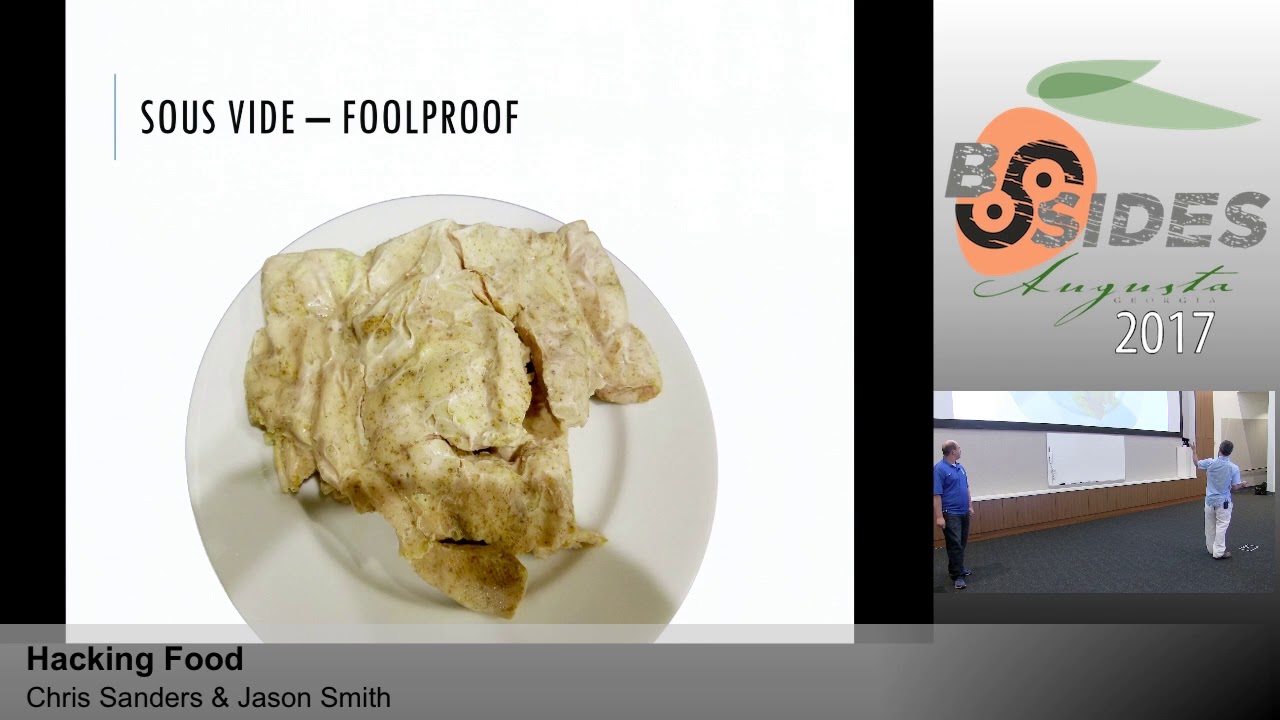
and you get probably better flavor than you can possibly buy at any restaurant in the city. So what does Suvi really have to do with You really just take some seasoned meat and you throw it in a bag. And you throw that bag in some water and you take this fancy edge at the right and you warm it up in water at a certain temperature. And in the end you cook it until that edge is at the temperature of the water. And that's the basic idea. So at a certain temperature, let's say 134 for medium steak or something like that, the water's at 134, the meat rises to 134. safe and medium all the way through. That's it. So it's foolproof. So who knows what this is at all?
Who knows what kind of thing? What is this? It's like broccoli cheddar soup. Broccoli cheddar soup. Anybody else have a guess? That's getting closer. It is chicken. So this is chicken. And actually this is edible right now. Which seems weird, but basically in one minute it goes from this to this, right? So even though it looks like something from a garbage can or something, it can really turn into something like this in one minute. And the way to do that is that this was fully cooked. And basically everything just merged together in the bag. It was a little bit of a save time. Yeah, all the chicken merged in the bag and it turned out to be great. I broke it apart. It's chicken nuggets originally. And then I
just put mine together and tried to get them all apart. So it's very precise and consistent. So this is the same picture we showed before, and I'll show it again, because this is a very expensive picture, right? These stakes would not be cheap, and you wouldn't be able to try and make this picture unless you knew you could do it perfectly. And essentially, these were all made in the sous vide. That's where each back was set up differently, and they're all hooked to, you know, this is perfect for that picture. So what does that give you? It gives you superior results. So at the right, these look like pictures I would take to try to
sell you away from traditional cooking methods. But in reality, these are actually pretty decent deals. You can cut a cross section out. That's what your steak normally looks like at the top right. With sous vide, you get this perfectly even king inside. So you can imagine when you cut into it, normally there's this juicy center, kind of, oh, this is a delicious steak. Instead of sous vide, you cut into it and the entire thing is, it's pretty overwhelming when you first try it. It's unlike any steak that you'll buy at any given restaurant. Salmon, same way. Salmon is kind of delicate. You make it at home and you get overcooked and you can make it
too tough. The skin can be tough. A good example, some of the fish last night at the double treat for the speaker's dinner, the fish was kind of tough. You had to cut it with a knife, right? Well, that's not the way sous vide works. It's always perfect. You just finish it at the end and it becomes a pretty mouthwatering. And then you add the eggs. So maximum ever over, or maximum ever over minimum ever. Not everything is fast for a sous vide. This is hands-on time, time that you're actually doing stuff, right? So I cook a sous vide a couple times a week at home. And what I'll do is after lunch, I just
throw some meat Basically, it does its bath, and I go back to work. It's basically like crock pot cooking as far as the yeast, but it comes out being extremely good. You'll notice that every meat here is easier to get sous vide outside of salmon, which is going to be easier to get better salmon. So, sous vide, I will read this off to you. I just kind of put this slide here so that you know later on the basic idea of this and this link, which is the best link to start with the seriesseeds.com. But basically what it's saying is that we start out and we take meat and we just throw some salt and
pepper on it. And we'll talk about steak specifically. Steak is a generously Then you throw it in this vacuum. And right here they're using a vacuum sealer. I use a vacuum sealer at certain beats, but you don't have to own one, right? You can take a Ziploc bag and basically leave just like an inch open on the seal and take it down into the actual water bath until the water actually pushes all of the air out. And then you just seal it up at the end. You'll get about a 90% vacuum on that, which is satisfactory. So you throw it actually down in the bath. I recommend that the bath already be heated up to the right temperature. And in the end you sear it however you choose to
sear it. So here, this is a torch I use at home. It's basically just a propane torch. And there's this shower head looking thing you just put on the end called a sear-zall. And all I did was I take a paper towel from the stake as it comes out of the bath. I make sure it's not damp, just as dry as it can be on the outside. And this torch will make pretty much a perfect stake in no time. And all that's doing again is finishing it. Soopie took its 90% and then the torch just finished the day it looked like wine and fluid. So soopie vessels, what do you use for actual water? Pretty
much anything. Maybe some banana or scale. I know that you normally use tip of light brisket, things like that. But you can use a smaller vessel. Let me go get some chicken thighs. But if you have just pots and elements, you can use plastic vessels. You can use those to bake. Some student heat circulators will even have a magnet on the bottom so you don't need to eat a clam or anything like that. This is how I started actually, a little cooler. I used this for months actually. And even like moving sake from one location to another, I wouldn't finish it again. I would just close the cooler, take a whole cooler full of water,
take it somewhere else, and I'd take it for a few days, finish it on site, and it's perfect. You could use a bathtub if you were in the laundry, so you could make a king bathtub. And it's a joking thing because people do things like suck on pigs, things like that. You know, large fish and you need a large vessel. And so a lot of people use like a king or something like that. Go ahead. You just don't tell them that big. It's not something twice. Even though it would take a while, you would want to use a larger set of devices. More multiple. Yeah, very few people use more than two or three. It
would take a while, but people would actually need another. I would probably still recommend code. You could technically use the back of a tool. I don't recommend it, but it actually is a decent idea. It fuels itself up. And simulates. It's insulated perfectly. As a gift, we can make it the best vessel. Well, I mean, here, it's a vacuum seal, it's not going to touch the water anyway. Right. So if you're cool with it, we're going to be nice. Yeah. And with your glass, I mean, too. So, just a quick thing, guys. The actual filters that are the most common are the novas and the jewels. So you can look those up. One's by Chef
Seth, one's by Nova, and I think they're by Jeannie. This is what you kind of get. We'll talk about it at the vegetation conference, though. No, it's not a flick. Hold on, I need to constrain myself real quick from being on camera. Okay, so let's talk about flavor really, really quickly. Flavor is the essence of food, right? We like different foods, they have different flavors, so a lot of people don't spend a lot of time thinking about flavor and don't constitute flavor. If flavor allows things like this, which makes them really weird, tastes delicious, show of hands, can I get one of your french fries and a milkshake? One second. It tastes good because we're
combining salty and sweet. Those are things that go really well together. Salt goes with the batter, it tastes really good. If you haven't tried this, I'm sure you trust me, it tastes delicious. So this is a picture from CookSmarts.com. It's called the Flavor Star. And this is a little bit about describing the primary flavors that we taste. Of course, flavors are the chemical compounds that come together and provoke a certain reaction in our brains that level reactions different for different people. Five main flavor categories here are bitter, sour, sweet, spicy, and umami. I don't really necessarily quite solve the umami. I just put it out a little more differently. sweet Meat and citrus work really well together. A lot of people will eat pork and
then we'll have like lime or orange and then marinate it on both of the porks. If you ever want to marinate a beef in something really unique, marinate it in lime juice. Maybe lime will roll with the shiitake sauce. And lime juice really permeates that back really well. It's a really great marinade. I like doing that. Lime is going to be eaten a lot. Lime and jalapeno are really common in Mexican dishes. Rye, guacamole, things like that. go well together. Barbecue, right, we'll talk about that a little more in a bit. Barbecue, since meat is savory, and you can combine it with either a sweet back of Kansas City or a Georgia-based sauce if you
want it sweet, or you can combine it with a North Carolina-style vinegar or mustard-based sauce, which is going to be a little more sour. Right, those things tend to go together. So a couple other examples here, I'm going to cook a few iconic, classic Southern things, shrimp and grits, which is maybe one of the best things in the world, and chicken and waffles, which is perhaps my favorite meal in the world. If anybody who's never even heard of chicken and waffles, I know we're in the South, so most of you should. There's a couple hands going up. It sounds crazy, trust me, but it's the best thing ever. Chicken and waffles. Try it and you
won't have to go far to find what it's at. So those are different flavors. Now, the thing I want to distill in here today is, you know, part of what we're doing here is we want people to cook more and to try it out. Part of the reason people fail at cooking is they try to follow a recipe and it tastes something that doesn't taste good. And most of the reason why is generally because there's a flavor that's missing. So when you're cooking something the next time you taste it, "Oh man, something's not right here," ask yourself what does it taste like? Okay, it's really sweet, or it's really sour, it's really bitter. Well, what
can I do to enhance that flavor? One of those things is by adding salt. Salt, again, brings out flavors, so you can actually taste what we're working on. But also, if you decide, you know, something is souring, eat more sweet. You can add something like sugar or syrup or honey or jam or molasses, maybe even fresh molts. It's usually one spicy. You can have peppers or horseradish, mushrooms, things like that. Savory is a trickier one, right? Savory is a little weird. You're going to add some sauce, fish sauce, some other things. Mushrooms work really well. I'm going to give you maybe the best advice I'm going to give you all day is to go to
angelon.com, spend $7, and buy this. It is called Taki Umami Powder. It's made from taking mushrooms, drying them, grinding them up into a powder, adding just a little bit of salt, and it is amazing on basically anything. I'll put a little bit on popcorn, I'll put it in pasta sauce, I'll put it on salad, I don't eat a lot of salads, but I tried to eat a lot of food at home. It's really good, and like I said, it's a round emotion that I've been seeing in my audience, and it's flavor and flavor to anything that's a little bit tricky sometimes, but I think you'll enjoy it if you try it. Now Jason's going to talk about something that also has a very funny version, because of all of
his fried chicken. Okay, so fried chicken. I can show up hands, who just makes fried chicken at home? So it's always this like minority of people that like, if I ask any group, like the two in ten or the one in ten, and you ask like, why don't you make fried chicken, right? And it's like, oh, it's not healthy, or I don't know, or it's too messy, or blah, blah, blah, right? And in reality, it's actually really super simple to make. It's not as unhealthy as you think it is. And even if you're on a card that, it's actually a reasonably low card thing to do compared to eating our chips and pay for this thing like that. But let's get into it. I spent a lot
of time making a lot of different chicken recipes. These are all written down on paper. You see these are all written down. And so now I've switched to basically just a few simple chicken recipes that I'm going to share with us today really fast. To start, about what is good chicken and what is bad chicken, right? The picture on the left is bad chicken. It comes from a popular restaurant chain that you may need to stay. It didn't come from one of the other ones because I tested those out. The chicken fillets here are excellent. They're not always excellent everywhere. You can't trust that even places that have this concept of super precise great chicken, it's going to be great everywhere. And so really, you wouldn't be able to
make this yourself. The chicken on the right takes all of 15 minutes to make. So by the time you even get to a place to go eat it, you could have made it. So, I'm not going to read this off, but basically the premise of this is that you have traditional steps, right, for traditional cooking, which is essentially most people will brine chicken in some sort of salt brine, and then they'll coat the chicken in some sort of egg and flour and salt, blah blah blah mixture, and then they'll just fry it at a certain temperature until it internally is at 165°F. And usually it's overcooked, right? Because you'll sink the thermometer down in, and
it'll read 165, so that's great. But that means the internal, the bar internal temperature is 165, and every other bit of it is probably way overdone. Now, soupy is kind of the opposite. You don't need a fancy thermometer to check your finished temperature. It doesn't say, you know, you've raised to whatever temperature is safe. And there's a reason that I'll talk about it. But essentially the same thing goes for it, that soup is the opposite of traditional and that you really cook it before you fry and the frying is just the same. So here's a quick recipe for nacho. It's a kind of traditional non-spicy fried chicken that you can make pretty easily. It's essentially
a copy of chicken filet chicken. It won't be perfect, but it'll be pretty close. So if you try it, you'll kind of love the way it's like. But it's super simple to make. The odd part being it's a dill pickle. Bill Bill choose Mariner, which actually makes the change. You won't need a thermometer. Fancy, expensive thermometer. I say fancy, expensive because if you cheat out of the thermometer, you could possibly get sick if you're not careful. But this thing is awesome. Again, we've talked about it a hundred times before, but it is pretty awesome if you intend to save a traditional food. But really, there's no realistic reason to stick with it. over sous-vide and
then frying. It would sound like one extra step to take the sous-vide, right? But it takes down the time drastically and it reduces any chance of getting food poisoning via the chicken unless you should be cooking it in purge bowls. This graph is basically showing you what traditionally you would have to wait. So in minutes, how long you have to wait at a certain temperature to keep it safe. So in theory, if I bring up chicken to 140 degrees, you would say that's undercooked You cut into it, it's going to be pink inside, things like that. You would say that's not edible because it would be in the noodles. Traditionally, it would be correct. With
sous vide, I would have that at 140 degrees for 27 and a half minutes, meaning it's already in at 140 degrees internally. So, you know, you're looking at an hour or two, something like that, total time. You would technically be able to eat that and take it right out. Though, it's going to be tough because 140 degrees is actually so hot. It's the opposite of steak, basically. Because it retains its juice, it doesn't necessarily mean that it's more dangerous. So here's a sous vide non-spicing recipe. Again, I won't talk about this too much, but essentially you're taking the cheapest flour mix and you're taking just whatever boned chicken, especially not boned in, because you're going
to probably someday undercook the boned in if you do it traditionally. You think, oh, it's perfect, and I say this from experience. It's perfect, you know, you bite into it, and it's a little like, okay, now I'm going to be simple actually. But that's why I recommend sous vide. And then you literally just take it, you salt it, you throw it in this bag, you stick it in the bath at 155 degrees. So I find that's the way to get the most tender, especially with dark meat, most tender chicken. And then you just remove it from the bag, add it dry, throw it in this flour mix, egg flour mix, and then cook it for
however long you want to cook it. Not too long because it'll get wheeled over with the fryer. But basically, you'll get perfect chicken. Just cook it until it looks, tastes, and just eats. I said the cheapest flour mix. I literally use this, right? It's like very cheap, Kroger or whatever. It's just flour and salt and whatever else they throw in it. I'm not really sure, but it makes for what you see on the right. And on the right, that came from two cooks in a very large pot that I have. It was making food for seven people, and then in total, it probably took four to five minutes to actually go from the soothing bath
to being what you see there. How do I make that a little bit better? If you like spicy chicken, this is basically a recipe for Nashville hot chicken. Who's had Nashville hot chicken here? Who's had it at AFC? Okay, that's not real hot chicken, sir. I mean, it's hot. It's not Nashville hot chicken. So this will make the best stuff that you've ever had if you like spicy food. And, again, it's a solid recipe, and it'll be awesome. And essentially, this is what you see at the bottom left. It's just that with the mix thrown on top. And that's basically what you get in these natural logic aerosols. So barbecue, I'll hand it off to Chris because he's near and dear to him for sure. And sadly I went
forward and we were pretty much out of time. So I'm glad to talk barbecue. Afterwards I'm going to skip through this in about 60 seconds. Barbecue, what you need to make it happen. Meat, heat, smoke, and time. Barbecue cuts traditionally are tougher cuts than meat. You don't see either low-foto muscles there. Areas that are responsible for motion. You have to push it a little slow because the fat shocks the meat, pushes it, moisture out of it, and that's not what you want. You tuck it out, it takes a few minutes, and that's not good. So, yeah, we've got some brisket and ribs and shoulders being attached are very important. to cook slow and slow you
can braise them but barbecue is certainly better than not to do that mostly we use wood because it's about to smoke which is flavor and uh it also provides heat which obviously cooks it somewhere between 225 and 275 which is what you're doing slow um basically you're cooking with conduction uh the metal of the cooker that's conducting uh Now, if you want to get started with good barbecue, there's a lot of considerations picking a smoker. The one on the top here is an offset reverse smoke smoker that was my use. On the bottom is a pearl smoker that's a lot more automated. I have this beautiful little chart that shows you basically the amount of
effort and the amount of delicious product you get when you're done. Generally speaking, a lot of people start to use the electric smokers, the little cabinets that sell at Lowes and Depot. I think those are the worst thing ever. I've already used a barbecue. I feel very strongly about this. But if you want to start, that's the way to start. If you want to go really hardcore, that picture at the top right is actually my smoker. I bought one from one of the people in the room. I'm going to bring it out to a little pig, which is a little hardcore. Maybe that's not for everyone. In the middle range, start with a pound smoker,
a model style or a hand smoker. 15 days work, they're a little pricey, you get something called an acorn, which is a cheaper version of that, and it works really well. We're going to skip this, and we can talk about that later. There's one more about a two-pack, and here we have my two packing Paragons. We're going to take a series of these for a lot of the photos we used today. Kijilo has all of these amazing. So is so far, Michael Brown, and he has So the last couple things here, we actually have a treat for you here. We talked about flavor, and so we want this forever to be known as a conference where Chris Sanders makes 300 cookies for everyone, that's what we
have here. So we got a beach for everyone. If you get any of these not in this room, you have to take them out. So when we're done here, Jason's gonna stand at that door, I'm gonna stand out here, we'll cut up cookies, we'll pass them out to you as you leave. These are actually pistachio, white chocolate, and rosemary cookies. So if they stay for a week, And I want you to think about flavors when we talk about things like savory or we think about sweet. You've got all those different elements in it. I'm not saying there's the best cooking in the world. It definitely fools you in terms of the flavor you would expect
from a cookie. So that's pretty much it. One last concept. We talked about food a lot. We talked about the dinner table. Food is a great, powerful thing that brings people together. What is, you know, agriculture is not bringing unique and different people together. So just remember the food's important. It's the people around the table that the food is really there for. So don't lose sight of that. Thank you all for that.
Related talks
 47:54
47:54 27:27
27:27 29:31
29:31 48:44
48:44 54:31
54:31 51:37
51:37