Quantum Computing and its Security Ramifications
Show transcript [en]
[Applause] thanks Thomas for the introduction well the crowd has probably reduced a little bit but that's okay many of you may be wondering why quantum computing in a security conference I'll talk about it but I hope it will read you some of your minds give you a little bit better perspective of a new field altogether for me coming out of this conference I'm a security guy by profession though but talking about quantum computing this is my past research my passion good the state so we will talk about why this presentation and a security conference or maybe to tickle your brains to understand we're already going into the future I guess it's all about the future you know we
learned from past we go into the future right so I'll try my best it's more of the presentation style is more of you know picture says a thousand words so less of a content more of a picture and a philosophy behind it by the way Prashant again I work in number I health services an IT security architect 10 plus years of experience in security the masters and bachelors back from India and I have done a couple of years of research in this field of quantum computing if you google my name you will find around for research papers one of which is an MIT Boston quite a long time back I've forgotten all the mathematics so don't ask me questions if
there's any mathematics involved I mean this is pretty much just tickling your minds as to what this field is all about I go by the name of Kai Farkas so that's my handle on slack on the exact channel we have here in Edmonton i I've made a little bit of a change in the subject so this is quantum computing a new paradigm rather than computing with some security ramifications because you know I thought about it a little bit yes security is important in this field and I'll talk about it but I think this is more general I got to give you an introduction why this field is what it is rather than talking the details on
what security is all about so why quantum computing Chris Oh her bender came to me when they were starting this besides confer and they said you know would like to speak a topic I've done some security engagements before what said yeah maybe I can talk about quantum computing why not I mean that's part of my research but what tickled my brains was this moto of the b-sides you know in general as this was being discussed in the morning right this is the goal of b-sides and generates a community-driven in exercise it's a you know it's a forum the goal is to expand your spectrum of conversation beyond the traditional confines of space and time that's quite a close to my my heart
space and time when it comes you know it talks physics I love physics quantum computing is marrying physics with computer science I'm gonna talk about it so I don't know how many of you I'm sure everybody has learned physics in some time in their life but physics in general seems to be you know if some philosophy or its thing out there there are scientists who are doing it in the background what's it in for me you know what is it what the practical implications of it are and Mary computer science to it and this is a deadly field of quantum computing which comes up actually you of a of folks who are from UFA would know there is actually a
world-famous nanotechnology research lab out here in Edmonton now I'll give a little bit of a difference what is nanotechnology what is quantum computing there's a slight difference but they ultimately come down to that level where normally you and me the very understand life and science doesn't work there was a very big scientist we were actually having a chat and the lunch time with some of my folks a great scientist in this field of quantum mechanics and he said if you're not confused by quantum mechanics you have not understood it so my goal here is to confuse you guys and hopefully make it a little bit more muddied water as to what this field is about and see how it goes the other
thing I like of this border was it is where conversations for the next big things are happening so we are in Edmonton you know Edmonton go Edmonton go b-sides conference why not talk about a field which is still in its nascent phase there are some practical applications of it so I'll talk about that as well let's do a little bit of a philosophy called ridin physics for those who are interested in it I'm quite quite interested in you know how physics tries to explain the world so I don't know if you can understand who this guy is from his here's Albert Einstein and the probability of them visiting unexpectedly is directly proportional to how much you feel like
being left alone actually I got my wife and kids to a to the airport today they have gone home so I'm alone and hopefully this statement doesn't come true that they come back they'll be coming back in a month's time because we are living in classical physics I'll talk about the Newtonian mechanics not in quantum world where things can happen right off the bat and you don't expect it so kind of you know starting at a humor Einstein was actually one of the one of the person who didn't like quantum mechanics and he had a big debate with this other guy Niels Bohr Niels Bohr and he's called the father of quantum mechanics Einstein is called the father of
relativity if anybody has heard that term before special relativity or general theory of relativity the way gravity works the way space-time is curved can you even imagine at this moment I'm looking at your past I'm not looking at your present think it for a moment this light has gone to you and it has traveled from you to me there's certain time back when I'm looking at you things change philosophies change and that's where Einstein said general theory I believe in a true cause and a true effect Niels Bohr said no maybe that's not true so you know basically Einstein said God does not play dice with the universe there is no there is no uncertainty in this world things need
to be certain well Niels Bohr said no that doesn't make sense you know quantum mechanics is important and it's a field and there are things which are uncertain until you measure them so I'll talk about that a little bit it's a very subtle philosophy but the moment you understand it it kind of rejects your brain and you know gets you involved why are we in this world of a VR you know the fact that I'm looking at your past I'm looking at these stars out there in the morning or in the nighttime I'm actually looking at how many billions of light years back in time as you may have googled and you have seen right they may not even exist
at this point of time from from where the light has traveled and light is the fastest in this the speed of light is the fastest in this universe as we all know that's a gain Einstein's postulate of his general theory of relativity so God does not play dice with the universe actually Niels Bohr replied back to this and he said not not only God plays dice with the universe but he throws it in areas where you cannot even see them but another interesting code as Einstein always used to say you know great spirits have often encountered violent opposition from mediocre minds so he actually called Niels Bohr as a mediocre binding can you imagine that's how the rivalry
between scientists happen of two different parts two different schools of thought in science and I none is right or wrong they have different perspectives and I'll come to that but they have very interesting perspectives of how to look at the world one another interesting code which always it keeps my attention reality is what is observed reality is what it is think it for a moment you have a tree out in a forest it is existing out there you haven't seen it it still exists Neil's forces know it doesn't make any reality for you because you haven't gone and observed it that it is standing in up there I'm looking at you you are a reality for me if you're
not there I mean it defies classical thought yes people exist you know they don't exist that cannot see them but in the world of atoms and molecules and particles this actually becomes true and that's why Niels Bohr succeeded in his theory of quantum mechanics I'll give a little bit of what it is then we'll come down to computer science and why quantum computing is taking off its roots okay very interesting I mean it's it at the end of the day when physics takes over you no UV no physics chemistry biology at certain point in time when you keep thinking about it you move into the world of metaphysics then you move into the world of philosophy then you've
probably moving into the world of you know the mass flows triangle if everybody knows the massless triangle of self-actualization I mean why am I really there in this world what's my purpose what am i observing is this all reality or unreal am I gonna die someday and what's gonna happen to me right
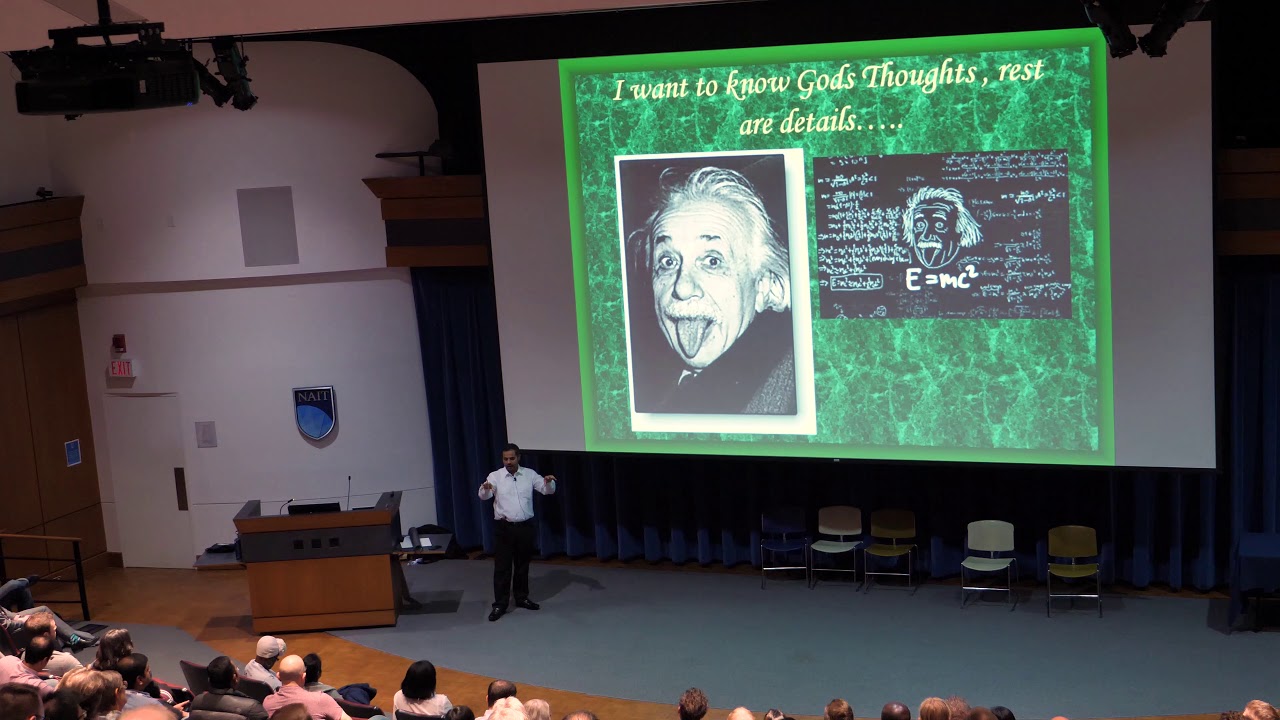
another interesting one I want to know God's thoughts rest are details so he was a great philosopher and you all know equals to MC square one of the greatest equations ever found by him is why it's quite interesting you know I was thinking about it when people were taking a giving a presentation I mean this is the pen right this pen has a mass if anybody knows physics a mass like it's a material right this material can be changed into energy it can it can be it can be absent at this point in time and it all becomes energy that's exactly how nuclear bombs work that's how exactly how atomic bombs work the theory of nuclear fission or nuclear
fission you know if you want to Google around why hydrogen bomb is what it is why an atomic bomb is what it is you're basically changing matter into energy the fact that that even exists the fact that energy and matter are interchangeable is fundamental and that's what he said right so he wanted to know why guards thoughts you know what exactly is the reality and he wasn't concerned how to project or how to understand that reality and that's exactly what quantum mechanics does it's a theory it's a model it may not necessarily mean that it's reality in its of itself but it can give you answers of the reality or things you look at correctly
and that's why it's successful to this date so there's a you know we all talk about modeling theory there's a model then there is reality how you model that reality and how you how you can find true answers to of that model of that reality for example you know then that model is correct special theory of relativity quantum mechanics any Theory you talk about okay particle physics so back from quantum mechanics into particle physics right everything is made of atoms and proton atoms and you know molecules you go a step further down neutrons protons and electrons you go one step further down quarks and leptons you go one step further down they call it the god
particle I don't know why they call it the god particle it's called neutrino and in the certain lab out in Europe they actually have an underground lever they collide different particles together they claim to say that they found the fundamental particle which can explain everything but there's a debate around it my point is this you know if you look from the scale of a nucleus or even you know we'll talk about quarks and leptons do a scale of an atom do you human being down to the scale of a universe to the scale of galaxies do you see like there is a pattern emerging out of it that pattern is what is in the microscopic scale can
be on the macroscopic scale and they are actually mimicking each other Newton was actually one day sitting on his desk and somebody came and he was making a model of the solar system somebody said wow what a beautiful in a perfect model of the solar system I'm actually I'm at least I believe in God so I'll speak in that terminology I'll try to argue why why there is a super power so he said so Newton was there he said okay what a beautiful model of the union of the solar system he said yeah this is what I made think about the solar system existing out there somebody might have made it to the fact that
electron if you know electron it's a negative particle right it's a negative charge 10 to the minus 10 to the raise of minus 19 coulomb with its electrical charge even if you change 10 to the minus 20 or minus 18 I mean you could imagine do the zeros this universe wouldn't exist the way you and me are here will not exist just because of the fact that you have changed slight decimal in the charge of an electron that's how precise this machinery of the universe is working when Newton said I could make this and you like this so beautiful think about the solar system of the universe somebody might have made it or how perfect and how precise it's
going so particles right matter is made of particles you have matter you have atoms electrons nucleus and neutrons and quarks the more deeper down you go the more you find but what I imagine I mean I'm not a particle theorist particle physics physicist but at certain point in time the particle nature of matter will cease to exist and you will always only have waves or energy in this in this vacuum and that's what equal to MC square is all about I'll just give you an example of what an atom might look like it's just a it's just a model
and this model speaks volumes actually if you look carefully of what we are looking at here we are looking at the center of this atom which is the nucleus they're looking at a cloud we are not actually looking at the way you always imagine an atom as electrons and protons going around it this is what quantum mechanics is you have a probability of that electron somewhere in that location of space but where it is you don't know because our precision our understanding breaks this is this is where you know if you have hurt Isaac Newton right the apple fell he said oh how come gravity he doesn't exist or what this forces which goes down and why not up and then
he came up with these three laws of physics right then Newton's first law second law and third law it vent along for 200 years until nine spork' more the quantum mechanical world came to a point where this classical thought that action and reaction force equals mass into acceleration or that inertia a body does not move until somebody Pat's it or forces it to move that Todd breaks down you come into the world where it is all all haziness that there is probability of things existing but things existing of themselves is not a reality or precise in nature so this is just an example of how you can visualize an atom from a quantum mechanical perspective
and this would be important because I'll be talking about quantum computing so why this probability is important hope I'm making sense here and it's not going over the board I'm just trying to you know bring it down to a point where it tickles mind and again gives you guys idea you maybe you can go a little bit more Google queries on what fun computing is so Moore's Law how many of you know what moves lies okay why is it called a law it's actually not a la it's an empirical observation a law is always precise and perfect garden mood who was IBM's chairman in 1965 around 1960s observed that the density of transistors on a microchip or on a controller
doubles every two years it's precisely 18 months actually but every two years if you extrapolate this law in time what you will see that the number of transistors will keep on doubling on a microchip or a processor or controller and how could they double on the same space on or in the same area they have to keep getting shorter and shorten right they have to keep going smaller and smaller to a point where it will come that a transistor would have its dimensions in the range of an atom and when that happens you're not in the world of classical physics or Newtonian mechanics those zeros and ones don't matter anymore I'm sure everybody know if one is a 5-volt on an electrical wire
on us on a motherboard right like it's a signal and a zero is a zero world right this this certainty of either you have a one or a zero breaks in that world of quantum mechanics as we have been telling that probability exists so moose law is going to break someday I mean at some point in time the transistors will be appointed for an atom and then different physics altogether takes over and that physics will then drive quantum computing which we'll talk about qubits and whatnot make sense like you are at a point and we are actually at that stage we have not realized it yet but this stage where you're moving closer closer to nanometer micrometers nanometers you
know and even further down to the level of so talked to Intel talk to AMD's of the world they will tell you how small the transistors are and these are the building blocks of a computer right a transistor is a 0 or a 1 right you actually look at how the bits get arranged in there so what is quantum mechanics I'm gonna I've been talking about it for for a while now but just a quick overview it is a framework for the development of physical theory so it's a framework ok it's a model of reality not reality in itself it is not a complete physical theory in its own right so it has its limitation
that it works in the field of atoms and molecules then at certain point Newtonian mechanics takes over which is Isaac Newton's way of looking at things those three laws I talked about right inertia action and reaction force equals mass into acceleration now where can quantum mechanics come into play and drive computing this is the beauty beauty of marrying physics with computer science now information theory with how computers can get changed they have to write if the Moore's law has to break your hardware has to change your things would have to be different so application software operating systems standard stuff right there will always remain for an end-user to understand what they're looking at I mean those
things would remain certain specific rules of algorithms of generating you know processing power of running the show and the back end when you're your density is so strong that there's no mood law anymore will run would be run by quantum mechanical rules atoms and molecules qubits things talking in probabilities so quantum mechanics has for mathematical postulates which lay a ground rules for our description of the world and I'll talk about it basically it's there there's those four fundamental principles if you understand them you can understand how this field can run computing sciences and they're quite interesting and very you know counterintuitive as I said if you're not confused by this field we have not understood it as Niels Bohr said before
how successful is this field unbelievably successful this is a mathematical model of the world but think about it like they're those brains in 1930s and 40s created those postulates they have been running actually quantum mechanics I don't know if you many of you know in in the world of physics they're talking about theory of everything I'm not sure that's true again I'm at East so I understand human beings may not understand here if everything because we are part of the same equation how can we understand ourselves by our own self so it's a it's a little bit of a oxymoron but they say a theory of everything would also need to have quantum mechanics as a
component of it you cannot have atoms and electrons Union you cannot explain them under the quantum mechanics is part of it but quantum mechanics has not explained everything of this world think about gravity right I mean I had this again again right you throw it it comes down right this simple fact of something going up and coming down which we all know as AI Newton said by Apple is coming down not going up this gravity cannot be explained by quantum mechanics and this is a problem for scientists these days they can understand a lot of things but they cannot understand gravity so theory of everything would include something more than what quantum mechanics tells us okay so and you know
that they are talking about gravitons they're talking about cake eons I mean these this is a it's a very fascinating word if you know light as we all see here is there's photons going back and forth if you heard that term particle of light is called a photon that they're telling a particle of gravity is called a graviton why gravity is just a force it could be a field with particles it could be understood in that in the nature of particle physics the way light can be understood in the nature of photons talk about cake eons it's a conceptual concept but they said take eons or particles which can run faster than the speed of light and if that
happens I don't know how many of you understand a hard special relativity if you run faster than the speed of light you can actually go back in time and there's a grandfather's paradox you know if if I can run back in time I kill my grandfather then my father wouldn't be born then I wouldn't be born but I'm here so how is that possible so this anyway there's a theory behind it but to this date the postulate that light is moving is the fastest speed in this universe still stance so quantum mechanics we talked about it at length how does information theory or computer science comes into play so let's go top bottom up so
information theory you know you have different if you have you have different fields around it right yes classical mechanics cryptography computer science the Turing machines if you have been into in into computer science as a graduate curing machine then what they actually mean Shannon's theorem of information theory error correction etc so this is standard computer science 101 you keep going up then you come into the realm of quantum algorithms form computer error correction in the world of quantum you know quantum mechanics and then you keep going up and you actually are marrying the field of information theory or computer science with what you can actually do with quantum mechanics at the end of the day
quantum mechanics is only providing you the resources to do computation that's all just like bits you know it's electrical wire zeros and ones right electrons up and down in a similar fashion quantum mechanics is providing you the resources you could use the resources create your own quantum algorithms and then go after it they're famous algorithms in quantum computing to this day chars algorithm you can actually break the RSA algorithm if you have or RSA cryptography right we talked about keys thousand 24 or 128 256 bit RSA cryptography these can be broken in the world of quantum computing and I'll just tell you actually IBM created a seven cubed quantum computer coding qubits on top of molecules and they
factored 15 into five and three back so these are prime numbers those who understand cryptography right prime numbers you can go one very easy it's hard to refactor it back into prime they did that the fact that it is 15 back into five and three is probably not that important but the fact that you could do that is important because now you can break RSA algorithm that this computational method so what is quantum informatics the basis of information theory is discrete mathematics binary digits as we all know zeros and ones right quantum information employs quantum states as basic elements of information so we'll talk about those what that states mean but I you know in
a term it's it's probability examples of quantum bits or qubits are like nuclear spin it could be motion of it trapped ions it could be photons and in an optical resonator each offers a future technology for future computing processing these are your resources these things you can use to code information in the form of qubits and then do your mathematical algorithms on that get the results out and lo and behold you are breaking a lot of stuff which currently exists or you're creating new stuff which does not exist even today so again the same thing in a pictorial fashion but I'll show you a little bit of a video you know what a qubit might look like this is an example
of a photon going up and down up and down up and down just an example of a particle of light a light can be measured in wave or in particle this is a very famous principle but not both at the same time either you are either you are a matter or you are a wave but you cannot be both does that make sense I mean it's a little country but you know either I'm a person or I'm invisible but I cannot be bought at the same time right so so this is an example of how a quantum a qubit would look like a qubit is not an electrical signal it's a resource provided in the world of
quantum mechanics again ions photon atoms electrons and they can be coded into these qubits again zeros and ones the beautiful factories are now talked about it's called the principle of superposition you can actually have 0 and 1 the same time coded on that resource of a Cuban it's not either/or it's both and when you look at it we'll talk about it's a problem of measurement then only one I mean if I'm looking at you you are there if I'm not looking at you you may or may not be there that's what nice for said right so but the moment I look at you you you're there so you are a fact for me some of the benefits which
quantum computing can provide so in excess of quantum information is inaccessible until converted into real information via measurements a very important fact and I'll come to that there will be actually a a topic on screwed injures cat paradox if anybody remembers their physics again in quantum mechanics there was a cat paradox and it offers security and quantum cryptography and other sharing protocols guaranteed by laws of physics rather than assumptions of mathematical difficulty a very fundamental statement here security is never 100% as we all know right I mean we could pay a lot of money to try to secure ourselves or be you know lock ourselves and try to be hundred percent secure but they're always raised to
break it but that's ordering topography you talk about mathematical difficulty algorithms and you try to break them and you cannot because your supercomputers can do that today and so it's not possible but in quantum cryptography where actually I did my research and back in Montreal my professor were talking to us Brossard who is the father of quantum cryptography he created a protocol called BB 84 been adverse ordinary for protocols we'll talk about it it's a cryptographic protocol but the fact that if it is secure hundred percent because it if it is not then you're falsifying the law of physics and I'll talk about it's called the Heisenberg uncertainty principle and that's actually a law of physics in
quantum mechanics if you so either you go against a law which would be awesome if you could break that will be you'll be obviously famous tomorrow because now you're not just famous in security but you're famous in - but you cannot break that law and that's why you are you're you know you can ensure that the security of this is hundred-percent and entanglement of states makes some uncomputable problems computable so we'll talk about entanglement spooky action at a distance anybody heard heard that term before beam me up Scotty spooky action at a distance we've talked about it I mean it's so counterintuitive again but we'll talk about that the slides come but this is a fact of reality it's it in fact
true and they have created an experiment surround it scoring just cat parallax is doctor squirrel injured or miss Willinger 1930s beautiful cat paradox so there is actually a deaf nuclear modular material out there so there's a particle which can either get be emitted from that nuclear call it a resonator a nanometer for example our particle may not be emitted from it now since it is quantum mechanical in nature because the particle is so small like it's a nuclear material there's a probability of 50-50 that it will send it or not send it right the qubits zeros and ones can be at the same time on a machine so you cuz you have it's in a box you're not seeing
it from outside you don't know what's happening keep that in mind now that particle has a 50/50 chance of being emitted or not that could lead to hitting a hammer that hammer hits a poisonous bottle that poison spills out and the cat is dead or alive now the paradox is I'm not looking at this box okay can I tell if the cat is alive or dead I mean I cannot for me there is a 50/50 chance of cat being alive or dead it's very hard to wrap your brain around this idea but this is how this paradox came into being now the moment I put big I take the box out yeah I just she'll be
dead or she'll be alive for me she is a reality now either it's a 0 or a 1 but until I observed it it was 0 and 1 at the same time does that make sense and so that is how they claim that quantum computing with qubits can do such a massive scale of processing even beyond supercomputers of starting to somebody today I'm not sure if it is 128 bits or a thousand thirty four cubits some of that one of that number but a safe thousand really for qubits so talents to a fourth qubit quantum computer just thousand twenty-four qubits like one Meg can refer every atom in the universe that's how large that computation it is and at the same time
because if I'm not observing what's happening inside that computer all the processing possibilities are there however millions are there to raise 2024 the moment I look at it yes I will collapse it to do a state where I will see something which is concrete but the fact that I can run a computer in a black box with certain algorithms on it with possibilities of thousand 22 race 2024 at the same time as if like I'm referencing every atom in the universe at the same time in that computer just one mega economy computer can do that Heisenberg uncertainty principle another beautiful principle so it so look I am here right I'm standing in front of you
my position is zero I'm straight and I have no motion I mean you can exactly tell that my what's my position and if my moving or not this is because you and me can see each other we are part of the Newton's world right this is classical physics standard those three laws as they apply in the world of quantum mechanics doctor Heisenberg said if your particle is so small that it is at level of quantum mechanical rules then you can either look at its position or you can look at its motion but not both at the same time that's not possible and he proved it and there are many experiments which prove that and this is the concept
of non orthogonal I'll talk about it so the fact that you can have this this principle actually ensures that quantum cryptography is hundred percent secure because look at if I'm if an alice is sending a qubit to bar up in a quantum cryptographic Channel I'm not looking at that qubit everything is flowing by the moment a hacker or third person call it a man-in-the-middle attack is looking at it to try to observe our intercepted message you have broken its quantum mechanical phase as I said in the strangest paradox you've actually broken its state it's not correct anymore it may not be good for Alice or Bob it's not neither good for me as a hacker
I may have denied that that communication but I cannot intercept it without interfering with it that's how you can if you will be breaking a law of physics if you're even mentioning to try to look at that at that channel so that's the beauty of of Heisenberg uncertainty principle ensuring that quantum cryptography will be hundred percent secure einstein-podolsky-rosen paradox another beautiful paradigm the spooky action at a distance you can have two particles at two ends of the universe they will still talk to each other even though the speed of light will probably connect them after a long period of time but they can instantaneously talk to each other that's what Einstein and two of these other folks talked about I'll
give you a small demonstration of this again it's a video of what a EPR I'll talk about it a little bit looks like
two particles the way it works again from a little bit physics but you have say one particle right this particle at this point in time is just one it breaks for some reason there's an internal force it breaks it goes so far away the initial momentum is zero right was standing still right if anybody knows physics the law of conservation of momentum law of conservation of energy and law of conservation of mass there will always be conserved it doesn't change there'll be only one energy and in a closed system there'll be only one mass you can break it in how many pieces so is motion momentum so a particle breaks goes into two ends of
the universe still the law of momentum will be correct that means if I takes it momentum going there and it's there and I plus them together it'll still be zero because the initial momentum was zero it was just standing still when it broke apart so the final will be zero to now Einstein said hmm if I say that particle has a velocity of 50 kilometers per hour going east I don't even have to look at this particle to say it's going 50 kilometers an hour going best I instantly guard that information because that law has to remain valid even at the ends of the universe and that's what Einstein said Niels Bohr said no you
have so Einstein said this entity look this is possible now I can look at its position I can look at this particles velocity or momentum and by knowing this particles momentum I can infer what this particles momentum is without even looking at it now I have falsified your Heisenberg's uncertainty principle because I know this particles position and momentum both does that make sense I'm not looking at it I'm looking at the other one but looking at that I can infer this and so Niels Bohr said no you're wrong they still are part of the same quantum mechanical system you actually have observed it you have observed it and that's why you can see you know that they are correct so there
was some debate again I'm not baby correct factually as to what it is but what I'm trying to say is he said look I can do position and momentum by looking at the other guy this is and the fact that you can do it at the end of the universe think about it like particle the end of the universe if it even has to make any change on its brother on the other end what is the best way you can do it you have to send a speed of light a signal right they'll probably take eons to go to the other end of the universe but we are not doing that what we are doing is just inferring that
based on the the under law of physics this is called spooky action at a distance and it is valid they have done experiments and it actually happens so this experiment led towards the concept of entanglement which is another resource of quantum computing and they said well this is possible we could do it so three principles superposition non orthogonality and entanglement based on three fundamental laws of physics scrutineers cat paradox Heisenberg uncertainty principle and Einsteins EPR paradox they are the resources of quantum computing you can actually use these as resources code them on qubits create quantum computers and run algorithms on it beam me up Scotty you know it feels like science fiction it may not be they've actually done an
experiment by which they have what they call teleported the term is called quantum teleportation they actually have teleported a particle from one location to another using the EPR paradox I was just talking about and I will show you a little demonstration of that in the particle world now what stops something from the particle world the commonly that the human world it's probably time if you can physically demonstrate something happening in the matter you may have to find ways how you can do it at the human level or in the matter you know at this level so you know teleportation could be a reality tomorrow it is what they do in the quantum world challenges so quantum cryptography has
been called has been achieved but requires further development so again as I said my professor with dr. teals Brassard Banat Brossard 84 protocol if you want to google it they have achieved that to run cryptography I'm not sure this was kind of a you know a speculation but around in the year around 2005 and I was doing my research they claimed that the Department of Defense in u.s. and couple of universities actually had a running quantum cryptography channel underground where they were sharing information it's just like you know internet came into the world but it was already there in the DoD world long long before and so you never know you know they could be
far far ahead in their technology and we will only look when it comes into fruition I will talk about some practical implications of quantum computing they are actually today and we'll talk about it quantum computers are not yet developed to a full extent their certain proof of concepts identification of computing problems for which quantum computing is an advantage we need to know which problems are there like factoring is one problem they have solved char algorithm is another problem cryptography is another problem there are other computational problems which they have solved with quantum computing at least in theory you need to put it into practice and who knows tomorrow it could be corn software and maybe quantum IT I
don't know how would security look like in the world of quantum IP where everything is fuzzy where everything is probable until it becomes reality when you see it just an example of the banner press or a default protocol Alice and Bob they send a signal over there's a full length of steps you need to take you need to measure that those particles on the Bob's and to try to decipher what Alice has sent but the fact as I was saying the fact that when you're communicating with it if a hacker goes inside it he's gonna break the law of physics he's gonna basically break the communication and break that that probability of of communication into you
know what is real and that is not actually what was being sent so that's how they generate this cryptographic protocols just an example of it a breakthrough in common computing until I think the NT server I don't know if it's up and down so you never know gonna have a quantum ping and you would know I don't know if my server is up and down and delino over there I can ping it
consider three aspects so these are the three aspects quantum cryptography from teleportation and quantum computing so an example of quantum cryptography how they generate two particles in a cryptographic world you see a electron going hitting an atom creating two of its brothers and they are now entangled with each other going at the ends of the universe so this is what entanglement is now using this entanglement you actually can create cryptographic channels and create algorithms around it quantum teleportation this is an experiment which was done which actually proved that a particle can be teleported from one position to another position you see there is a emitter of light so you will see a light coming out from there it'll
go split into two so we'll let the video run
those are two entangled pairs right as we have been talking about one of them goes to the ends of of its of its measurement there's actually four entangled pairs which are which are there so it's a little bit more complicated than a tube to qubit system so two of them the match here of the pair's and they will be measured at this point and by this measurement I could tell as part of the EPR paradox what that other particle is doing and I could actually relay that this particle is coming at this position at this time and what would be its position what would be its momentum so you know just a pictorial representation not going into too deep but they did
they have been experiments to prove this this theory quantum computation so when it coming back to computer science what what is quantum computing doing in terms of creating practical applications so they'll talk to talk about this but this picture here is off d-wave systems in Vancouver Burnaby they are a company in the market and this is the quantum computer they have existing in their lab you can actually do certain computations on it what you can do I'm not sure haven't done a research on it but they claim to have a quantum computer with some practical applications you can use magic cue technologies is another company out in East Coast u.s. they claim to have a condom cryptographic you
know channel created and you can have Alice and Bob and send information back and forth so you can google that too so regarding devices in the field of quantum computing what are we looking at what kind of possibilities are existing in this world right so we are in the world of quantum communication or quantum cryptography I mean which is still known we're talking about BB 84 sending information back and forth not breaking the protocol those things are well understood in the world when you go past think about fun of sensors widgets Oh sells quantum games and toys I mean I don't know I mean the world is open right you have these resources provided to you by this physical theory now it's
up to you to find ways and means or innovation to look at what you can do I mean there even the fact theoretically that you can solve certain computational problems in computer science using this is it's fascinating ENIAC 1946 everybody you probably have seen this picture before right the the father of computer science computers for example such a big machine what we have today is all you know a same example in a phone right this is the one name in architecture basically you just have an output and input and a processor running in the background with the memory that's exactly what this machine was doing we have come within what 50 60 years at the
most from that to this imagine this is a quantum computing lab currently within the next 30 to 40 years what could have happened you know you or we all know we are in IT how fast this world is going right from 2000 where I didn't even have an iPhone I didn't know what an iPhone is do today I can't live with this without this right it's been like 18 years and now you would have you would have something which you can use example from IBM the seven qubit quantum computer I was talking about 15 changed into five and three the fact that you can refactor back a prime number into prime factors as I said you know there
are possibilities to break RSA algorithm or you know those kind of cryptography protocols because they're based on the mathematical difficulty of something happening ion trap quantum computing they're working on in Simon Fraser University out in West Coast on using ions to do do do foreign computing this is the d-wave system so they have that one was an old picture this is a new one they have this in their lab so this is a reality you just want to show you that this is not you know this is not Puri anymore there are some practical implications and the fact that we will be moving towards it there is no other way unless you want to have more faster computers you've got to
have transistors you've got to have systems much faster you are ultimately moving towards the speed of light you're ultimately moving towards that mini rich mini miniaturization of of devices that these things will come into reality one way or the other right google has a quantum error correction a chip you got I don't know how many chips are how many qubits are there nine cubits you actually have those nine qubit they created this chip these nine cubits talk to each other and they correct each other's errors so if I'm a 1 even the qubit is not a 1 at one time you're 0 & 1 the other party is a zero and it's supposed to be a 1 I will do
coherence with it that's because you're closer to it you can influence its state and I will correct it back to its normal state which is the correct one think about it you're you're correcting errors using qubits now this is stored you can do it in a communication channel to quantum random number generator this could be a reality I guess it's a reality I'm not sure how true this picture is I took it from Google but you know just like there's no real random number generator in the computer science like in normal computer as we all know right this is classical physics this not there's no know for 100% randomness out there you are using some clock cycles
you're using something of the electrical signals to try to create random number generators but in the world of quantum mechanics as we all see the scrutineers paradox and the fact that you will always have randomness until you measure it you actually could have a real random number generator application through a quantum computing device
atomic clocks another big one right you can actually have clocks as we all know these clocks again have you know some error existing because these are classical clocks the moment you go in the world of atoms the precision increases the the moment the precision increases you can actually have clocks which are very very correct I don't know if they can ever be 100% or fundamentally correct but you know you can increase that precision to a point so that's another application stability equivalent to losing less than one second in 300 years that's the end of my presentation I like this vision Churchill as a coat you know it keeps me reminded right now this is not the end
it is not even the beginning of the end but it is perhaps the end of the beginning we have just ended a concept moving into an unchartered territory where the possibility is open so thank you very much for your time and attention I hope it was good [Applause]
Related talks
 38:16
38:16 43:14
43:14 44:49
44:49 45:38
45:38 32:14
32:14 29:06
29:06