Stress, Mental Health, and Finding Your Groove in Cybersecurity
Show transcript [en]
foreign
well I've been told we can go so let's get started so thanks for attending um I'm actually really really excited to be here this is the first in-person presentation I've done at a conference in I think about two and a half years now so I'm gonna ask one thing from everybody for the next hour or 45 minutes that's just a little bit of patience um I've built some really bad habits in the last two and a half years doing a lot of like virtual presentations um so I'm realizing that what I'm used to and what uh in-person presentations are like might be a bit different so we're going to be good so thank you for
attending besides Calgary thanks for attending this presentation I'm going to assume if you're here you're probably stressed out just a show of hands who's stressed out ever just everyone put your hands okay if you're not some degree of stressed out you're probably stressed out so a couple years ago on back in 2018 um I had sort of a peak when it came to stress and mental health issues I started seeing a therapist and I spent two years talking to her and at besides Calgary 2020. um I actually did a presentation uh on on my mental health issues what I learned talking to therapy and since then I've had almost nothing but good responses and good reactions
from the community for that I was constantly um encouraged to continue to speak about that continue to bring it up continue to talk about it so it's been two years since I've done that uh covid has since kind of happened um we've all got used to Virtual environments and a lot of different things have happened with my mental health since that conversation so what I want to talk about today is just kind of maybe update the community and talk a little bit about what I've learned what I've gone through and hopefully it can help everybody else so really quick I'm not going to go through all these you can read them there if you know who I am cool if you don't uh my
name is Michael spalling I lead the internal information security team at the University of Alberta so the U of A is one of the top five universities in Canada um officially were top 150 in the world but we tend to straddle the top 100 based on what what ranking system you're using in terms of scale so the U of A we measure our budgets by single digit billions uh we measure user counts in the hundreds of thousands we measure devices in the mid to high tens of thousands so it's it's a relatively larger institution um I like working there it's post-secondary and as you can see from a lot of what I'm generally involved in I focus a lot on the
post-secondary industry when it comes to cyber security so that's something that we're going to bring up later on in the presentation but full-time career job I lead the U of A's information security team I'm also an instructor at the U of A so I teach one of their Advanced network security courses and one of the um the mint programs that's a master's program I'm also a research supervisor in that same program so as a requirement to graduate the students have to do sort of a six to nine month research project that involves seeking out a subject matter expert in their area to supervise them through their research so I'm actually doing that right now for one of
our students and the last thing that I do um is I co-chair one and participate on of just post-secondary committees tied to cyber security curriculum uh in their courses so I've spent a lot of time focusing a lot of my efforts on post-secondary as it relates to cyber security so a little bit of a background and we're going to look at at three things today so I'm used to moving around like this I'm not used to standing just behind a Podium talking to a microphone so if I'm naturally doing this and coming back I'm sorry um we're going to look at three things so I said I've had almost universally positive responses when I talk about mental
health and that's definitely been true for I would say the cyber security Community but as I engage other people and especially in the last two years I've actually I've had some negative interactions and I wanted to speak a little bit about those so that's what we're going to talk about at the first part the other thing that I've learned and this has really kind of built up my stress a lot in the last couple years is expectations versus reality uh there's a lot of you know just online communities reddit's got a bunch where you know they show something that you think you're getting and then the next pictures that you actually get and it's they're not
related you know it's more comical than anything else so I've learned a little bit about that with the cyber security industry you know oftentimes we have expectations of certain things and then reality sets in and you realize that they're not they're not the same so I want to talk about that but the last thing what can we do to help that's something that I want to talk about um I've learned that there's a lot of stuff out there on Mental Health now which is great there's very little actually tied to cyber security which is kind of sad and the stuff that is out there is frankly it's mostly just statistics it's like did you know that
98 of stock analysts burn out in six months like yeah I don't know if that's the actual stat I made it up but it's probably accurate um so I want to actually talk about what can we do about it because that's where a lot of the stuff I've learned with mental health and cyber security kind of falls apart is everyone's stressed everyone's anxious but what can we do about it I'll share with you some of the tips that I've that I've learned um and the last thing normalizing the conversation so the key word here is conversation so this isn't meant to be you know a talk at you thing where you go hey that was a cool presentation and
you leave or you go that presentation sucked whatever and you leave um the idea is to spawn this conversation up with people um one of the nicest things coolest things that's happened since I started talking about this publicly is I've had actually a lot of people not going to out them or anything come to me privately and say Michael thank you thank you for talking about this because I can relate to everything you were saying and the the commonality across those types of people is that they're all different I've had every age group every gender every race every every everything every employee I've had cesos I've had people that just got started say Michael I could relate maybe not to
everything I talked about but to a lot of those different portions so this talk is is universally applicable to people and to the people who are out there talking about this kudos to you thank you I was actually um asked to speak at Beau Valley College virtually a couple months ago uh for an event that povalley was hosting for their I.T staff um so James invited me to speak there and we talked publicly about some of our experiences and that that was like that was great that I think that helped so that was awesome um last piece of intro Tech here very important one I'm not a doctor I'm not a therapist I don't play them on TV so I'm
not licensed certified in any way to tell you what's wrong with your brain um my therapist can tell me that so this is not you know advice it's not medical advice don't take what I'm saying as medical advice number two these are my thoughts and observations Okay the reason I have my in there is you are welcome to disagree in fact you go right ahead you can say well that's stupid I don't agree with that I never experienced this totally fine these are just my observations okay and number three your mileage may vary so working for the University of Alberta and in the role that I am I'm blessed to have access to certain types of benefits I
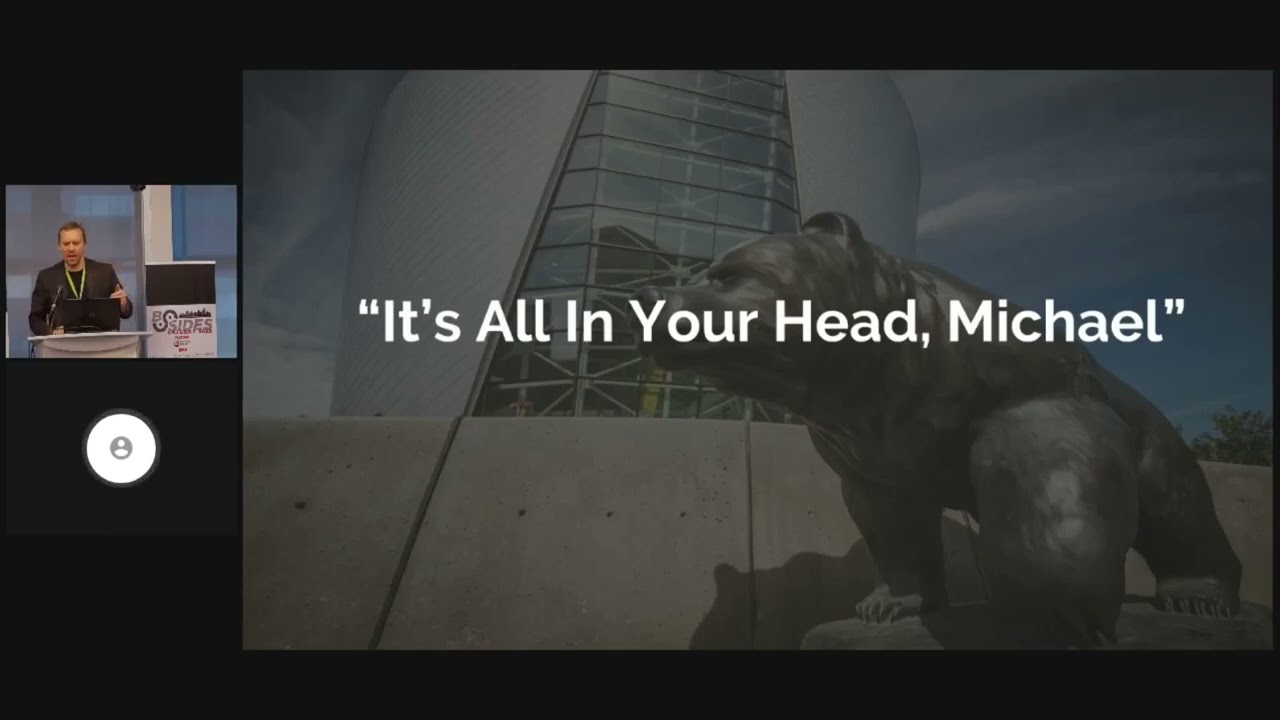
have a lot of leeway LCA with with perhaps how I do my job and how we do security but I realize that that may not translate to some of the other organizations out there so let's get going it's all in your head Michael out of curiosity has anybody ever said that to you you know you bring up a problem to them and they just go ah it's in your head and you you don't really feel good when somebody says that right I I've had that said to me a few times and it comes out with very dismissive it's very very passive um obviously I'm not gonna out the people who've said that to me but um
I've had great conversations with people who have said yeah this is awesome let's talk about this more but I've also had people who have told me they don't get stressed so when I when I asked earlier who's stressed right now and you know people didn't put up your hand well one of the great equalizers of being a human being is that we all get stressed we all get anxious right death taxes and stress is really what what should be those equalizers and I've met people who claim they don't get stressed um I've met people who claim they don't get anxious um how many of you have heard of imposter syndrome just you know how many of you have
imposter syndrome you can put it on you see the funny thing like like I see people here who are literally chairs of boards just put their hands up saying I have imposter syndrome and like crazy but it's a thing um I had someone tell me imposter syndrome's not real uh someone who had never even heard of it when I was explaining what it was they said no Michael that's not that's not even a thing and I was like but of course it's a thing like there's literally books on this stuff there's there's research in that area you can't just tell me it's not a thing so um I'm not going to get into those those
those discussions but uh that's some of the barriers that I've hit in the last couple years is even people not realizing that things like imposter syndrome are real so I expected to go into the conversation saying oh yeah this will be easy and then no you have to actually convince them first that it's a real thing never mind trying to get support for it um I was actually accused of being selfish in the last year I I build on a birthday party um last minute and and I was called Selfish because I didn't consider the thoughts of the person whose birthday it was and I didn't consider the thoughts of this and this and that and like I
understand I get that and and I can see why they say that but I had gotten to a point in my head where I couldn't do it you know I was so stressed I was so anxious I I just could not go to that birthday party anymore and I had to take time for myself so when somebody says to me now you know I'm like oh it's all in your head I usually have two responses to that is first off find the common ground I agree with them uh yeah you're right it is only my head it really is some of it may manifest as you know physical symptoms but that's the problem it's all in my head but
number two that doesn't make it any less real just because it's just in your head and maybe it's difficult to measure it's difficult to describe it might it doesn't make it any less real so um I'm showing you my notes Here so I've made a point of time decision if I go back to the birthday party example right is I had to be not selfish but self-care it's one of the key things my therapist has taught me is that at the end of the day when you're dealing with mental health issues making decisions that are for you yourself and your best interests some people might think they're selfish but at the end of the day it's all about
self-care right you do have to look after yourself and your mental health first and I'm terrible at that right I'm usually trying to put other people's first I'm trying to you know schedule stuff coordinate stuff and then 10 minutes before the event I'm sitting here going oh why did I agree to this not this by the way this was great I love doing this but I'll just clarify that right um but uh I'm just gonna say if you happen to be someone who has said you know oh mental Health's not real or let's um you know imposter syndrome's not real uh just if someone ever comes to you and says I'm having some mental health
problems just please listen to them okay take it seriously and listen to them and see what they have to say so again it's all about supporting them so it's all in your head Michael like I've had that said to me but you're right it is however that's the problem and it doesn't make it any less real so let's work together to solve it um the other one expectations versus reality this is where we need a little more to decide camera security side of the house so I explained what this means earlier if you don't know again it's just you know my favorite examples are um you know people like they they go to Amazon and they buy
something and they think that it's going to be this like super cool like six foot tall Pokemon stuff yeah then it shows up and it's you know like maybe a couple inches because then it's like what's going on um another really interesting one uh but Instagram reality it's literally a subred credit out there where it's like you know you see selfies of people what they post on Instagram and then you see selfies of people they post on real life completely different right um but that's actually a fascinating thing to me because that's not real right that's not real and I can't stress that enough um online does not equal the reality of it but a fun thing about cyber security
I've learned is that so much of what we do is online right um maybe you know it's 2 A.M in the morning and you're trying to you know get a firewall to reboot or something maybe that's physical but the rest of it it's almost an entirely virtual domain now for us so we spend a lot of our time online and because so much stuff online is easy to misrepresent I've learned for me it started to cause me some stress over the years as to you know is what I'm dealing with online is this actually the reality of what's going on or is it not so I've tried to become a little self-aware with what I'm learning what
I'm seeing online and comparing that to what what I consider to be true in reality so I want to just go through a few examples of this I'm going to take a quick drink real quick but how many of you are involved in incident response like security incident response how many of you who aren't how many you want to be you think it's pretty cool how many of you saw these slides and you go yes I want to get into it now um some of these are amazing like my favorite
that makes things just sound soon super cool all right here's a guy in the bottom bottom right there incident response he's got his fancy futuristic little iPad thing he's just pushing the lock button and we solve their problems um what else do we got here there's lots of lock button Cyber attack security breach Okay so I just went to Google and I just searched for literally security incident response and I cherry-picked all the really fun you know it's a lot of like like graphs and flow charts no one cares I picked the cool stuff because that's what they want you to see right when you go to Google and you search security incident response this is the type of
stuff it shows you it makes it look really cool and really sexy and really awesome and really neat you want to know what security incident response actually looks like that real actual picture um I had this talk in my head for the better part of like six seven months and uh I submitted to besides Calgary got accepted that's me not me that's me taking a picture this is actually me this is real um that is me doing security incident response at 9 30 PM in my in-laws basement they live two hours south of here I'm from Edmonton by the way they live like Lethbridge um in their laundry room slash basement uh because we were dealing with a pretty
big breach so we just learned about that morning um I was on vacation by the way and I get a text from one of the guys on my team saying hey I think we have a problem and you know that's generally a daily occurrence in my job but the question becomes is this like a hey FYI we have a problem I'm just you know keeping you in the loop and we'll deal with it is this uh I was at the lake with with my my wife and my kids and sister in laws and their kids you know just to come back to shore problem or is this a catch your vacation short and come back to Edmonton so spoiler alert
was number two it was at the store and get on this call right away uh we realized what was going on we realized that we had to bring in some external groups and we had to coordinate all of that so given everyone's schedules 9 30 p.m at night my kids are in bed my wife's upstairs and laws are upstairs this is me at 9 30 doing incident response this is what it looks like and bonus if you can't tell by the way that's not a chair that's a foldable step ladder okay I couldn't even find a chair so that's this is the reality of of of of incident response another fun one um I don't know if you can read that
so there's a really funny website out there it's called viralpostgenerator.com it asks you two questions it says what did you accomplish and what's your inspirational message and then there's a cringe slider and you can slide between low level of cringe and high level of cringe and anywhere in between you hit generate and it will generate you uh sort of lincoln-esque post um and it you know and it's completely fake but it's hilarious so all I put in here was like you know cyber security I passed a cyber security exam and what's your what's your inspiration you know do it you do what you set your mind to so this is made up but I can see people
laughing at this how many of you can relate to seeing these types of posts in in your feed basically everyone's just kind of going uh-huh how many of you post this stuff yeah everyone just said okay I'll Trust so this is I want to talk about this one for a second um because I'm going to be honest with you these posts they make me feel bad about myself which is really weird because people tell me you know I'm generally accomplished and okay if you want to say that fine but at the same time I see something like this and I don't feel very good you know I have a lot of security certifications they weren't easy to get
um one of the things that I learned about this is it gets my brain going in this spiral as I read this and I'm like wow like this is super inspirational this is the easiest thing on the planet look at how cool this post is look at how easy look how happy they are to have gone through the certification process who's ever been happy to go through the certification process right you're happy when you get it but the amount of Stress and Anxiety you deal with and I noticed that that was um I was just time out super happy there's a lot of students here today um that's fantastic even six seven years ago frankly we never really got students
coming to security conferences so besides Calgary besides Edmonton the other ones that exist out there hearing that you know there's 80 I mean what was it 80 something students 100 students that is amazing to hear their students here because it also means that a lot of the stress stuff translates to what a lot of the students are going through particularly in cyber security exams so when I look at this I start asking myself like why is this person making it sound so easy right why is it not easy for me why is everyone else liking the why is that of 10 million likes on it it's fake but you get the picture is it easy for them well I suck right I don't
have it this easy at all I'm doing something wrong right and this is just like one post okay so this is the expectation if we've never gotten into the industry and started looking at security certs and it's like well this should be simple right but what is the actual reality of doing this type of stuff it's a lot of this right no one ever talks about how much they had to study or how long they had to study and they whine about it but this is the reality right so this is me mostly just Googling like stressed out going ah so there's uh oh no I talked about that already right so under and about a lot of what's online is is
strongly embellished and I'm going to talk a little bit later about what you know things that have helped me learn about this but if you feel like this I'll strongly encourage you to go seek help one of the biggest things I've learned with my therapist over the years is I asked her a few times I was like so when are we done like when are you going to give me the the bill of clean health and you know it might to me I'm here right we've reached the point where you know you've made a lot of progress in the last couple years but think of it this way as just maybe it's an oil change for your mind it's
preventative maintenance for your brain at this point um so you don't have to hit a Breaking Point right you just basically have to decide hey I need a little help you reach out to someone we'll get to that and and you can help the last one I want to bring up speaking of reaching out and getting help this is oftentimes the expectation of what people have when they say I'm going to therapy or I want therapy or I need therapy right um from my experience there is a degree of truth to this I've never had to like lay on a couch like you usually see that's kind of funny but uh group therapy with other people talking about
this stuff has helped a lot immensely that one on the bottom right I picture me being in that person talking to my therapist because we've moved to Virtual but the expectation we talk to therapy is is you know the one on the left there is kind of that's a little I'd say I don't know people do that but this one is a little more real for me right when people say I want therapy and I want to talk to somebody this is often what they're looking for they're looking for maybe a small group or more importantly one-on-one with a professional therapist or psychologist or whatever to help before I go any further um I wasn't sure if I should put this
next slide in because I'm probably gonna offend a few people are there any HR staff here no okay that makes us a lot easier um what's the actual reality of a lot of organizations when it comes to yeah we promote mental health they do two things okay they give you a lunchtime webinar on the topic that's mostly useless and you don't even get paid for it or they give you Pizza um I mean we all love pizza like I love pizza and if Pizza could solve my mental health problems I would be standing here you know I'd have pizza with me everywhere it's not that simple so I'm gonna plead to you guys I lead I lead a
team of a five security analysts and as much as I'm sure they love pizza if my approach to helping them with with their mental health problems was all right Guys Pizza Friday two months from now I don't think I'm gonna get much anywhere so this is a plea to the people who are trying to help and that's one thing I want to make clear I'm not you know dunking on anyone for for trying like great but understand it to start okay so if you're working for an organization or you're responsible for an organization for doing uh Mental Health Awareness stuff please understand that you know a once a month Friday pizza party I'm almost 37 I have adult money I can buy
pizza whenever I want and I'm just going to throw that out there just know the difference between buying Pizza to help your staff versus understanding what they're actually going through and what some of those works are there um I have attended some frankly some good lunchtime webinars on the topic but they generally tend to summarize what's taking me four years to kind of learn so I would encourage anybody you know if you are doing the lunchtime webinars don't consider the job done okay don't just say yeah we support mental health we did a webinar three months ago why is everybody all stressed out still like come to webinar next time continue going um I am going to plug something really
quick I don't know if you can see that but uh working for the University this is actually how I got my start with doing mental health um if now I can't speak for anybody else's benefits program but one thing the university does provide to to staff is it's called um the employee family assistance program so it's done through a third party through um home and health they just had a data breach that was part of it um but that's kind of common now right don't even last it's just like oh yeah those things happen um but uh it's done through through that and it's amazing this is where I got my start it's literally you just you call
them and they say yeah you need a therapist cool here's their availability was relatively short they work around your schedule and had I not ever made that call like four years ago I probably wouldn't be doing this conversation right now so these things are great if you have any say in your organization's benefits plan or you want to maybe do things better I would strongly strongly recommend talk to human resources department talk whatever is involved in benefits ask them what do we have for mental health benefits and support because it turns out we've had this like for I've been at U of A for 12 years and we've had it I think like the whole time
and I didn't even know that so these types of things where your employer can actually have like signed agreements and contracts with um uh with Professional Services and it's it's personal so that says it helps you manage anxiety stress uh depression addiction mental health low self-esteem uh relationship stuff if you're having like marriage issues family issues difficulty with kids uh workplace issues and you hate Bob beside you you can talk to people about this stuff um that's one of the biggest things that's held so this is the part of the presentation I really want to get to just be mindful of time um I'm sure people probably hear because this is what they want to hear you know
tips that have helped and hopefully it helps them so I'm going to restate what I said earlier this has helped me Okay this may not necessarily help you you can try it there might be some stuff in here where you might actually go Michael you're crazy um that's probably like the second slide coming up but number one curate your social media so in this context social media curation what they usually mean by that it's the people who run the social media accounts for organizations or whatever and they're digging through all the digital wasteland out there finding the things that they believe that their followers want to see okay that's curation but you can do the same
um I don't want to mention the name of a platform so I'll just say that they they well actually no it's coming up in the next slides I guess I have to so so LinkedIn um is a platform I don't have social media I'm going to start with that I don't have Twitter I don't have Instagram I don't have Facebook um I don't have any of that stuff someone in the audience just looked at their friends and went what yeah I know I know I don't have any of it don't worry uh I used to have Facebook like 10 years ago I did like I have an Instagram account but no one follows me I've never
posted anything the only reason I have that is because like a lot of the sites like Reddit they link to Instagram and now you know after like three unlogged in views in our Instagrams like you have to log in to continuous all right whatever so I have that but I don't count that so the only real social media if you want to call that is like I use LinkedIn and that's been um that's been crazy like I can't fathom the people who spend all day on Instagram and Twitter like I mean I'm a nutcase up here and I don't even have that stuff so I can't imagine what people are going through with it but one
of the things that I've learned is with some of these social media platforms they keep showing me stuff I don't want to see and what I started doing now is I started asking myself you know why am I seeing this you know and and do I want to see this and if the answer is no I found a really simple way of doing it and that's just nuking connections so um as everybody pulls out their phone and out goes am I still connected to Michael uh yeah sorry um but this this has actually been incredibly helpful um this is the opposite of what you know you generally hear out there right build your social media following build your
brand get your followers do the whole big caboodle um I've never been a fan of that I much prefer real world interactions like this um you know people I saw a fascinating post recently where someone was talking about how they just hit like 10 000 followers on LinkedIn and I'm like really cool I just like Nuke mine in half um so I was much more interested in things like like quantity versus quantity or quality over quantity um and I learned that uh I like the people that I'm currently connected to I know who they are so I will be honest if you just pulled up your LinkedIn and you said you know Michael's not connected to
me anymore it's frankly it's because I didn't recognize your name okay that's that's how I went through my list I looked at it over a couple weeks and just said who is this no I don't know you I don't know you I don't know you and I learned that that was one of the major contributors to me just not feeling very well about myself looking at LinkedIn was seeing all these accomplishments from people that I don't know that I have no personal investment in and what's left on there 95 percent of them at least I know who they are right and and it's people that I used to work with people I currently work with um it's it's people that I've
engaged with professionally over the years people I've met um so if you want to add me on LinkedIn um you can yes I guess uh that's always how I end this presentation you add me on LinkedIn and you might be a statistic two years later um but the other thing that I did is I also added stuff that I'm personally interested in I like Lego if you've been on a present on a virtual call within the last two and a half years you've seen come on behind me I like Lego so I added Lego I've never followed Lego on LinkedIn really and now I did um I kind of occasionally enjoyed WWE aew I started following them on LinkedIn
right because I've always treated LinkedIn as like a professional cyber security thing and it's flooded with cyber security stuff and we have a very negative industry so it's fun to just kind of see the occasional Lego Post in there or seeing some dude get suplexed off a rope while you're you know it's really sweet so that's the first thing that I that I would talk about is is I'm not going to encourage you to do this but it has it has helped me um is instead of chasing connections I've been you know curating connections and and finding the stuff that actually helps um find your groove so if anybody has ever said to me and
this is I'm talking more to the students but this this still helps I talk to a lot of students who say Michael I was giving your information um can you please tell me you know how how can I get a job inside cyber security so
I've said this so many times I'm gonna say it again okay seeing I work insecurities like cyber security is exactly like that so one of the huge things that stressed me out over the years was trying to stay on top of everything and that's just become impossible so I've now decided I'm going to pay attention to Enterprise cyber security like at that scale because that's what I work in and the exploit development side of the scene because I really like that stuff
that because I kind of want to learn about it but I don't know anything about ICS security I may not know the first thing about perhaps iot security um I'm super super happy that other people on my team manage governance and audit and compliance stuff because that's just not my role uh Roseanne Shelley Gordy I know you guys are watching this uh so to you guys um I'm so happy that they're on our team because we work so well together because those are their interests and their passions and my teams they're they're a little different so that's one of the things find your groove okay it's okay not to know everything if you're interested inside with security or
you're in cyber security um I had someone come up to me actually in the past and they were like hey what are we doing about this this thing the cyber security thing and I was like this is the first I've heard of it and they're like you haven't heard of this yet I was like No And they're like aren't you the security lead yeah so have you not heard of this yet I was like do you have any freaking idea how big the industry is like I can't know about everything but that's part of the strategy is I actually rely on you to tell me about this so thank you and now we'll start looking at it right you
know there's nine people in the season portfolio that I work out of odds are one of us has at least seen it and we can start talking about it um but it's okay or it's okay to find your groove um a few others ask yourself who increases my stress and who reduces my stress so I'm sure right now every single one of you just pictured that person all right they increase your stress oh man but you probably also have those people that decrease your stress you know the opposite they're the people you can give anything you want to and they're great right they're going to handle it you know they'll do a good job you don't worry about it so this is
something I wish I learned years ago this is like something I've learned in the last maybe 18 months is uh this is me sport me speaking more as Michael the the security manager more than anything else of managing people is knowing who increases my stress and knowing who decreases my stress um and that's that's not like like my team specifically is just knowing the people around me I work in a gigantic organization of a lot of people and there are people that frankly I'm going to ignore them when I see them walking down the hallway I pull on my phone and I go oh no one just they're massive stress increasers right why they're increasing
your stress you know that that could be your own personal reason but I've just learned that um yeah you know that the people that send you a chat message at 3 55 pm on a Friday because they forgot that a firewall's a thing and tomorrow's a giant change that they've been working on for two months and it suddenly isn't working you know oh my gosh so identify these people ask yourself are you increasing my stress or reducing my stress it helps immensely now the catch is you might not you know your minds may vary you know and my job there are people I just I can't ignore even though they're huge stress increasers I can't ignore them so you
have to learn to deal with it but if you do identify the people that you can just kind of ignore because increase your stress and there's no obligation to engage you just don't I'll be honest but the other thing I'm going to say and this is the people um I'm sure many of you probably report to somebody uh I've also learned the same thing about myself so one of the biggest things that I've learned is my role as a stress reducer for the people that I report to so I report to our ceso he reports to our CIO there's a whole executive layer there my job as a cyber security lead at the University of
Alberta is you know one of my jobs I should say is reducing their stress because I could not imagine what it would be like to be in one of those types of positions having a security team that is increasing your stress every single day um now the nature of our job perhaps it does it does increase the stress but when someone explained that to me just like light bulbs went off and I was like oh my role is to increase your sorry yeah maybe I can increase the stress my role is to reduce the stress of the people that I report through as well so that they can go worry about all the other stuff and then me and my team we can
clean up all the stuff and only bring to them what really needs to be brought to them um so yeah so when somebody says you know Michael you to deal with something we deal with it and that starts building trust so ask yourself who's increasing your stress and who's reducing your stress a couple other one this is super recent in fact this is like I had this stuff I had I had the slide say stop owning stuff up until Friday afternoon of last week we had a big departmental meeting and our CIO this this conversation came up it was super timely in our um uh I.T Department monthly town hall is this conversation of owning stuff came up and uh it was
our CIO who who had you actually used this language so so Mike um his name is also Mike I'll credit him for this is what here's what I'm not saying okay I'm not telling you to stop owning stuff because we have to own stuff right and in this context when I say own stuff I mean see things through to completion you know there's a lot of people that just want to Chuck it over the fence and run away from it um know what you can own when I started at the U of A like 12 years ago uh in order to try and be cool and awesome and want people to like me I just own
everything whether I knew how to or not I was like I'll own that and you know you drop it all and and it's bad um I would tell you though over the years I think that that strategy did work to some degree um you know people have told me that you know Michael you're very reliable uh you know we can give you stuff and you can just you get it done you know you you own the situation um but oftentimes I said about stuff that's not cyber security not that I don't own that but it's because I Branch outside of that and own things that I shouldn't I've stopped doing that because I can't do that anymore
Instead try redirecting so what that means is when someone says to you hey Michael you know why does this application work this way part of me would be like interested yeah that's a cool problem nothing to do with cyber security but just something up here goes I want to know that too and yeah I'll own that and I'll find out and and uh let's let's let's figure that out I can't do that anymore right now what I'll do is I'll just be like go talk to so and so go talk to this person you know maybe I not I might not be able to help you directly but I can at the very least tell you which team to talk to or
who to engage and we've had a lot of change um administratively and academically at the University in the last couple years so there are a lot of people who may not necessarily know who to talk to about stuff but because I've been there for 12 years I still have a lot of historical knowledge about the place so that's that's my other piece of advice here is you know try redirecting the other key thing that I'm going to tell you guys um I don't know how many of my co-workers are watching this right now so they're going to learn something here but uh I've also learned to stop speaking when there's a major incident if it's not cyber security related
um when I've had situations where there's like like a cyber not a cyber security issue something's going on maybe it's a networking thing or something my team has roots in our networking team uh we work with them regularly a lot of the security stuff that we do is purely networking focused and I've learned over the years that if if there's you know things are going on in our incident group chat and I speak up and I say something like oh well maybe it's a or b everyone just kind of stops and they're like oh oh yeah well Michael's dealing with it now I'm not dealing with it was a suggestion but people are like oh yeah Michael's
going to own that okay yeah cool and then like three hours later someone be like so was it a or b and I was like I don't know it was just a suggestion why do you think I'm doing this so so redirect right but also be careful um I've got a couple more and then we're mostly done so I'm gonna give a to-do list oh I saw a couple head shakes okay okay so I I generally have to-do lists but this is what I really want to ask how many of you have a stop doing list yeah okay this is one of the coolest things I've ever learned and this has held me crazy I'm gonna show you my
actual real stock viewing list okay it's not huge but this is it yes it starts with McDonald's there's Chinese food in here but this is my actual stop doing list now we can laugh about this for a few minutes but I want to talk seriously about this so you'll notice each item has two sentences one and then an indent below it so when I started making a stop doing list uh I only had that first sentence there and I would often make them point in time and then I wouldn't remember why I made this so I'd be sitting at a McDonald's drive-through at 9 30 at night waiting for you know like a Big Mac I'd get home I take a bite and
I'd be like oh this tastes disgusting it's like 600 calories I'm trying to lose weight why am I doing this and I eventually clued in oh wait a minute not only should I just you know write what I need to stop doing but I need to remind myself you know so future Michael can thank Kurt Michael what I'm feeling right now so the first two yeah that's just a personal thing you can make fun of me later for that one but there's a couple things on here that I really really wanted to point out because I feel that they're related to social media they're related a lot of my stress right stop worrying about things that
people have not said or negative scenarios that have not happened how many of you get into fights with people in the shower in your head okay good that wasn't as weird as I thought people put their hands up all right how many of you just go through your head you know my therapist calls it um uh oh intrusive thoughts okay so that's the word right intrusive thoughts I don't have them nearly as much as I used to but oh boy did I ever um that's a summary of that right and I said things will generally work out for the better uh the next one right stop feeling bad if people don't acknowledge your social media posts okay how many of
you make a post on like LinkedIn or Instagram or something you go away for an hour and you come back you know like I wonder how many people have liked it yeah come on you all do that put your hands up I know you do right how many of you you know and it builds that sort of thing that like wow this is cool and I'm important um but I've learned over time that when I meet people I've never had a situation where somebody you know was like yeah Michael you you suck because of your social media post from yesterday like I've never really had that they appreciate who I am in real life so I
realize that as long as I continue to engage people in real life I don't have to worry about what's going on in social media land um I do make the occasional post and then I still find myself guilty about you know coming back in our later I'm looking um but it's just a reminder to myself it's mostly the second one right it's a reminder to myself that uh you know people they do appreciate who you are in real life um that's the one with the kids is older that was I have three kids they're ten eight and seven and we're about to buy a dog so things are gonna get Bonkers more so than they usually are but when they
were when they were really little uh I was struggling immensely with balancing my full-time job my uh obligation on my students being a husband to my wife uh following my kids and they were little so this is just a passive reminder um but some of the stuff in here uh Sugar Foods ignore that one um you stop worrying if people don't get back to you quickly yeah yeah you know that's one of the fun challenges too is there's a difference between being available and being accessible right we're generally probably all accessible but how many of you have have you know you've messaged somebody and 30 minutes later they haven't got back to you yet and you start going like what did I do
wrong like do they hate me like is a person upset with me now you know and then and then it's fine I've seen people go yes okay I'm not crazy but then uh uh you'll eventually they get back to and they're like oh my gosh I'm so sorry like my phone was charging or I don't know some other reason right you know but uh they either forgot they're busy or they always apologize right so that's my reminder too is I have to remember find myself at this stuff right stop worrying because I haven't got back to you right away it's okay and then the last one um this is I'm gonna spend a couple minutes on this one because this is
probably the most important uh how many people it says stop worrying about other people's thoughts on your comments they are worried about themselves and how they responded so how many of you have spoken up in a meeting and you immediately regretted it okay or and it ruins your day right like you you spend the rest of the day going should I have said that I probably shouldn't have said that well they probably think I'm so stupid right now oh gosh I should have said this instead okay so here's the deal if you're doing that everyone look around hopefully you did and you saw everyone's doing that about themselves right um I've talked to people who who
have said they're like Michael I'm glad that you spoke up because I didn't spoke up and I'm you know punching myself in the head because I didn't speak up and I should have spoke up so this was one of the biggest things that I realized was was everybody is worrying about themselves and you know it goes back to the selfish self-care thing but that's okay right so um I had a bit of a disagreement with the co-worker this week uh you know you know a talk about um you know how do you do start with why do you start with why women representation and and you know we ended up chatting about it behind the scenes
but at the same time I'm reminding myself like like wow the person probably thinks that I'm a dick and they're probably worried too about how they responded so so just remember this one okay when you're worrying about yourself and you're worrying about maybe I shouldn't have said anything or anything like that that's kind of what everybody's thinking so just just remember about that no one thinks you're stupid because you spoke up well maybe they do but they shouldn't you're not stupid you're awesome so last slide and then we're done uh make time for yourself and the people you care about for real actually do this I intentionally put that on there it is so easy to see a slide like this and feel
woohoo awesome make time for yourself and the people you care about I work with a lot of people in cyber security we all work with a lot of people in cyber security um do I care about all of them not particularly do I like a lot of them some of them but there are people that I I love and people that I will make a note to to reach out and say hi to and and whatnot um but actually do this uh one of the biggest things that I've learned in the last two and a half years through my therapist is that I'm far more social than I gave myself credit for um it's amazing what happens when you
get like confined to a basement because of the covid you know situation and you don't really interact with a lot of people for a while um I could do a whole other presentation on this but it's just time I won't but it's it's fun the stuff that my therapist and I have been talking about in the last couple months right when kovid started it was all about the survival of a business and the survival of the organization and can we transition to remote and the answer to that mostly was yeah it turns out we can but now they're starting to see the ramifications of people and humans and what actually happens to groups of people when you don't have that constant
social interaction um we had a huge huge I'll just say a fun fun interaction between people in our uh an anonymous chat system that we have at work for Stuff where somebody had asked uh can we move back to hybrid work and the people who do not want hybrid work they love working from home chirped up and it just kind of became back and forth and I was sitting there watching this in my distance just fascinated by it because there was a lot of really interesting ramifications stuff with that that I've been learning to my therapist lately so naturally I got involved by just posting links to like Rick rolls you know and that's about it and uh I wasn't going to get
involved in the actual the actual arguments but this is this is really really important actually pay attention to the people that are important to you um on a strictly personal note uh about two months ago like I just I don't know man I walked off this cliff and just plummeted into this this disconnect I felt a strong disconnect from everybody around me and I called my therapist you know just kind of out of band was like Hey I know we're not scheduled to talk yet but I need to talk to you because this isn't going well and that was one of the best talks I had again it's a whole other conversation um but actually pay attention to the
people around you pay attention to the people you care about you um trying to see what else I have on here uh oh yeah the other the other thing is make time for yourself okay make time for yourself uh Leisure Time is what you want to do not what you need to do um the last item that I'm Gonna Leave off is I've noticed for me and I'm gonna extend this to the cyber security industry how many of you feel like you're always at the back and what is it beck and call of other people there's always someone else coming after you right you know you have your stuff to do but there's always someone who needs
assistance there's always support there's always a team you have to manage there's always people above you asking for stuff you maybe have spouses and need stuff kids that need stuff that's my life okay I get so little time to actually do what I want to do and you know what I want to do I want to just sit down and play like video games for half an hour and just not be distracted right and I so rarely get the chance to do that so do things for yourself two huge things I've been doing and this is the part where maybe like Michael you're crazy I've been getting up at 6 a.m um for the last three weeks now uh
that's because my wife gets up at 6 a.m every morning and she exercises she does her pop sugar Fitness thing in the living room um so I've started doing that with her and because my wife and I you know it's a relationship that I obviously very clearly care about um it's an opportunity for us to spend more time together and well yeah you know she's she's doing a fitness thing I'm practically dying because I'm so out of shape uh but we can spend time together you know the kids are still asleep it's dark outside it's just the two of us and it's really really nice uh and then I go to work and I'm usually at
the University about 7 15 a.m um our team stand-ups at 9am so that gives me you know by the time I'm you know sat down ready to go it's usually 90 minutes it's an hour and a half a day where no one else is really online yet or no one else to do anything gives me a full 90 minutes every day where I can do what I want to do with my job uh and honestly I spend a lot of it just in our malware environments I spend out of looking at at uh the metal reports I do maybe some of the more technical stuff that I want to do because as soon as 9am rolls
around and all the team you know the the team show up um I am going to spend the rest of my day on someone else's dime being there for them so that's essentially the presentation um references for pictures more references for stuff that's it we are at 12 15 nailed it right on time so any uh any questions comments I I'm from Edmonton so I'm going to be leaving at about three o'clock tomorrow but uh yeah I'll start here in the corner sure
oh I never considered that so I'll tell you the first thing that came to my head I'll tell you the first thing came to my head my kids so okay there you go there you go so so forget the professional discussion um man I'm trying I'm trying to figure out how do I summarize like like three years of bringing up my kids in therapy uh in like 30 seconds um I love my kids don't worry they're the greatest people ever but uh yeah one the answer that I'll tell you is boundaries um I have had to set hard boundaries with my kids so they know that when Daddy's on a call um they they cannot be around me now the
problem is where my office space is in our basement is also the same space that their gaming computers are in so yeah my kids have like expensive gaming computers so whatever it's awesome we play Minecraft together but uh that's what they kind of want to do right so they know that when Daddy's on a call it means that we can't play Minecraft so they do the little hovering thing and they look around and they'll try to walk up and be all cutesy about it and daddy right but I've had to put my emotions aside for a second and yeah I love you guys but you know set the boundaries so we have that now uh same
with the bedroom um oh that came out wrong uh same with that's not what I meant same with like we all do it you Retreat to your bedroom you lay on your bed you just pull your phone and you browse something right it's like just get away um but we usually leave the door open so I've had to tell the kids too and like my wife does it is all right when daddy's just laying on the bed and he's just got the fan on and he's just looking at his phone or something or doing some work like just don't disturb him it's okay to be like Daddy like that's fine but don't just barge in there with like lightsabers and
Trump jumping on me and you know get on the bed get it out so that's what I would say I'll go with that I'll just say try to introduce some of those not barriers whatever the word that I said earlier is just when they know when it's time to engage and when it's time not to I'm not a parenting counselor at all but that's helped me so does that help at all okay there was a question in the corner yeah Kim I think
yeah yes so if if you know me you know what I'm about to say if you don't know me I have a lot of stomach issues I've I've learned to deal with them in fact stress was one of the biggest like contributors to that um but I did learn that like fast food beef burger specifically would just wreck me so I could have like chicken but not beef so yeah that's that's the clarity there's a little personal note um I don't mind going uh you know getting McNuggets at nine o'clock at night like I don't feel bad about that but uh yeah it's that's specifically for for beef burgers yeah cool anything else Corner yeah
hi
yeah so I I actually I work from the University of Alberta campus um I only actually work from home consistently for like maybe two or three months into covid um I've spent the better part of probably four or five days a week four of five days a week actually working from the office um I can't work from home I'm not one of those people that just can do it um My Illegal is it's where I play video games it's where I relax and unwind and I hate combining that with my my workspace I have to keep them separate um so that's why I've been working from uh the office mostly because when I'm at the office
it's just my work environment and I know that probably sounds crazy to a lot of people because when I bring that up people say that's weird because a lot of them have learned to just merge their their work in their their home environment so for my family my kids it's also one of the reasons why I've been uh hanging out with my wife more in the morning um yeah I'm a little tired more than normal but that's okay but it gives us that time just to kind of be together and then um I go to work I do my work thing you know we can still chat and you know throughout the day which is nice but
then when I get home um the other thing for me is that uh like I can't bounce between things right when I switch between tasks think of it as shifting gears not flicking a light switch you know I have to wind stuff down and then wind stuff up and that that 10-minute commute it takes me to drive to and from my house is where I make that mental switch from Michael the security lead at the University to Michael the husband and father um and yes you know things will will I have you know just nature of my job I have to be available you know for what I do um which is where kind of you know the
boundaries comes into play but for me that's how I've learned to separate that is home is home work is work and it's incredibly rare that I actually have to like deal with something after hours at work um but but I can plan for the stuff that I can plan for and then I can let my wife know when the kids know um like this is a fantastic example uh the kids knew that he was going to be away for a few days and uh I mentioned we're getting a dog um it's from a greater just out of here uh we have to give it a few more weeks to grow older but they're like can you get the dog layer down
there no sorry guys uh does that answer the question at all okay anything else it is lunch time by the way so the longer you stay in here the longer the lineup's getting so all right we're good thank you [Applause]
Related talks
 50:04
50:04 53:36
53:36 59:46
59:46 24:52
24:52 57:38
57:38 49:50
49:50