Offensive PCAP
Show original YouTube description
Show transcript [en]
besides DC would like to thank all of our sponsors and a special thank you to all of our speakers volunteers and organizers hi I'm Stuart McMurray thanks for coming to the talk on a Sunday afternoon is actually usually after hangover time so I think we're probably good there I'm a red teamer tire net me OK gold apparently all right let's try this again hi I'm Stuart I'm not carrying the plague as it turns out I'm rumored iron net sort of doing UNIX and network II things Twitter get uh panels that's a Twitter QR code what you really want to do is point your phone at a QR code that a hacker puts in front of you
worth mentioning I'm not affiliated with in Matthews made up Wireshark or really anybody whose great tools we're gonna be using for this talk real quick come to the guys in the back here me Mike is maybe I have enough button
I'm gonna shout so where's the mystery man because they're uh yeah I've done that about six times I thought about that alright can you hear me the back now awesome Thank You mr. AV dude alright so now that we can hear maybe get to the important bit that the views my company would like me to tell you that the views in this talk are not my company's views also when you're doing networking sniffing and injection and whatnot it's um you can you can do some things that maybe you shouldn't do without telling somebody so consult consult the appropriate authorities and don't don't just start watching a network without or shoving things on to a network without
asking so before we get into this what is Limpy cap it's it's what underlies there we go so it's what underlies and map Wireshark bits and map Wireshark TCP dump so on and so forth it really is just an API a nice nice abstraction layer over layer two sniffing an injection the genesis of it was in the 80s at Lawrence Livermore and they were like hey we have some bugs and this ARPANET at that point we have some bugs in our network stack we don't really have a great way to watch it like you can you can hook up a debugger to code but not really so much on the network sacks like alright well let's write an
API and nowadays what it does it attracts away the low-level interface to your network card low-level programmer interface to your network card to a nice little platform independent well interface accused packet sockets on the in Linux these BPF devices in the UNIX world and the bsd world on the windows world uses n disks it's a little wonky on windows it supports like 100 odd platforms it's really cool it's a c library just about every language I've looked at has some sort of foreign function interface for it to varying degrees of ease of use if you're you know further reading TCP dump and map github google's go packet library is quite nice in the go world escapees
really cool it it just gives you a Python interface to almost all things network so it's really easy to just test things proof of concept things so what we have all right we have our power strip miked so we have graphically is we have our application just my pointer cool so we have our application sitting there and it's attached to the NIC notice the firewall is here so we have is comms come in over here our pcap application gets notionally not in real life it's not actually exactly like this but notionally you get frame so the NIC and you can do whatever else an application land and then then you know hands of the card on the firewall
so it sits you outside the firewall it's almost like NIC level access to the network which comes with some ups and downs alright so why why would we want to do this what are the ups well in the c2 side of things and the red team side of things HTTP is is well known it's really easy to use there's libraries everywhere for it unfortunately defenders know it very well it's very easy for them to look at there's libraries everywhere for it so it's you know it'll work most of the time especially if you domain front out you know you'll probably win but every so often it's like somebody is looking really hard at that I'm speaking domain
fronting that actually works really good just about everywhere except when the provider like turns off your thing I was it was a Friday was giving some demo to the some math nerds using Google's DNS domain fronted to YouTube the Monday was like at a client-side dudes I got this great demo here let me show you and it would not work I was like yeah DNS over YouTube so um you know it's roll your own works quite well you could use DNS tunneling 4c2 it's quite nice and slow sometimes it gets caught pretty easily if you want to go fast so you know maybe just roll your own on the sniffing side of things you know the not the injection see to making
coms there's a lot that happens on the wire if you just sit and watch the wires just TCP dump on box you pop there's like all sorts of good things there it's not a box once is okay I wonder what's on here I found LDAP just kind of normal on a Linux box and I found LDAP was using hashes like just sending hashes in the clear which is not great but kind of found this hashes word s and I'm like hey I'll just wrap TCP dump and grab some ashes so worked pretty good there and you can you can just kind of make your own little bespoke adder cap or better cap or Cain and Abel or whatever
without the fuss or the signatures that that brings and and on the sniffing side you'll see in several slides later it'll give you some coms that you can you can do comms but without actual network sockets packet socket also if I've just you know fiddled around with we'll just say send out packets but with a source that's not the box that fenders are like hey where'd that come from I don't know sorry you can you can just totally roll your own protocol pretty easily and the fender is like hey I px that doesn't exist anymore kneeling great more more importantly none of this shows up in netstat so host-based defenses are like easy well that's cool it's one of those
talks this morning alright so that's me right there right now how do we use this man pages are your best friend TCP dump man pages are actually really good they're really helpful the OpenBSD man page just for pcap actually are quite well he's on time are quite well done failing that just a quick google search so using using the library going going stepping through the api at sea right so that's like six function calls later and you're like hector done that one line and go but six function calls later first thing we do is we attach two interfaces say i want to sniff on this interface or i want to inject through this interface pcap open live is one way
to do that see the other one in a second you give the source interface you give it how many bytes you want to grab off the wire at once promiscuous mode was cool back when adapters were like hey i don't care about this packet so i don't tell the colonel nowadays you don't really do that so much anymore given an error buffer handle errors by the way as I go through the API calls I'm just going to skip mostly over the how you do them the examples slides are on Twitter so if you would like to go back the great reference it's about what that looks like the other way besides from attaching to a device the more
modern way he's using pcap create see create your pcap handle tell it what what to attach to set some options you can set the promiscuous mode or if we're gonna turn on RF monitor mode for our crack ish things you switch on activate it looks like this in you know more or less in real life so we're gonna attach DM 0 and set the snap shop length 250 bytes so we maybe don't care about the rest of the packet and turn it on activate it alright one last things that pcap gives us or the underlying subsystems could give us and then pcap just wraps it nicely is it's actually a virtual oisin leader that's like a bytecode
interpreter that bytecode will determine whether or not the packets processed so sort of a fail early you know return or at least you don't have to process everything reduces your processor load which means that your malware is less likely to get caught you just send it in as a string and this is a BPF filter we give to Wireshark or TCP now a tcp port 80 and source address whatever source whatever so you set it on the pcap device compile it set it as a filter and then free the memory C being not garbage collected so it looks like so compile it let's look at TCP port 80 you get layer 2 frames when you TCP dump or excuse me
when you lit pcap you layer two frames so one of the things you have to do is figure out the layer two sides you almost never care about that you might but you almost never do and also you're not really guaranteed to get Ethernet it turns out that if you're dumping on loopback you'll get a different sized layer or two header if you're dumping on the any virtual pseudo interface you'll get a strange layer two header so pcap datalink pcap datalink valda name and description will give you a nice way to get that looks about like that okay so now we've we've done the legwork the boilerplate so to speak we've attached to our interface this is the interesting
bit so we'll loop over it so we give a callback function that's where our application stuff actually ends up and looks like that so you're taking a a user cuz it's C just like hey in the memory I need and it'll give you the packet header as well as the packet bytes itself starting is layer two so you write that and you start looping handle packets as they come in looks like this the return errors are a little weird but it works quite nicely in real life and then a handler looks something like this so we'll look at the maybe we'll get the length of bytes on the wire or excuse me the length yeah I
think the bytes and wire lengths we've captured they're not always the same so you might get a truncated packet heads-up for that last thing we look at pcap inject to send packets on to the wire this is how you make your strange protocols or this is how you're like hey here's a packet from the rest that doesn't exist open your mind it's really simply you give it some memory and the pcap handle you've created and it puts it on the wire so you're responsible for all things layer 2 and layer 3 and it just goes so it's it's pretty unforgiving if you do the wrong thing you can you can dupe to network so don't
do a couple other handy things when you're writing this pick up and look up dev will give you a capture interface if you don't know what the pickup final Deb's will give you the capture interface on the UNIX world it's easy it's easy row or em0 or something in Windows the interface names are very long and they have friendly names like Ethernet adapter Pro 110 gigabit or they have like GUI gooood I guess in the windows world they have uu IDs on them so those and you can give especially find I'll find all tabs you can give your user like just a select one of these adapters being layer 2 and layer 3 is up to you
packet checksum packet checksum calculates nice little library it'll calculate your PCP UDP and ICMP checksum so you just like say here's my packet go and it'll add the check sums in there Skippy's worth mentioning again it's a library that takes courage just about all this for you so a few proof-of-concept dings right a dude is like hey can you like actually really send data out with ICMP and I'm like yeah so escaping when your past is processing packets that you get when you pcap loop in your handler function instead of having to calculate offsets to the various header bits for your manually most unix systems and I think the pcap library and windows gives you a
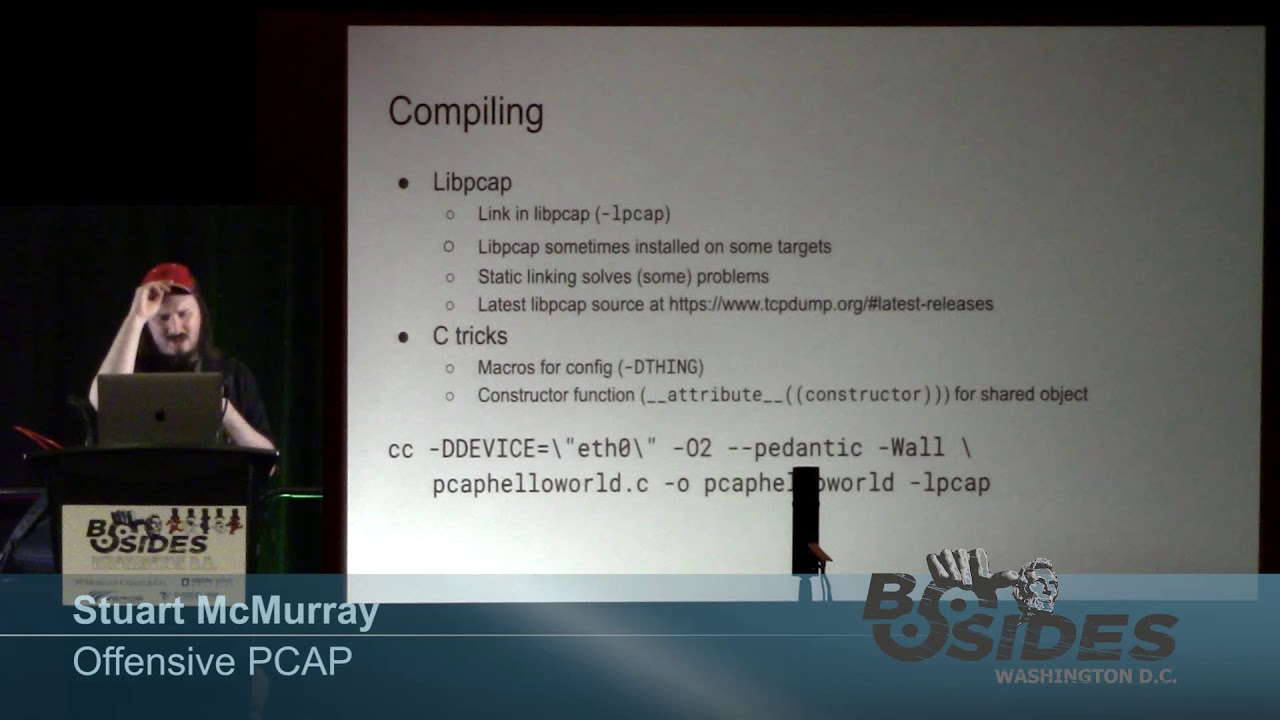
whole bunch of structs that you can just point memory to is like hey structure starts here and that's where your offsets are so it's really easy just to grab like to extract IP and this the IP checksum or something to grab it out of there alright so notionally we've written some code how do we actually use it compiling it in is pretty simple just link in lippy cap like you'd link in any other library it's alpi cap assuming your import paths in whatever are set up on debian systems Debian based systems you know apt-get P captive or Lippe empty or whatever sometimes installed in the target world as well so when you put a thing on target it's good to say hey
is this you know is this P cap actually on here just Attica lis link it solves those problems statically link pcap in your mind it's just a library that wraps an ApS system call pcap sources are a tcp dump org latest releases it's not a bad idea to grab the latest one so that you know that your pcap enabled application malware is using the version of the library you expect a couple of tricks and see that I've come up with compile-time config just use macros for that D thing D something D interface D device is a great way to set a device if you know what's on target but you don't want to have to do some sort of like
config file or like just guess at the right interface and it's also really handy to use a constructor function if you're having a shared object rubbing shared object in a memory constructor functions are great way just fork a couple throw spawn a couple threads and it will will save you a lot of pain all right so now we've built it notionally it's a couple ways we can run it standalone binary if we're going to run it as a program as a process you typically need route on Linux you need cap net raw on Windows depending on how the libraries installed interacts with n just you might need administrative you might not it's good idea to drop
privileges especially if you're taking a peek app or a BPF filter from a user because compiled bytecode is always a great place to find exploits and when you put it on target it's not a bad idea if it's a Linux UNIX target to run ldd on it and so you see if the libraries are actually there if it's not it'll say hey library missing or library wrong version or whatever else then you build a statically or bring your own whose LD preload for that sure if you're using it as an injectable library if you're shoving it into something whatever process is running needs access to whatever underlying mechanism pcap used for that target so if it's a if it's a
linux box you need that process to be able to make a packet socket which is not Universal pretty much anything that starts on boot will cron systemd assistant e is interesting to inject into but that works containers get kind of funny because of how they interact with interfaces so make sure you're not preferably not in a container environment or maybe if you're just sniffing that's fine too I found out when doing this if I either pre thread create or just fork and fork it solves a lot of problems still pretty hard to see if you inject into syslog and you have another syslog process and it was really gonna notice or if you have another thread we're just really
gonna notice if you're just like taking over a process it gets kind of funny if you're using LD l so preload to inject and you're doing something like catching a trigger packet here or you're sniffing something just like sniffing the wire turns out that loads into every process so like 600 callbacks later you're like oh hey maybe I should not do that LD preload can get you around that nicely alright so we'll have a do a quick demo we'll just send hello world as a layer three payload so like instead of IP we'll just have hello world and we'll send it to the broadcast interface what we'll do is we use a preprocessor macro to select the interface we're
going to use so we're not gonna have any runtime selecting it and this will all work in as a constructor function so we inject it the constructor function spawns a thread I think if I recall but there's no main function so it it's a little weird like that there's a source for the little demo and it's also online as an ASCII cast it looks like this so a pull pcap down unpack it compile it um this is unfortunately what happens when you build a peak app I found that just about every one of these I've looked into it's been okay but it's um it's not necessarily what you're hoping for so well Thomas source save it as P couple
Oh world and this is what it looks like so what we're gonna put on top of our Ethernet frame holo world we will hey go back we've defined device to the macro store in the pause in time and then this is how you roll a frame so we'll just you know make up a buffer I'm pretty large where you go here we make a buffer it's just enough size for an Ethernet header and our hello hello it says define macro sure we'll cast that rule point that a nice truck ether header so we don't have to figure out where to put in the the source and Mac desk MAC addresses let me do that I'm
just like that it's pretty easy we'll we'll set the ethertype to chaos just in case somebody is a list machine running around and copy copy in the hello so open the device pcap open live just like that that's 8 0 I think send it out with pcap inject and that's that's it notice that was in in it or in a constructor function main just returns so that way it's a nice little trick so you can use the same code as an injectable library and as a standalone binary yeah so we build it builds nicely it's there it's a shared object so we built it with no right where we shared object Larry's islamically link so we have to make sure
that Lipsy and whatever else are on target but we linked in statically pcap right there so it's a 50 way to not have to deal with entire static linking but you get your your library in there alternatively we can build it the hard old-school way is in the library there we go but still it pcap is there even though it's a shared object file just nifty way and we'll TCP dump in the background so we'll look for anything not IP because chaos or ipv6 and we put that in the background because tabs are hard with s kinema well not a little things there we go and we see that TCP dump says yes there is some strange ether type we have
a holo world out and that's injection in a network it's really quite simple shown into a library as well notice it it goes into the library it works but because we said it as a constructor function not in main more explained Eisley downside of course is it's you know a little easy to find if you're digging through memory maps so there we go well close the close that and so I can never happened cool that's the demo okay so that lets go out to these little demo you can put loads worlds on the wire you can make your blue team wonder what on earth you're up to I'm just couple of like actually useful things you can do with
it so number one sniff the wire I mentioned when I was I found that UNIX box the LDAP by the way I had like 16,000 different sets of creds off of that it was awesome which also meant the blue team when I was using them was like hey whatta just try them all was like what are you doing dude but anyways we'll just if the wire and and nowadays most things use encryption they say it turns out they don't actually turns out banks really like FTP to send transactions like batch transactions between each other I'm not SFTP not FTPS like just FTP FTP so if you're on a box where you can see this you either on an end point you can
see the end point coms and that's your FTP or something like it or you just found yourself on a router that's running sub friendly version of an OS that you can jump code in to see what your climbs so we'll have a very contrived scenario here one of things we're gonna do is we're going to narrowly filter one of those days we're gonna narrowly filter just to look for push packets so no sins no UDP nothing like that and that just keeps the resource consumption low especially if you're on some small routing device you don't really want to do that tools that do this already TCP dump indecent if are very old same with T shark very old and they you know you
can wrap it pretty simply to do most of this sometimes you want your own bespoke code will use this tool called telnet watcher it's online there's the source and just it watches the network actually I wrote it when I had to tell me that having pot going it was I wonder what these dudes are actually doing so I'll just watch telnet TCP dump will work in a pinch it's written for open BSD you can compile it for other things fairly easily but I've learned not to put malware straight use ibly on the internet because turns out it gets used SSH worms are really popular by the way just let you know so our little cookie
scenario here we've landed on a host its FD being matched financial transactions off and we've got root it looks a bit like this so we're some some transaction transfer box running an FTP D and we are lead hack sores we're on this box and there's some bank and SSH comes going be around there there we go so we're on target is root we'll just start this thing eating it whatever options in in real life you probably want most of these to either be defaults or baked in at compile time but we'll watch the port 21 we'll watch the interface vio 0 if we were making a BPF filter that's what it would look like we're not obviously
surco and we see somebody's already starting to come in so we see banker Joe and his neat password so that's already a win we've got a transaction we've seen him batching some transactions that's cool so that's that's neat we can also do something like this so we take we just happen to find that an ID RSA key we found it mount root so probably somebody doing something funny with NFS I will just exfil that we use a taillight watcher to catch it doing notionally on another box there we go we've wrapped it with a bunch of exes so we can grip it out pretty easily and now we have his SSH key ok that worked so a
little bit better grepping and we got a message he just just by watching the password line we've had to have been on the other server to do that of course so that's cool another thing you can do is socket list coms so if you do not for whatever reason want a socket there there is a socket of course there's the the packet socket which you can see in SS if you really ask for it nets that on the other hand you can't so I was at University of Wilmington helping there CCDC team I think we have Wilmington dudes there we go yeah I was hoping there see CDC team and they were like they figured out if they run net stat
peanut constantly they'll see anything with a network connection and the Box the target had like SSH and FTP or SSH and something like not a rat basically like hey if it's not SSH and whatever that thing was kill it I was like well okay so I need no socket with network comes that that works so what I came up with the idea was just I would use pcap to sniff the network and if I got a packet that looked interesting I would I'd use it so that's cool rare tool called peak at knock it's on the internet their source literally does just sniff the wire and look for something interesting it'll look for something that says command my command
to run in the word command or call back and address to call back to in the call back it's nice and ejectable run standalone it's cross-platform um it's not weapons-grade was talking to a fellow yesterday he's like hey man this tool of yours is really great except when I try to inject it into system D and then it crashes the box I'm like it's not weapons-grade but cool so we're gonna we're gonna say we already have the log server run compromised we've got root and we're going to try and get a call back based on what we can send the transaction transfer box so we're us we're gonna try and log into this box in such a way that this is log
D server will call us back so there's vio zero so we're on dot 42 and we'll ssh to dot 43 with this address with this username call me back to dock at forty two point four four four four and a bunch of things up here to just make less noise and we got a connection dot forty four which is not 43 which recesses HTML 42 so that's that log server this was the log log entry by the way we can see that were on there on there's route this is a little shell cane it is something that nobody is ever going to kill just in case and it's it's just shoved in as with peak a so you shove something in
there using pcap shoved into a system do you by the way to in it shown in doing it nobody'll notice there we go that's how we did it that's the only Westerner preload so and this is what it actually looked like on the wire there was a syslog message that said in Valor user callback that says log messages on the wire so pcap picked it up and used that to figure out what address to call back to another thing you can do bypass the firewall so I was fiddling around with this and I realized that pcap sits outside of the firewall on linux unix so if I use pcap to grab something I can skip over the firewall and inject
something into the network stack with the tap device I'll also work for the time device you just want to go for layer three cobalt strike does something pretty similar with its it does a forget the VPN thing SSH will do this also for you just a little more complicated if you actually want to weaponize this it's a pretty good first the pcap project is fairly simple so we'll have is the kernel talking receiving the network talking via lippy cap just some user land process which will shove data into the kernel over tap zero this also works OpenBSD it's pretty trivial to port to anything else but not much like random people grabbing stuff from beastie off
the internet so our scenario the same boxes we've been on ftp isn't working anymore for access we've got credit you since ssh but we still wanted like open up that ftp again by the way you end up doing you end up doing a lot of filtering fiddling with BPF filters and if config when you do this this is what it looks like we have the network out here it'll send data to the NIC normally the firewall would drop it and say no this isn't something we want you know we don't want FTP anymore but the NIC sends to the process bypassed fw the tcp dump or flippy cap using process which i'll send it then
into its virtual nic into a kernel so it's I'm just left II way to hop around a firewall looks like this so FTP no longer works for us we can't we can't grab it C password we can still SSH in though so we'll do Thank You Joel Edison same transaction transfer box and we see that sure enough we have a block drop in a default block and just a pin hole punched for 22 that's a problem for us so what we'll do we'll just put bypass f/w on the box because we can still ssh and get back on the box you should know the MAC address so this is a 6 for FC is the MAC address
for this the interface that we're going to mooch from and bypass happen or the firewall with there we go so we've make a tap device and we'll give it the same MAC address because the kernel expects things coming from the interface for the MAC address if you're gonna give it to it with a MAC address sure there we go they look pretty similar different IP address but pretty similar and we'll run it and say anything coming in to any any our packet we'd like anything coming in to 1.2 54 so we've sort of functionally now have tap 0 on the network with the address 254 also another good address because people like yeah it's probably
something with network dudes using we'll just ignore that oh no we tried 254 and sure enough it works we get it C password down and hopped over firewalls easily with that last last demo is EDR D thing I was writing these was like hey these are all great they all work on UNIX most of them work on Linux which is what you'll find everywhere I was like what about Windows what if what if I try to write pcap code for Windows and the answer is don't do that it's not a kind thing to do so but it was like what does Windows give me that's kind of neat and needed hack eration turns out they have a nice API
to drop a tcp state from the state table so you can say yeah I know we're doing TCP comes just forget about it not like send a reset not send a fin it's just like it doesn't exist anymore so I was like hey if I can't just send to something I don't want somebody talking to I could tell windows to ignore it because it'll make a state I'm just like hey no nevermind we're not doing this it's like what what is worth dropping and edr is worth dropping so EDR usually nowadays has to call it to some see to management's using server that's these things it's like yeah I can get a shell on your box dude admin stuff and I can
transfer files and like potestas H that's a rat what are you doing dudes but anyways someone catches sin and as soon as we see it from some defined range that we know the EDR uses or the other way around like we only want this box as the bad guys to be able to talk to us you make your users kind of mad like don't do this if you don't have to but it works so we get a sim a drop a syn/ack the box like I'd have no record of this connection and reset TCP kill is pretty similar except it forges a bunch of resets because back back then Windows or excuse me Linux did
not have a an API for this so we're going to watch pockets matching the filter a BPF filter set TCP entry the only thing set TCP entry does in typical Windows fashion is it drops TCP entries so are this for Windows if you're reading my windows code I I would like to apologize for the lack of Windows II things I use I use functions like open and printf this is probably something you want to incorporate is it another tool we probably don't want to write yeah just a standalone tool but it works so in this in this scenario we'll pretend we found a Windows box after hours we don't really know where the management servers are but what we want
to do is just wipe the box sort of a corny Sony ish thing source for the EGR sniper the P campus tool and the source for the wiper wiper is actually like don't put it somewhere you don't expect to wipe but it's a nifty little way to say hey you're like super leet a guy M lav that detects things before they run doesn't one thing made about Windows though is pcap sits inside the firewall so you have the NIC and it sends data first it gets firewalled and then through end this the the driver layer it'll go to your pcap process so it's not it's not quite as nice and friendly you can't do it do so many crazy things
on Windows but that's what you got so there is no s Kinema for this just some screenshots this is what you know I started wiping started deleting things I understand that you should not be deleting all these things on Windows I've been told and the seven address here is gents in the back can you see that didn't when the ladies in the back is that new is going to be interesting
hey it didn't work well that's cool I apologize to people in the back you have to take my word for it that this address is and I grade it out but it's the address of the servers for whatever I just googled like best free malware if necessary anti-malware 2019 or something put it on the box and that that was in fact their address and if that's trying to get out meanwhile we're losing loads and loads of data I've also been told that things in C Windows he shouldn't really remove from a Windows box and I tried and and the AV was like hey hey C to server or AV server can I can I let
this happen and the server didn't say anything so sure why not I'm also told that like C Windows System 2 I and I is not something you're supposed to remove windows side up like it worked and then and then Microsoft like Windows itself started calling out to Microsoft addresses and I was like maybe we don't do that so that happened okay so it's summer if you're gonna if you can use pcap and I recommend it and it's a neat thing to learn just how networking and how things work under the hood with a little bit of abstraction layer I got to attach to a device so either pcap open live or pcap create set and activate it's usually good to setup
BPF filter you don't necessarily have to but if you're gonna do it compile the filter set the filter and free the memory depending on what you're doing it's usually good to grab the data link type and then sniffing inject off you go I'm not going to read this but it's good reference for how you can compile it likewise reference for how you would have acute it couple ideas so it's like hey what but you know if I if I had an intern what would I say hey intern here's a cool thing to learn pcap so a VPN device like we showed in the couple demos ago take your favorite rat a ter sniper and it doesn't it's not
necessarily a see specific thing so if using one of the nifty go frameworks nowadays added in their weaponize pcap NOC maybe add some encryption add some authentication at some replay protection port scanner it'd be kind of cool an injectable port scanner may be using a different source address so that you have you know you own another box and that's where you're getting the syntax or something like that we kind of cool to get your shell output or X whatever over syn packets or ICMP or whatnot all right so thank you for coming any questions none that by the way is another legit QR code is that a hand or was that a nope that was a
scratching of the neck all right well no questions thanks for coming [Applause]
Related talks
 35:42
35:42 44:07
44:07 47:21
47:21 32:19
32:19 21:49
21:49 31:31
31:31