Know Your Value: Salary Negotiation and Career Worth
Show transcript [en]
foreign
[Music] all right awesome so the video is played right and are we good to start awesome well thank you and I guess for those who were able to watch the video think about this situation what would you advise my niece should she accept should she negotiate or should she reject the opportunity I love audience participation so please please it put your answer in the chat boxes I'd love to hear uh your response of what you would uh advise my niece and I can tell you one quick thing is that from this lenses you're watching I'm sure all of you will agree that it's so easy to advise but think about your situation when you've been in her shoes
and how many times have you negotiated the offer and for those who did negotiate please in the comments write and chat and what was the outcome when you did make the ask or negotiate Jambo Namaste konichiwa bonjour and greetings to everyone no matter where you are in this world today I'm in beautiful Whistler I love this conference because you can do it it's a hybrid some of you are there some of you are remote it's fantastic huge shout out to James and all the volunteers at besides Calgary for doing a phenomenal job thank you [Music] thank you to you as the audience for joining us at besides Calgary as we cover an important topic don't settle
for less know your value today with uncertainty in the economy I've seen so many individuals get impacted and it's heartbreaking to read all about the layoffs I see on LinkedIn I see all these updates and to add on top of all that inflation is rising things are getting expensive just the other day I failed a full gas of tank before it was eighty dollars today is hundred and twenty dollars it's a pinch and with uncertainty one thing for sure is be prepared for change and whether you've recently been laid off or if you're considering changing jobs or even if you're staying with your existing organization learning how to position your worth is important and through our talk our hope is that by the
end of this session you'll be able to apply some of the learnings to your journey because together we can close the gap and as we share our viewpoints please note that what we share today is our personal viewpoints and not of our employer so let's start off with introductions sheriff and I uh we've known each other for quite a few years it's been such a pleasure uh getting to know her and be part of your journey Sheriff had in Canada and so I'll hand this over to you to do a quick introduction of yourself great thank you RT um first of all I'd like to confirm from the audience because they're super quiet can you hear us
no audio okay all right can you hear us now can you hear me did you hear hearty yeah that's the real good um no no audio I'm getting perfect toward you someone said I'm getting no no RT yes um so we're getting no audio some can hear uh hopefully I hope you can hear us okay I can hear moderator and RT both okay great so I guess we go I thank you Artie for having me it's my pleasure to be here my name is sharifat they said they could hear our tea but they could hear me but not Arty um testing again can everybody hear me or no
see um can you will you be able to join through the to the event link through the event link yeah we are airing two times through the stream link I have joined through there oh we're done a minute I'm just going to oops
tracking the chat [Music]
[Music]
[Music] and I'm just checking the fact [Music] are we still there
love technology when it works but don't love it when it doesn't work [Music]
okay you're back I can see you I can hear you what about the audience can you hear and can you see us I don't know I'm just gonna try to present the slides quickly I'm gonna go back to this session can you see the slides yes okay great hopefully it's better now can you go to the session and and see if they can hear us okay let me go back to the session
can you see the slides yes yes okay so it looks like people can hear us okay great so I guess we'll carry on um you need to mute the others the session that's it yeah just to transform everything all right um well be great to see the chats to know if they can hear us because there's been lots of audio issues but yeah thanks artsy for having me my name is sharifat and I'm happy to be presenting with my very good friend Artie we've met a few years ago and it's been an amazing time um when Atty reached out to me to say hey come let's talk about this I'm like yes definitely because even for me this
is a problem right sometimes you sell yourself short sometimes you you don't know you just don't know especially because there's so much around conversation around salaries you don't really know when to get the best value for what you're worth so I'm really happy to be here I'm hoping the audience can hear us and we have a fantastic time today awesome thank you yes I'm going to be monitoring the chat as well at the same time so hopefully everyone can still hear us um and if not just keep typing in the chat uh so a little bit about me and uh about my Safari my network knows me as a change maker and my purpose is to be a
voice and I've dedicated my entire career to break down barriers and boundaries for underrepresented groups in stem and in leadership and I've done this through several different channels one of them being stand out to lead she sharing her empowerment and it's just been amazing to see the impact that has led to a positive impact all these initiatives is uh creating change I was also honored for my contribution in the cyber security industry by being named as one of Canada's top 20 women in cyber security and this inspired me to write a book The Rise of the Cyber women volume 2. I served in four boards as an advisor right now for observe ID I also
volunteer for OAS Vancouver chapter for Oasis western Canada affiliate and a new initiative which is the women in security documentary celebrating Amazing Stories and moments of women and allies in security and outside of work I enjoy cooking I enjoy writing my motorcycle in fact just yesterday in Whistler I think my parents were probably the oldest couple that did an ATV with me so it was fantastic having experience that Journey with them so that's a little bit about me Sheriff would you like to add anything about yourself because you've also been Canada's top 20 in cyber security so go for it absolutely thanks Etsy so here I am I'm a business information security officer with TD and
like Katie said this year was nominated and awarded as one of the top 20 women in cyber security in Canada I'm grateful for that opportunity it's been fantastic experience that people actually recognize all of the work you're doing and to see what you're doing to support cyber security and remain in general um my daily life is I work with TD Bank as a Visa like I mentioned I live in Calgary I was supposed to be in person today but I didn't want to be alone on the stage when I have rt online so I decided to stay online and do the do the presentation and I just figured out it will work better if I was online I have
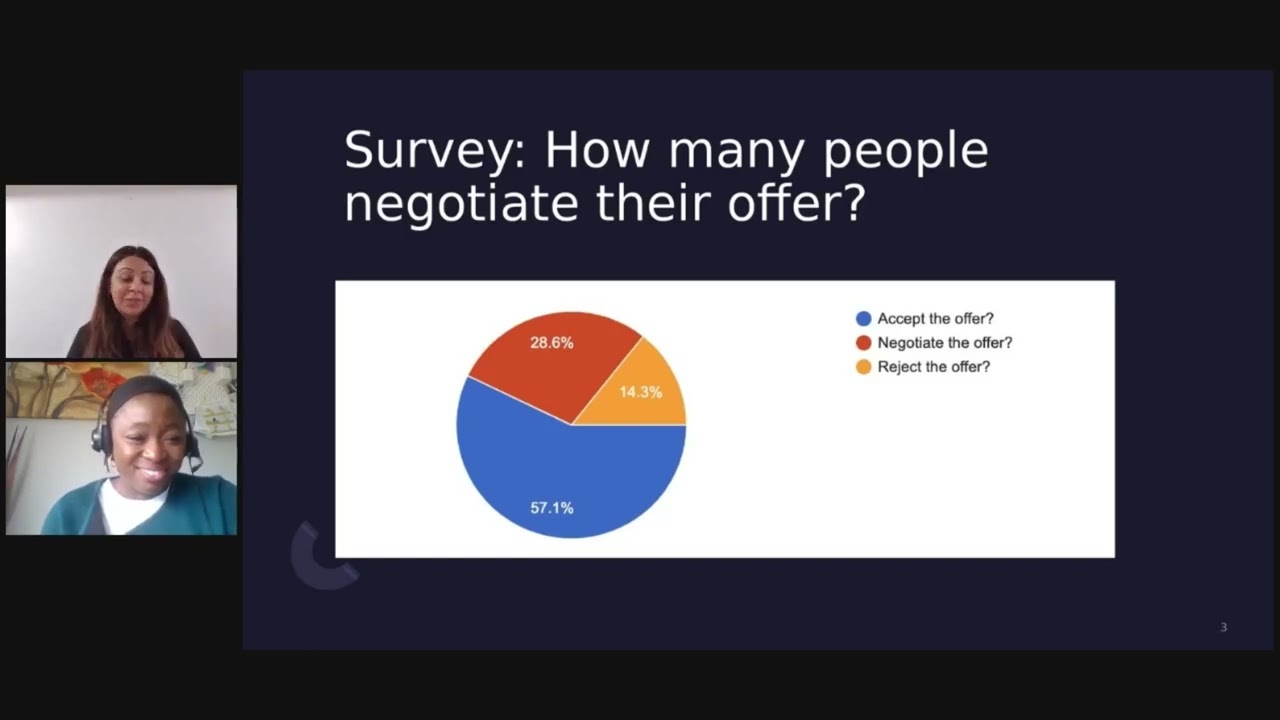
three children and I love cooking as well like Artie I think cooking is actually therapeutic for me I love cooking strange right but I love to cook I love to travel I love to meet people I love to discuss and engage people in different ways I'm happy to be here great awesome thanks haircut for those who are able to see the video at the start hopefully it did play um but basically the video was my niece I was offering a job to my niece and as I mentioned earlier on is everyone will agree that it's obvious to advise her to a negotiate um so I was actually very curious I actually sent out a survey to my network
just to see how many people chose that option to negotiate their existing job and as you can see here uh in this Statistics only 30 percent negotiated and I will tell you 20 years ago I myself was actually in that category I was in that 60 category and I did not make the ask it's because I felt I needed the job more than the company needed me I didn't know my value and I was going through and as I was going through my own Safari I began to do a bit more research to see am I the only one here who is on my own and didn't negotiate or are they others who are like me and I received several
answers and I'll summarize it into these four categories which I think will resonate to many of you as I share this but please in the chat I'd like to see audience uh participation um so please keep the chat going the first one is I heard when I was asking individuals why they didn't negotiate and the first one was fear fear of what the employer will think is that reputation your reputation risk of um you know when you're being offered in fact I know here for a fact for those I've had conversations with some of them who have been impacted by the layoffs one of them uh came back and said well it's harder uh when you've been laid off
because you fear that they'll offer the world to somebody else rather than you if you try to negotiate so that fear comes at very various different forms for some it's like I've just graduated and I don't have another alternative so there's fear I'll take whatever I've got first the second reason is imposter syndrome I've heard at many conferences and I'm glad to see that many individuals are starting to talk more openly about imposter syndrome and many of us at some point in our career have experienced this um and then the third reason I heard from individuals who were like me that didn't negotiate was the assumptions and it's the assumptions that you feel that you need to prove to the company
first before you can make the ask I've heard from individuals sharing how organizations have that culture where even after you've proved your worth you could be in a situation where you'll need to aim for the sky before you're even supported to make the ask so there's always these assumptions that you have to prove first before you can make me ask and then lastly I've heard from so many who have shared that I just didn't think about it I didn't think about asking it I didn't know what my value is um I don't know what my worth is I want conversations from a few individuals who shared that Sheriff up from your journey have you had any of these objections applied to
you um when you've been offered and may not have negotiated yes um definitely I know for almost every time that you know if I had a position I've had to go through everything you described so it starts with even though I wasn't maybe I didn't lose a job or I wasn't asked to go I have these Alpha at hand but everything is running through my mind so I'm thinking should I accept it is it good enough should I ask for more if I ask for more are they going to go to the next candidate so all of this happens in my mind and takes a conscious effort to say well you got it because you're worried
ask for more if you want more so definitely I have gone through this um in the past and recently as well and it took that conscious effort talking to people and actually making a decision from an informed point of view for me to go ahead and ask for what I really wanted absolutely and exactly sure if that even for me I can sort of relate to the one which was the assumptions I've always been a top performer and when I was new in this country coming from the UK I just assume that performance would automatically get me that pay rise every year over year over year and I remember actually this was many years back and I
questioned my employer um and I did actually make the ask because I assumed enough it wasn't happening so I made the ask and for me it was decline so please audience do share some of your experiences that I would love to hear now one thing as it when I did make the ask it was declined and I know as I reflect back as I fast forward you know 20 years plus when I reflect on this I realize I was not prepared for that meeting and how to position my value Sheriff you brought that a little bit earlier on when you mentioned that and in that scenario it led me and I do remember this clearly during that
scenario when it was declined it actually led me to consider another offer from the competition and I actually left and that's when I was offered what I asked for but unfortunately you know within the existing organization it was too late because I did make the ask and this is what can happen over time as the employees can can leave but on that side you know it's both sides I look at myself I was not prepared when I made that ask back then and we've all seen research in statistics right there's always inequality in pay and the Gap gets even wider for you know women women of color um for lgbtq and of course all other
underrepresented groups and one thing I'd like to share is change is taking place which is great but we need everyone involved in order to accelerate it um otherwise you know if we don't have everyone's commitment it just won't happen so we're going to address some of these obstacles that we talked about through the five W's which is why who where when and what and as you can see on the side there is this great statement I love this statement and every time I bring it back you know every other month I just bring it back just to re reflect and realize and it's that when you start seeing your worth you find it harder to stay around
people who don't and it's so true so let's start off with why and the impact knowing your value can have Sheriff let's start off with what are your thoughts on on the first one which is why yeah absolutely is is important for for the very first reason that you need to have the knowledge of what you want what you what you're worth if you want to ask for more then you need to know your value right you need to know how much are you worth if you do not have a baseline for the discussion like you indicated at in your case for that offer in which you eventually left you would not be able to
ask for what you want if you do not know your value then you can't you can't you can't negotiate you can ask yourself whatever comes to you you don't even know if you're you're getting the best or you're getting what is not what for you and it's it's it's it's it's very important and it's actually the first step you know your value and whatever you ask for if they are able to meet that then yes it's worth it if you're able to do more than what you've asked for then all good for you as well yeah what do you think Katie about why it's very important to know your value yeah when you're just about your value or your self-worth
one big thing that I advise uh you know individuals is not just about your strengths it's about believing in yourself as well understanding your purpose and how work plays uh a role towards your personal values that are important to you the big thing is it's very important in believing in yourself for it because trust me you will notice along your journey Society May weigh you down people will sometimes value you value you less than what you really are it is human nature and we need to challenge that I actually went for a leadership training uh a few years back and this was in Boston and it was a self-assessment and I can tell you through my own experience it was a
self-assessment for me and please audience and share this as well what your response is right if you've experienced that self-assessment where you have to rate yourself I can tell you I rated myself lower because that's what I was led to believe so please share share if any of you have had that self-assessment and if you've also uh rated yourself lower and one thing is when you know your self-worth and your value you can actually address all those obstacles fear um imposter syndrome uh assumptions and it will make it easier to make the ask and even though if we look at this everyone has a different approach we see things through a different lens right the one thing that sheriff as you
mentioned is making that ask but always remember one thing is when you are off of that position for example you always have to remember that they have offered you that role because of what you're bringing to the organization and therefore just keep thinking believing in yourself there's also another example I'll talk about uh which is an article um a very interesting article is um it was from news and they explained it really well there was two candidates basically uh one individual who um I mean both individuals were offered hundred thousand and one individual had asked for seven percent more and it was granted now let's assume uh between both individuals the same Rises the same
promotions are applied if you fast forward that and start calculating over a 35 year period the individual that started a hundred thousand would have had to work for eight more years to match individual two eight more years I know I've experienced in my own self when I was new in this country I just took whatever I could because I needed a job right I started off at a very low level it took me so many years to finally get uh to where I should be so this is just something it's a really interesting article it just gets you to reflect when I read that I was like oh my gosh yes that's true just looking at
that um in my scenario definitely more at least a minimum of two more years of income I would have had by now uh if I had started off at a higher rate yeah you know as we were talking about the RT I think we should explain it a bit small for people to to get it so whatever you start off with as your base your increase is a percentage of your base your bonuses is a percentage of your base so look at that person you know if I said to five year period that person would have to walk eight more years eight more years to catch up with their peer just because they didn't ask for
more and do you know that companies even expect you to ask for more a lot of companies expect you to ask for more so knowing your value is important it's important for you to get the best for you and I also want to look at it from an angle of also understanding what is it that you need to do to go to the next level what do I mean by that so you have done your research you've done your self-assessment you see where you are and you see the kind of opportunities in which you want to go for trying to understand your value can actually help you to see the difference and what you need
to do to get to your next level so really knowing your value will also help in helping you grow and helping you get to that very next level I think we should go to the next one so who is responsible to correct the paga I love this question yes um we are all responsible whether you're an employee or an employer in my opinion it's we're all responsible now we shouldn't wait for legislation to happen or I've heard statements it's not my responsibility whether you're a hiring manager and if I mean if for those who are hiring managers put it that way if you see an unfair advantage in your team's pay be a voice as you are in a
position to make that change if you're an employee you need to make that ask the sheriff that has mentioned several times make that ask but remember when you are making that ask do it in a way that matters and we're going to share a few tips I did see a question from Rebecca in the audience uh when we reached to where some resources that we're going to share we'll definitely share a few tips as well now I recently had a conversation uh back to who's responsible even your peers your colleagues your friends I had this conversation just literally two three weeks ago and I'd worked with him about 12 years ago and I was in the
process of accepting an offer and he happened to be working at that organization and so I connected with him after several years and I wanted to know a little bit more about the organization organization's culture and when we connected the first thing he said was thank you and I was like I was puzzled why is he saying thank you and he's I didn't realize this but from 12 years ago he actually remembered the full conversation we had and at that time he had opened up where he was uh within his own um you know like what he earned and at that time I felt uh as a peer I felt that based on his level of experience he
was less than industry standards so I shared a couple of pointers over to him and he actually remembered that at advice 12 years uh later he still remembers that till today so I was pleased to have had that conversation with him because he did say to me is that conversation helped him internally as well as within his own career growth so it was a positive result for him so you know what all of us are responsible Sheriff what about you any any of your thoughts and examples yeah and I agree with you everyone is responsible for this as an IRA manager yes definitely you have you know what the budget is you know what the company can afford to pay
you want the best candidate you have interviewed this candidate you've seen that this candidate is able to deliver the value you go for it and offer them what you're worth but right so that is from the hiring manager point of view from the organizations for interview your policies your processes should support offering the best value that you can afford as an organization to your candidate you want the best candidate to work for you then you offer them the best sets I know most organizations have minimum and maximum ranges yeah so make sure the minimum range is competitive enough and attractive enough to the candidate but ultimately the responsibility I would like to say really depends on the candidate
you're the one asking for this you're the one who you understand your demands you understand your worth if you have done that first step that we talk about knowing your value you know your value you know where you're bringing to the table you know the value you're going to hide if the organization fails to recognize that if the IRA manager fails to recognize that then you take it ultimately into your own hands and take responsibility to correct that pager because it has a way of going in a loop once you start off with that um compensation that is below your value it comes away it has a way of just going in cycle you keep going in that scene
and it's quite difficult to break away if you do not take conscious effort to break away from me and actually go back to re-evaluate understand the value in which you work and then begin to ask for more so I'll leave it with all everyone like you've said but ultimately you are the candidate you know what you want you know how much you've invested into gaining that experience how much you have invested into becoming who you are then you ask for more and you know at the end of the day what's gonna happen it's either yes or a new right no we can't offer you this is what we can offer or yes yes we can afford it so you have nothing to
lose to be honest I totally agree on that um you've got to make that ask and I do want to add one more thing is is that uh you know for me just within organizations I've been a voice for transparency within organizations and the companies have mentioned that they've fixed a pay Gap I see a lot of things on LinkedIn I hear from a lot of individuals but just for for those who are organizations that are mentioning that just make sure you're backing that with data to share to your employees don't just make that bold statement do have that data to back it up and there are some few companies out there who have begun sharing data but of course I'd
like to encourage more and more organizations to be more transparent uh in that uh in the on that process versus waiting for legislation because I know some states in the US have started beginning uh you know providing that information as part of a job description so let's move to the next topic uh Sheriff at uh which is when to negotiate when you think uh it's good to negotiate in two parts to that maybe we start off with when to negotiate and then we move to when to turn down the offer absolutely so when do you negotiate um I think at the very beginning you got a call from a recruiter or a hiring manager they're interested in you
and for them to have reached out they see that yes you may qualify for this role or you're eligible you can fit into the organization they've looked at all of that there's nothing bad intraining up the question to say hey how much is this worth and that helps you and saves you the headache of going through the whole process and leaving the negotiation till the last so you can ask this is you know how much uh what was the conversation like what what does this rule offer me in terms of compensation and they'll give you an idea usually they start off with a range oh it's it's this between this and this it also depends your experience and blah blah
blah and at that point you can begin to okay something I would consider or this is not for me but you can only make that decision if you have understood your value if you do not know your value then anything that has been offered to you will seem as attractive and then you will consider it so I'll say at the very beginning or it can also happen at any time there's a three to this though RT and this this is from a personal experience of someone that shared with me so she started off video with this interview and she had initially given it what she wanted like and they were happy with that but she continued with the process and at
about when they were trying to offer her they offered us something which met our expectation but she did a research a little bit later and found out that she could actually ask for more what do you think could she have gone back to us for more you know it's an interesting conversation right and it's back to exactly to your point right is if you fail to prepare it and prepare to fail right so when in that situation she started off asking for what she asked for and that's what she was prepared for and she was prepared to accept that so then as the employer has given them given her realizing it's less I mean there's two parts to that right some
good leaders very few good leaders will actually say actually and this this happened to my sister-in-law uh she actually didn't value herself like where she should be and she was offered you know if she was asked which role would you think you would fit in and she said a level one and the leader actually said actually I don't feel after the interview you're at that level one and corrected her and so she was hired at a level three so you can see the difference right from a leadership perspective that corrected it for that individual who didn't but to your point I mean if if that's what that individual asked for that then and they got it and
they weren't prepared now going back and asking for more it it's too late interesting so what's your what's your thought about when to negotiate yes okay so um I love this question because I'm in sales and you know the funny part about being in sales even when I'm speaking to csos like yourself uh first in the first 30 minutes they asked me what's the price for the solution I'm like I haven't told you the value yet okay and I've always asked question right and a good thing you know sure but I love what you said right is it's a great time you know just like how customers are constantly asking me in that very first
um meeting even though I haven't shared anything about the product it's the same concept right it's always try and ask that question or you know I love how you phrased it sure if that is just you know what are the salary expectations you know by you asking that first right um and you know or if they ask you usually a recruiter will ask you first right at some point they'll try and figure out do you fit in line with what their expectations are right and is this a budgeted position right uh pretty much just turn around turn that question back to them and just say hey I really appreciate your question what's important to me is transparency within
the organization that I'd like to hear from you what is budgeted for that range and exactly to your point so I think every single one of the conversations you tend to have in an interview process you're always negotiating you're always negotiating um and I can so relate to um the scenario that you provided share effect but there was another one whereby if we look at when to turn down an offer right which is for me I've been in that situation many times where I have turned on offers and for me it's if the company does not align with my personal values no matter how attractive the offer is I will turn it down and this is something that you
will know during the interview and I remember a few years ago Sheriff Haddon this this is like you know something it was an unbelievable offer it was a fantastic offer like a lot more than where I was and of course it was attractive but I remember I was in California and um the in I guess a very senior executive of that organization I was going to meet them uh they had a pa uh who I could see when they came out of the room where he was doing this because I was there on time just up there just a few a few not even a few minutes late but I was right there on time but I could see the conversation
and hear actually the conversation he had with his PA I didn't like what I saw because you know you need to treat your employees and and when I see that that wasn't the right thing that was done I said that was a clear indication of what the culture is because it gave me what the view was from a leadership perspective um and that's where you know when I flew back I said I called the hiring uh recruiter and I said you know what thank you for this opportunity but um this is not something that aligns with my values and that's kind of where I turned it down what about you Sheriff yeah and absolutely spot on um there are
a couple of things I look at culture is one and it's important that you say that for us to be so observant to see how people treat other people right it's just like when you're dating you're dating someone and you go to a nice restaurant and it's treating you all nice and straighten the waiters and every other person like trash you know that you're not a good person so it's very similar to that yeah you but I also want to call out um that there are other things Beyond conversation that determines when to you know like you said the culture is one your what Your value is one as well for me it's very important for me to to work
for more um to be removed Walker because I have little children well not so little but they still need me to to perform up it's not easy being a full-time working mom you know in Canada or in the U.S or any of the advanced countries back home you get a lot of help you get everyone to help you but here you have to do most things yourself so that's very important to me and I found myself toning down a couple of offers because yeah it wasn't a work for me and that had nothing to do with the composition so annoying part of knowing your value is not only understanding your monetary values for all the other
things that are important to you do you want more vacation days are benefits important to you um is work flexibility important to you culture all of those things are important and once you know that it will be screaming to you when you know this offer is not right for you just like your case um Arty when you saw that person treats it's PA that way you said no I don't want to work with such a person and you move down great sorry I guess we'll move on to resources because of time yes yes and I totally agree with you uh just to add on to that part is it's not just only about pay right it's all about the other
pieces I was literally in in the process of negotiating an offer and with everything going on in my personal life I needed uh more time before I go back into the uh go back and work and what was uh great about the organization I accepted the offer was I said I need two months before I joined and they were um happy in my career when I see that level of flexibility what you're asking for um there's so many other things other than pay more stock options more vacation time like you said so many things that you you can ask for yeah yeah so you mentioned uh the next one is where to find resources um okay so this is a good one
um I've used Glassdoor there's a lot of information in there that has helped me quite a lot I've even just Googled in general I see lots of comments people have shared things anonymously I also saw some recent statistics from and this is on LinkedIn rep view that you know for me for those who are in sales and they've got some interesting statistics that has provided a lot of transparency and disclosing the information or pay information another one that I reached out to is my mentors for those who have mentors um you know reach out to your mentors and just have those conversations because they've also helped uh play a role in on for me understanding my value
um from where I was before to where I S you know over the years I've been working with mentors and they've helped me along the way um what else I'm just trying to think just just try and look at uh you know companies of similar sizes you'll be able to try and see information when you're going through interviews you will kind of know if you're interviewing with a competition or a couple of companies who are in a similar industry you're kind of through conversations from recruiters you have those kind of conversations and just know back to what Sheriff had mentioned about you know knowing uh what's important to you is even just knowing how some organizations operate like for
example smaller organizations in my field they'll offer a lower base rate but a higher compensation variable whereas large organizations will high will offer higher base rate versus a lower and a lower compensation compensation rate that's basically how it is in the industry so just knowing a bit more about the market doing your research Google is my best friend there's so much information Nation out there what about you Sheriff that what resources have yeah I agree yeah I really agree with that in addition to all of those sources that are available on Google and talking to your main so I realized that talking to people that you trust also helps so if you're just in doubt you've checked
um all of the publicly available resources but you need a bit more confirmation something closer to home you can actually look out for someone in the company which you can reach out to um and hacks you know I'm not asking for specifics I just need an idea what you this is this is what um I'm considering to ask for do you think this is within the range of what they do do they will offer and I've tried that before um about last year I was being interviewed for for a role with a company and before I joined CD and you know I was gonna ask for a particular amount I ended up not going with that company but it wasn't because
of compensation though it was related to work from home and I reached out to someone who was working there to say hey this is what is happening this is a mountain being offered what do you think and she gave me insight to say oh I think this is this will fly this wouldn't fly this will go and this wouldn't go and that really helped so this brings me to the importance of networking who is in your network who can you reach out to to talk to and ask about these crucial questions because compensation pay discussions are so Hush Hush the people do not want to talk about it you need someone you can trust that you can
be open to you know and they can also be open with you and talk to you about and really help you with that because you don't want to accept an offer and you get into the company and you see what is happening and you certainly become demotivated because at the end of the day once you're in the system you get to see more you want to be happy joining the company you don't want to run away after a few months because of composition got so I I in addition to those resources you've shared Glassdoor is fantastic LinkedIn is fantastic a cocktail of roles I've seen in the U.S I see they actually put the pay range in it it's
not very common in Canada I at least see uh pay pay ranges in in job ads in Canada and so you can also reach out to a trusted person in your in your network or in your cycle yeah I see on the chat uh great comments there um on the explanation there about uh when um you found yourself being the lowest paid in a team right and the important lesson there was um in terms of negotiations right so yes um keep keep the chat coming definitely keep it's it's such an important uh skill definitely and it's it's as simple as just making that ask great um and Sheriff I love what you said it's just ask ask your peers because I don't
know why it's so hush-hush yeah like wherever you sign it's very confidential right yeah and we need to start changing the uh culture and the environment so that there's more transparency because companies are saying we're transparent and we're we fix the pay Gap so bring that transparency and share that right yeah so I guess uh let's move to the last part which is uh summarizing and uh tips like what you can apply to you know three or four simple tips on negotiation strategies and tactics sure fat what are your what are your top tips yeah so first of all I'll say when you're going to ask for more sell yourself so let the your recruiter whether you're
talking whether you're in negotiation with let them know the value you're bringing let them know this is the reason I'm asking for more this is what I'm going to do this is what I've done this is what I'm capable of and that will help you make that this discussion or negotiation go much more easier than going to say a I need this because I just want this you know uh so that that's one for me um the very first one is sell yourself make it clear this is why you you you you you want this this is what you deserve and this is this is these are the reasons why you want this um another one is of course do your
research go with facts and figures know what you're going for and you know you once you've done your research you know what the cap company or what the organization is capable of paying and then go with those and and that will help you with that discussion yeah what what are your thoughts auntie uh yes first one I would say is be Fearless um and make that ask it's hard but trust me once you start it becomes easier and easier and easier so be Fearless it's kind of like as I bring you know for those who got to see the video with my niece the example I give is uh when she asks her parents she wants a suite
um even though she knows that she's not supposed to ask until she finishes her homework for example but she's fearless she'll still ask right so have that in you is have that Fearless peace in you because guess what in my niece's case the parents what are they going to say no but I'll tell you sometimes I've seen the parents say okay go for it right and she's fearless and I sit and I'm like oh my gosh I can't believe you just ask after they just you know said something to her and she's grounded and she still asks for that amazing we need to bring that back in ourselves right um and you know as as uh SharePoint we
brought that example just always ask when they've given you an offer for example if you if you didn't get around um you know asking them what the budget range is and they give you um the offer simple ask is is this negotiable right um and I will tell you in my career 95 right will say yes it is negotiable right and exactly I'm sure I think you mentioned this earlier they've got a low range and a top range recruiters always start off with the low range I don't know why but they'll always start over the world range because they're expecting that they'll have to negotiate so ask them right it's just negotiable and many of them 95 in my case have said
yes and then this leads me to tip number two which is as I mentioned earlier on is you if you fail to prepare prepare to fail so I agree Sheriff up with your tip as well is do your homework and find out the right information there's lots of information from your peers also from your colleagues from your mentors get that information in advance and prepare and align it with your values that's really important you've reached that stage where you have the right to bring your feedback to ask right but make sure you ask in a way that matters right and remember in fact I just had a recent conversation with someone was informing me and it totally aligns with what I've
been saying in many talks right it's what you're bringing to the organization it's no longer about is this this individual wants to share it to me and so it's not about is this person a fit for the company it's what they're bringing to the organization that's why we're hiring them right so keep remembering that tip and I agree sheriff is that Network building your network is important I've done talks on how to build your network and how to build your brand a lot of times what I've learned from me personally is that my network and my brand has actually helped you know even position me at a certain level and that's actually just even off the bat
just helped me in conversations where recruiters are actually not going through that low level range um or starting to talk to me about low level ranges because they've seen through my network or heard through my network or through my personal brand and they're coming with you know like they're starting off with a much higher level than that low level and then my only last one which I mentioned at the very beginning was be authentic be yourself and believe in yourself right and when you believe in yourself you'll know your value and this can help with fear and imposter syndrome so believe in yourself so those are my tips Sheriff about anything else you'd like to add yeah I would like to add
some of the things you shouldn't do right so we've talked about all of those things you shouldn't do so like we said I hope you heard us clearly don't accept the first offer he feels ask for more don't accept the first offer because your employers is expecting you to negotiate just just ask for more if you really want to work with the company you know ask someone if they say no then you you go ahead and say yes that's the best they can offer and also know when to end the negotiation like don't let it go too long like it's not a should I see it's another piece of bread and the shop floor and you're
negotiating it's something important once you know your watch you know when to bring the negotiation to a close so it doesn't go too long and you know people's time and I'll be wasted um going back and forth know when to to to bring it to a closure in a nice and polite manner not threatening to to oh I'm I'm gonna decline or you don't need to be um pump parts or being overconfident you stating the facts clearly with facts and figures and of course with information of how much value you're going to bring to the organization if they insist on not appreciating the value then it's it's so be it you bring it to a natural close so
I'm just gonna add those two as to where some of some of the things you shouldn't do don't drag it too long and don't accept the first offer thank you I totally agree with that I love those two don't do's and totally agree with those yeah so I guess maybe sure if you want to uh do some closing comments and then we open questions any any questions let's look at this uh but before we move into questions a huge thank you to the audience that love your participation love all your questions uh in there in your comments so thank you for sharing and of course to besides all the volunteers um everyone behind the scenes that have
made this uh such an amazing event okay uh there was one question how can we find the dollar amount for our value uh we kind of shared a little bit in terms of the resources um Sheriff had anything else you would like to add on that question no I think we shared everything we talked about Glassdoor we talked about LinkedIn we talked about talking to people um you could reach out to people in the organization you know to have a little bit more information on that and you know comparing all of those resources together looking at um the other organizations similar to the organization you're working you're applying or you're being um asked to join you can reach out to just
compare do all of your research and combine that and yeah okay and then there's another question there how can I negotiate when I already said my expected salary and they gave me more than the expectation okay so yeah so you asked for something less and they gave you more is that that's what the person is saying mm-hmm so I would like to take that um basically I assume that you you set your expected salary because you understood your value and you've asked for what you feel you're worth and the company is coming to offer you more um are there other things in the offer that you've checked or two did you look at the number of vacation did you look
at the benefits if the pay is good are there other areas of the offer you can ask for more right um so that would be what if everything absolutely takes the box for you and you're satisfied you feel happy about the offer then go for it you can accept why not but just before you accept make sure you check everything the pay might be fantastic well what about vacation days what about flexibility at work what about development opportunities what about having shares of the company think of other things that can that can help you get more more um from the offer [Music] and I just want to add on to that what Sheriff had mentioned is I was once in a
situation where when I did ask for what the expected range is budgeted for and they gave me a Range when they provided me the offer um they came back leaving a little bit room in that range and because I already knew what was a low and high end right um my my question and these are conversation this is a live conversation I had with the recruiter and I said well why have you left some room um compared to you know like the hot the top end and they gave me a really good reasonable explanation with regards to internal uh how they go about with bonuses promotions and things like that so try and remember make it a win-win
right that explanation for me at that time was reasonable so instead of just sticking to the remember as we mentioned it's not just only about salary at that time with that conversation I pivoted to okay let's negotiate some other things because I know I wanted that top end I didn't get the top end and they gave me a reasonable re explanation on why it was um I asked for uh more stock option and so they did increase the stock option so try and think when you're negotiating it has to be a win-win for both sides right and exactly as Sheriff had said accept it if it's if it's a good piece end it and accept the offer don't keep don't
prolong it as as I totally agree with Sheriff it's do you have any more questions or yeah let's see uh lots of good feedback oh great I don't think we have any more questions which then makes it we are out of time yeah it's really been a pleasure of being here with you at the Fantastic doing this I absolutely enjoyed this discussion and you know I wish I knew some of these things earlier in my career and we had the opportunities to attend conferences like this uh we hope the audience enjoyed our session and lengths some things ask for more know your value negotiates um be happy fantastic well thank you all for joining us and feel free to reach out via
LinkedIn to share that on myself happy to address any other questions that you weren't able to ask in the chat great thank you bye bye
Related talks
 50:04
50:04 53:36
53:36 44:56
44:56 59:46
59:46 50:00
50:00 27:01
27:01