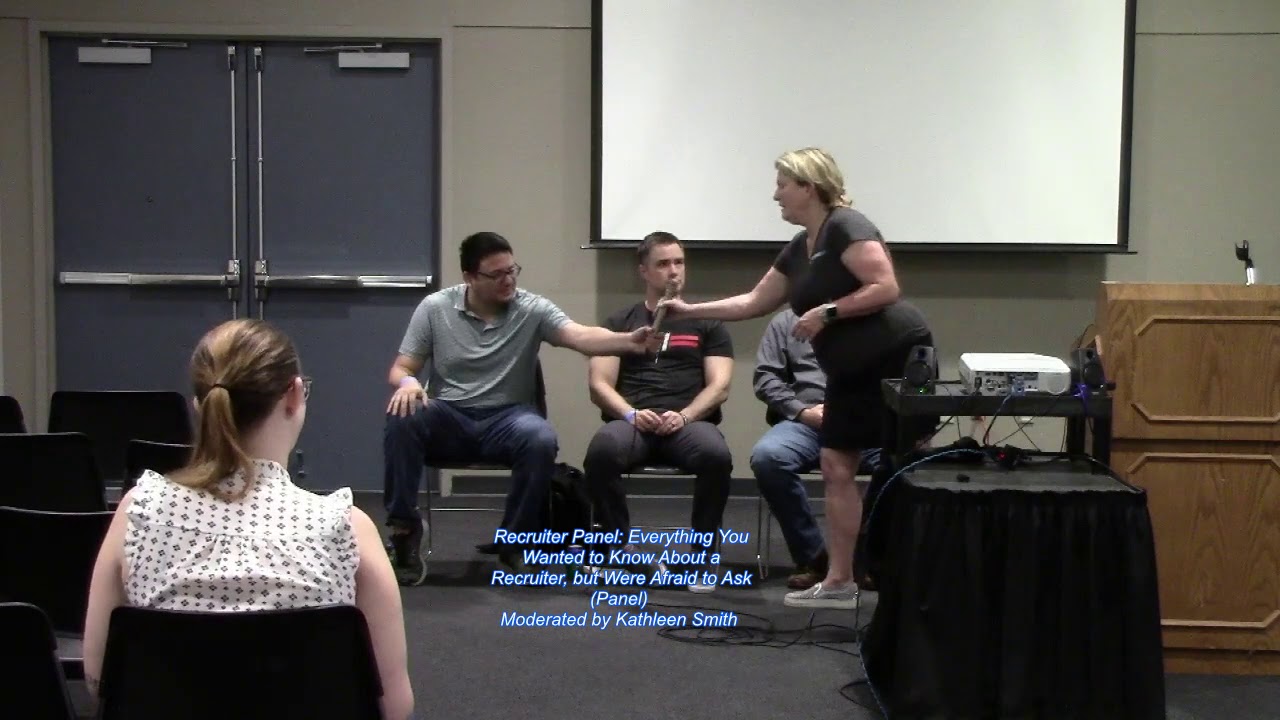
Recruiter Panel - Everything You wanted to Know About a Recruiter, But Were Afraid to Ask
Show transcript [en]
yes it's going to be an iron geeks website which is the most popular website in the community so what they must the most so this microphone is for the recording not for people to be able to hear you so just realize that so thank you everyone for coming to this morning's panel that is recruiting so for those of you who are in my presentation earlier I really highly recommend that you network with recruiters you network with people within companies because you never know when you're going to need to find your next job and what's interesting is that we have networks of people who help us get our no vacations where we hang out where we get the most you know recent
technical information the very few of us actually have a network of recruiters that will work with and recruiters are going to be the people that are going to be there your ambassadors and their advocates going into any company so you want to make sure that you have a network of recruiters the challenge that I am finding in this community is that we rely on all of the negativity that people are sharing about recruiters there are several twitter handles out there that are called recruiters say and they actually embarrass other recruiters by posting sort of their at which any of the LinkedIn messages that are out there so we have a lot of negativity out there talking about
recruiters so one of the things that I have been doing over the last several years is bringing recruiters that I know in the community to come present and talk with the community and share with them what's going on the other side of the terminal or what's going on behind the curtain because a lot of us get frustrated when we're trying to apply for a job the challenge is is that we don't know who to ask the questions for and so one of the reasons why we have a recruiter panel insert for recruiters to actually share what goes on in their companies so I'm going to have each one of the panelists and reduce themselves sort of talk about
their recruiting or what they do as far as the recruiting process a little bit about that company and I'd like you to share at least one thing that not many people know about yourselves so first Michael the first thanks for thanks for having me so about myself I hired retired Army I my last 20 years in the Army my last seven almost eight years in the Army I managed recruiters manes recruiting stations for the army retired in 2013 and I started recruiting for recruiting agency here in San Antonio as a tech recruiter and before I became a tech recruiter I barely don't have a plug a computer in it was kind of a crash course into the IT field and then we're
going to make you a tech recruiter I in the a20 the the more senior you progressing throughout your career the more it becomes about business development and less about recruiting less about HR and my passion was that recruiting the human resources portion of it and I actually found a passion for the IT industry so it was amazing to work for about three years and I left and I went over to a company called DTS I so what's DTS i DTS is is it acronym so diversified Technical Services Incorporated we are IT company who provides IT services the United States military we our corporate headquarters is here in San Antonio Texas as well a good portion
of our employees do you have offices throughout the country we roughly employ little over 150 people it's good times for DTS I because in this industry you have two types of companies you large companies or small companies so since 1980 DTS ID has been a small company the threshold is not the amount of employees that she won't employ it's the amount of revenue that you bring in maintaining over a certain amount time frame next year at DTS I will be considered a large company so we're going to be doing a lot of hiring to maintain that large status and now we had to compete with the big boys one of them she mentioned Lockheed Martin that would be that would now
would be a competitor of DTS I so it's guitars and what people don't know about me I guess I grew up in Nebraska I love Nebraska football go Huskers okay mines big ranch setter this is my I don't know forth first time doing besides I am also an army guy got up back in 2005 and a guy I knew said hey I just started a company called advocate solutions group why don't you come and be a recruiter and I was a medical guy in the Army I don't know anything about recruiting he said don't worry I'll train you so 14 years later Here I am I've seen the company grew up from three guys sitting
around a cubicle typical startup environment playing pranks on each other remote-control cars in the office too we have about the same by 150 something employees all over the country and so I recruit almost exclusively IT professionals for us who do everything from cyber net ops a little bit of software a little bit of medical stuff and some training bless that's what we do strive a little known fact my wife and I spent all of our money on travel we just were especially getting out of the country then at 50 something countries and that's what I love to do my name is Gregory rebus I am NOT a recruiter I'm actually a text screener so I work as a as a sockley over at
defense point security down the road got into that basically in college as a psychology major didn't know where I wanted to go and so naturally I enlisted spend a little bit of time in the Air Force I'm still a reservist and I yeah hey I know them I yep still still in the reserves that said as a cambric when came back to school finished my 4-year degree in psychology and then spend most of my time doing cyber security things so once you make it past them you gotta make it past me so what's interesting is that there's some memes out there that say what a typical day of a recruiter is basically with their feet up on a desk
and you know reaching all kinds of CAP names and stuff so I was hoping that our first two panelists can sort of talk about what your typical day is as far as looking at for candidates or recruiting and then Greg if you could just sort of tell how you incorporate the tech screening in amongst all of the other things that you do so there is no typical day in recruiting the soap my my Porsche my job is I think I'm the middleman between the hiring teams and the candidates and my job is to bring candidates into the process and then tell the hiring team why they should hire them and so when I come into work
this in the morning I check my email and I'm getting emails from candidates I'm getting emails from both the candidates and the hiring managers I answer those emails and then I see who who is in that station that in that process and how can we progress those people and that's the good portion of my morning somewhere somehow I got actually fun time to recruit and actually reach out to people there are days where I do I do it as a recruiter do a lot of traveling when catherine reached asked me to come here I was actually in Huntsville Alabama at the National Cyber Security Summit there I'm not complaining because it's actually one thing I enjoy about
recruiting because nothing is no day is ever the same in recruiting and that's kind of like what I like is walk to the door and see what my battles I gotta fight but it's fun I enjoy it and yeah
so it's a lot a lot of similarities there I'll put two other recruiters I'm a recruiting manager so we have a daily call where we sync up and say what are you working on today how did it go yesterday and then typically I'll spend the morning what I call moving the ball forward on our open rec so contacting hiring managers contacting candidates following up on interviews that happen trying to schedule new interviews I'll go and look and see who applied for our open wrecks and our applicant tracking system if I can find time because again there's no no typical day as he said I'll actually go and do some head hunting getting on monster dice
Careerbuilder indeed LinkedIn any number of our tools and actually trying to find people and reaching out to him but then also supporting our business development team because I say hey we're trying to write this proposal for solicitation we need to know how much pen testers cost in Colorado Springs so I'm having to go do some compensation analysis for that I might have to find some some resumes for a proposal for key personnel I don't travel as much we won't really do a lot of big career fairs just because we don't have large groups of people at any one location so I work from home which is awesome love the commute so my regular day is
going to consist of you know training younger analysts responding to alerts doing all the fun things that you're involved in a sock what where the text being fits in is we we we go and the leads get together and we sit down in a panel two to three depending on the day and availability and and try our best to see if not only if the person is a good fit but if you know you know what what what kind of what kind of knowledge that they come that they but they bring to the table and that can vary widely and and well and that's okay but if you but if you have a sort of a
more detailed background in security we're gonna expect more detail answers from you so it's sort of like a on a sliding scale depending on the position you want so I'm gonna build upon that and let's talk about what are some of the things that people really mess up in the process so Greg we're gonna talk with you first about in the tech screening process what are some of the one or two things that people mess up most often a couple of things actually moves that calm down man I know it's really kind of nerve-racking to do these interviews just just take a deep breath breathing control is really important with that the second thing is
if you say that you're you know we're I really am into you know current affairs and in cybersecurity and I really do this and that and I ask you what blue keep is and some of you may or may not know what that is you should know what that is in this case blue keep is a vulnerability that came out two weeks ago for affecting RDP that allows people to trivially compromise other computers very very critical very loud so if you if you if you ask if you if you talk about the law right keep up with current trends and you aren't up in current trends that that's sort of like a big ding another thing would be home laughs
demonstrate your passion by by doing something at home that's that's gonna put the technical people at much more at ease we if we know that he messes with raspberry PI's in his free time that's value so i'ma have to say communication both both from a were you out in the process but if you're not going to be available letting me know you know that's just one of my things that if you email me I'm going to get back to you within 24 hours and if this can take me longer than 24 hours to get you the answer that you're looking for I'm at least going to say let me get back to you but all all email
candidates and then I won't hear something back for three or four days and I'm interpreting that as they're not really interested in my job maybe they're going for something else but I'm at that point I'm not considering them to be a serious candidate now I'd say the other piece of that is is ghosting and that's when a candidate just stops responding to emails or phone calls I know that's a growing trend I would advise you not to do it even even if that's acceptable some places I if I have somebody ghost me if I'm talking about a job they're interested their interview and all of a sudden they just disappear I had to happen recently where
that happened to me and a guy followed up with me later and he said hey I'm interested in this other job that you have posted and I said hey when we were talking six months ago you just disappeared on me and that's that's not gonna be a good fit for our company so it can come back to bite you so if you're not interested or if you get another job just say not interested anymore Thanks doesn't have to be complicated so I'm going to second on communication a few years ago there was a word that was not in my vocabulary that is on the top of my mind every day and that is succinctly Burgett nervous people tend to ramble on
when I was in the I remember when I was an agency recruiter I had a candidate who is for not technically phenomenal two great things for a lot of great companies that I was sure that this candidate would have got the job went to your interview with that company's recruiter and he rambled on for must recruiter said I set my clock to one of the questions it was 15 minutes he just kept on talking and I tried to stop him but he just kept on rolling with it some time I came in to be succinct I like I said it was that way we're on my back yeah break it up be short with your communications when you
when you answer a question during the interview keep it to one or two minutes we're all human beings we all get nervous my wife is a good example the way to get around that this practice and repetition practice makes perfect right so practice your interviews with that with a fun with a significant other before you go on a real interview and practice keeping your answers succeeds so let's turn this to the positive there are 1 2 3 things that the job seeker has done that has made a positive impact on you or what are some of the things that you think a candidate should do to really have a positive impact on the oil process but I think tailoring the resume
is is always a big one because we we can tell when somebody's just sending their resume out to every single job that they find on there but I can also tell when someone tailors it especially if they put in the objective statement somewhere I'm looking for a cyber security job with advocate Solutions Group I know they've taken the time to to tailor it and to send it to me I'm automatically considering them to be a stronger candidate um hand in hand with that is a simple follow up just because of my thing I got to respond to candidates that email me if somebody applies for a job and then emails me like a day later I'm going to
bump them up to top of my list of okay I really need to go look at their resume I need to consider them as a candidate so it's such a simple thing it takes a minute of your time to send a follow-up email it makes a huge impression on me so one thing that I would say would be I do agree 100% with what he just said but one thing I would add to it would be after the interview the act of thanking that the interviewer seems to be a lost art is it is rarity that that I get an email hey Michael thanks for thanks for setting up that interview please please for this thank you later onto the
interviewer I would say I get it's an email like that one out of every 50 interviews and the people that do it set you up set you apart from the rest that don't and and to get one step above maybe the day after the interview actually stop by the front office and drop off a thank you card you can go up you can go to you know Walmart and buy a box of thank-you cards for what $2 the day after they'd have signed it day after the interview dropping off the receptionist they give this to James I just talked to him yesterday more than maybe 500 would do that literally I'm not making it's it's crazy
yeah made a lady come in and she had completed like five hack the Box challenges which is like not an easy thing was able to talk us through it and that that's gonna set you apart is at least from us on the tech side it's your extracurricular activities you know what you're doing in the free time we have had another person that have just like that military guy that had really unusually detailed process it was unusually detailed process of breaking into a corporation as a part of a Red Team three really really clear and succinct processes that that you can take and and insecurity well knowledge of the offensive side of things is is pretty that's that's going to step
that's but that's really nice to have it's nice to be able to think like an attacker and then be able to demonstrate how you would defend against those attacks in the interview in fact that's one of my questions I'll ask I'll ask you is what you know what are some ways we can defend against these things and the best way to get that is to drop disproves participate in online websites and and complete challenges and and and do attend conferences you know things like that so one thing that we said was competitions and we talked about that in the earlier presentation which is competitions are an instance where you have a short time frame you have short
resources you are working with the team you've never worked with before and you are going up against an adversary you have never gone up against before what does that sound like that's work experience so if you're not looking at competitions as work experience you're really shortchanging yourself so anytime that you are part of a competition be it on-site or online take some time after the competition to actually write out what happened you know what was the goal where did you fail weird what did you learn because what's interesting is that a lot of people will ask you during the interview process tell us something that you failed at and what you learned well a lot of us are not going to want to say
that we failed at work you know that the server's all went down or something like that but if you have an instance in a competition where you failed at something and you learn something now is great fodder for your communications during your interviews so definitely look at your competitions as a way of learning work experience but also do yourself the favor of writing down what you learned what the process was and also whether the the other non-technical things that happened for you during the competition what did you have to do did you have to learn how to communicate differently did you have to take a leadership position did somebody drop their pack and you had to pick up after
that so a lot of people think that recruiters are the sole decision maker that you know this recruiter is the one that was mean to me and didn't give me the job and a lot of people don't understand behind the scenes that there is a very long convoluted process so he's hoping each one of our panelists and sort of goes will step-by-step what is the hiring process the recruiting process and what are some of the things that people need to do to make sure they move to the next step Michael was it a very complicated question but I will do my best to answer it so let me ask the last part of that question first what can you
do to move along in that process would be to follow up to follow up with your recruit if you're working with a company that's our crew to follow up with that recruiter if you're working with the hiring manager fight over that hiring manager adult you know we I'm sure we all dated right you know nobody wants to date that guy a girl that calls you 20 times a day saying hey gladly girl let me grab me we also get that person right so there's an art to it how much you follow up and what you say when you follow and then would always be polite responsible let me see I would suggest that the day after send that that thank
you email that Thank You Carly I was talking about don't do it the same day because it was a fine art silly right don't be too pushy but be a little bit pushy so what is the process so I is a recruiter I don't I don't usually hire anybody if they're working on my team I would be involved in that hiring process but maybe more than 90% of the people that that that I talk to you I don't hire I have the authority I do have the authority to say say no you're not a good fit for our company so the process of the people that involved we're going to be we have with project based
companies and our project is with projects so with the US military so our program our project and our program managers and our account executives are involved in the hiring process some of the some of those people the candidates may talk to you some of the people the candidates may not talk to you but they're still involved and on the backside and HR and also our Human Resources team gets involved too and the service our Director of Operations everybody gets involved with the hiring process the most important part for you is the candidates but can you do we would be to follow up and that would be so I probably have final say in about 1 out
of 8 positions this specific contracts remember it's low level and they trust me enough to not screw it up but the rest of them if if it's a prime contract we have an internal corporate program manager that we always have interview because I'm putting myself in your guys's shoes you don't just want to talk to your recruiter you want to talk to somebody that's going to be a supervisor that's it's it will tell you more than what the recruiter can if it's a subcontractor then we're gonna have them talk to somebody on site with the prime who's able to answer their technical questions but that just gives candidates a robust view of the job and what they
could get from me what can you do I'd say just be responsive because remember we're trying to move the ball forward we're trying to get these positions filled and especially if a new security clearance is involved or have a background check all those sayings can delay the process and if it's taken you to three days to respond to requests for some documentation that just slows it down so I love a candidate that what when I say handed you to sign this and send it back I'm getting it back within 24 hours that's that makes me happy and the hiring manager as well so for us it's we sit on a panel and the ultimate the
ultimate decision is made by consensus we all talk about the analyst strengths weaknesses the fundamental question is is it is it worth training this person to work here that's that's that's that's what it comes down to the less we have to train you the more likely we're gonna hire you that's it's just basic it's just basic man-hours math so the more the more skills and more the more techniques and interesting things you can bring to the table that's going to be the edge and you don't need necessarily work traditional work experience to get that stuff like I said new challenges that kind of thing once we make our decision that decision is ultimately do we want this person on the
team are we okay with training them I'll be okay with their current technical ability and then we refer to our manager who will will shock managers who will speak a little bit more into their personality and if all those are worried you get hired that's basically it ways to differentiate yourself instead be fluent be fluent in and tcp/ip be fluent and if you have a poster if you have a host forensics background be fluent in them we can we can push towards that direction there's a lot of different ways you can you can you can you can yeah you can you can you can stand you stand apart so I think one thing that we need to
understand is that in the recruiting process the recruiter is not the soil decision maker and that is something that you want to definitely ask through one of the initial questions maybe the phone screen can you sort of walk me through this process what happens at this step what are the different steps I'm going to look for because a lot of people think that they apply for a job and when a decision is made it is not made within a week it is made over several weeks correct absolutely so and you need to understand that there are many different steps to this process there is applying for the job there's the phone screen there's the technical
screen if it's a prime or a subcontract you have to meet with many different program managers and now what that also should be telling you is that anytime you're considering quitting your job you are going to have two to three months where you're not going to have a job because you're going through all of the different process so understand that it's not something you can turn around on a dime it is something that you're going to have to go through various different steps and various different people in me so let's talk about one of the main tools that get someone an interview let's talk about the resume now we have someone here who's going to
be doing resume reviews all day today he was doing one and I grabbed him I thank you again for doing that but one thing that I see a lot in the community is people trying to make their resumes pretty okay we're not a graphics industry you are not trying to impress everybody by making your resume look pretty but can each one of our panelists sort of talk about what good things you see on a resume and what drives you nuts on a resume Michael so I would say that's the other job you're applying for make sure that that make sure you tailor your resume for that job I'm not saying make stuff up I'm saying highlight your
your experience for that job and ink don't talk your resume should have a lot of stuff that little bit stuff not a lot of stuff about things that do not relate to that job directly you know there's soft skills that could relate to any job so they should be speaking about I remember when I was in that agency words and I tried to download a resume and as soon as I hit the download button my computer froze up so I went to the we had an IT somebody who worked on the desktops and I said hey my computer froze up what's going on so about 10 minutes later he said wow you just downloaded 100 page resume resume resume
should only go back seven 10 10 years maybe there's no need to go back any further than that because anything that we did in our professional life 10 10 more than 10 years ago relevant to what we do today not really no so that they should be that doesn't mean make your font size 7 so that whoever reason has to squint it's to really but did that get you give me that two three pages so fartsy be like 10 to 12 times new roman' something something really simple you know that there are three types if you didn't know there's three types of resumes chronological functional in the car like a final combination resume the most
ninety-five the vast majority of the resumes that I see in my hiring manager see our chronological a couple last week somebody sent in a cross functional resume I was it's me I know it looked like I'm included as he resumes all day long I said it looked pretty good to me I was actually quite impressed but that's what I said to the hiring team in there right this isn't a resume you need to call them tell him to make a resume so if you want so if you do if you do a cross function or a functional resume be prepared to talk about it and talk about why you just did something that the vast majority of this
population that does not do so yeah yeah I always have a lot of strong feelings about resumes so I'll just say I just say it just remember that the resume is not to get you a job is to get you an interview and so you you just want the resume to say what it needs to say so that somebody like me says oh I I need to call this person and have a conversation with them about the job and then it's in the interview that you're gonna get the job so just a couple a couple of things and if you come see me I'm sitting over there after this I'll probably today the same thing a lot of
our jobs you have to have certain things in order for us to even consider you may be a clearance or certifications or a degree so I like the ceilings up at the top if I have to go digging I'm listen I just I'm human I'm reading stuff fast I'm looking at 50 resumes in an hour and I might miss your come to you Security+ because you put it buried in a list of bullets somewhere in the resume so I like to see clearance certs education maybe your major skills up top before you even get to your experience section I also I would advise you to stay away from anything subjective I'm talking about you being a
results-oriented team player it's on everybody's resume and I'm just telling you the moment I see those words my eyes go blue and I can't even read that past that paragraph anymore so keep it objective talk about your your highlights your accomplishments I'm gonna find out if your results-oriented by what your accomplishments say I'm gonna find out if you're a team player in the interview I'm asking you how well you work with others on that project that you talked about so those things are gonna come out but you rating yourself as a good communicator on a resume is it's not gonna help you it's just going to distract from what you ought to have their own line so yeah what--right
laughs about like if you put those soft things that's like you didn't put anything just I don't care I don't care I don't care it's what is interesting is I worked with VMware for you know three years like that's quantifiable make it quantifiable and again like she said put all that upfront up on top so that way we can whenever I and whenever we're talking with you I could just point at my computer screen and say well he did this and this and this while you're muted or while you're you know explaining an answer please I do this last week please don't give me your resume and paragraph form oh my god it's the worst I want to be able to
quickly see what you've done I don't want to have to read you know a hundred words about you know Sun Microsystems I that's not good not gonna do that I'm gonna ignore it so you know it's fill you all a curveball something that is not on the list of questions mainly because this is the first time we've had a panel on we've all had someone who is a veteran so I want each one of you to sort of talk to our audience here in military City or to our video audience sort of some things that transitioning veterans do on their resume or in their interview process that you think that they should do and what they should you know
something positive that they can bring to the table so Greg I'm gonna start with you first one two pieces of advice to transitioning veterans so you may experience up top I don't care that you're that you were a dog handler it's still relevant I still like to see the discipline up there you know I'd like to see just don't don't put your unit but only I want to see okay well I you I was NCOIC of X right I want to see that right across the top yeah that's that's something that that Betty that is interesting to me we we hire a lot of military guys that might be because we have a lot of military
guys but so we think they're great but yeah that's that's that's something that you know that that they would like to be on the lookout for especially if you have a military cyber background you need to be you need to make that very relevant to even if it was like you transfer out of the unit like two three years ago right new PCs somewhere I want to I already know that you were there and and that you were doing that that task because that's where that's that's really great that translates very well to my to my particular sector as a as a sock lead right I want to see that you that you've maybe you have that
analytical capability that you that you've brought in and from from the military I said don't don't put your PT score don't put your marksmanship score though yeah don't put your army Achievement Medal if if you're not out yet but you're going to be getting out I like to see your availability date because I got some people that are you know talking to me about jobs and they're not getting out for six months to a year my okay talk to me when you're about two months out you know that's that's too far so that's helpful and this this really goes for everybody not just veterans but when you're listing your bullets you want more than just your responsibilities I see this a
lot on veteran resumes is they just said this is what I did that's what I do is what I did but you know on your your NCO yards or your Oh a ours or whatever called food yeah you're talking about the awesome things that you did like your accomplishments and so those are that's what your resume should read like it should be very accomplishment heavy how're you selected first out of 25 people for something that's something to put on there not just that you showed up and didn't get an article 15 or fired or something like that so talk about your accomplishments I would say that job interview is not a promotion board and don't treat it as such don't go in there
knocking the door banging three times kicking the door down right so it is is a casual conversation for the interview to learn about you and for you to dance for you to learn about the company it's interview phase both ways so that don't be over military bearing too in your interview just keep it casual because that's what it is do not put acronyms on your resume I was in the Army 20 years the Army has a lot of acronyms and if somebody was it might be seen by a veteran it might not be seen by ready and the chances of that veteran being in the Army is is 1 out of 1 out of 4 what I'm fine right if we
include the Coast Guard and we have a lot of acronyms in the army there the F words don't know and they're f1 in vice versa right what's a captain in the earth or in the army versus a captain in the Navy so don't put your rank on there yeah you might put your make under yeah yeah and because is it you know if you know the company you've done your research about the company you know there's a lot of veterans in the company you know you you could but you know taking your resume towards the company towards the position at the end the day but the biggest thing that I can give you is treated as a
casual conversation and not a promotion board so one of the things that I see on military resumes that sort of shocked me is that someone let's say they're a logistics officer and just sort of believe that everyone understands what our logistics officer is or I was a platoon commander but I have no business skills excuse me if you're a platoon commander you have got the work force you have to move you have supply and you have to move you have a time line you have a lot of things that you have to do so definitely taking some of the military components and try to put the business spin on them because that is one way that you will be able to
sort of bridge the gap between yourself and someone who is possibly not former military who will understand that so we have some questions from the audience did you have a question sir so I'm going to repeat the questions for our video audience so looking for opinions from our Reza from our panelists on cover letters and also different tactics as far as the kind of paper that the resume is on and is it hand delivered oh there's all those good options or not so Michael so okay I can can make or break you if you submit a cover letter make sure that cover letter talks about and I'm saying this for a reason make sure that cover letter talks about that
position and that company I have seen a lot of cover letters talk about positions that have nothing to do with the position that that person just applied to we're not I see it a lot so make if you do write a well-written cover letter it can it can make you just your today like one of my hiring manager yesterday when my hiring manager said you know this this person the hiring for system engineer when this person has seven years of systems administration experience or base offer resume she's really not an engineer but man she wrote a really awesome cover letter I know it's hot to her so we commit we can you can make you or break you
I don't want if you are going to an interview I would suggest bringing a copy of your resume if you use the expensive paper I would I would know I would notice that if somebody hadn't even had to be that resume I think it is a need to email me a copy excuse me a mail me a copy of your resume I like to keep things paperless if at all possible and and even if you were to email so we're a federal contractor and we have to obey by my OFCCP and even if you if you did email me it mail me that copy or email me a copy of your resume I would still have
to have you apply for all our positions that you would be interested in and submit affirm applications so but during the interview that yeah that would be a perfect time to hand that nice piece of copy piece of paper to the interviewer on the cover letters I'd say most of the ones that I see if I could summarize it it would be I think I'm awesome and I want your job you know it doesn't it's not tailored as he said I don't I don't need a cover letter typically because I would just rather somebody tailor their resume to the job but if you do a cover letter you could I like to our to do a
mine like if you took the job description you know about the bullets of the job description maybe you don't do it for every single bullet but if you write to those bullets that you see like I see that you are transitioning from VMware five five to six point five well I actually read that in my last job that's a that's a pretty awesome thing that you could include in your cover letter it would also be on your resume probably so so I don't know that you necessarily need to have one but that's what a cover letter should look like I also go paperless I don't I don't want anything in the I definitely don't want watermark out
probably pity somebody who he's dewater my fancy piece of paper but I kind of agree I don't like know something want a market I mean it's cool let me generate conversation I guess about you and then it's kind of silly but that's not that's not something that's gonna that's gonna make or break you maybe if you're that close to the line I mean you should have studied more cover letters are nice because it's additional background that we have that we can set aside that we can read more about you before you show up I do I do I do like that but and yeah if you can tailor it to our requirements that's perfection it really is but this
is you know it's way nineteen out Nina 1970s style you know interview process we have a physical object you give me I'm gonna have it on the screen it's fine so I'm just gonna have our panelists summarize you know is there one more parting thought that you didn't get to cover in this panel that you want our audience to know Michael I would say speaking to the veterans about how to write a resume you already do not veterans you already have all the information that you need to write the resume can look at the awards that you were given look at your counseling statements if you would only listen to your aunt's we are in your lives
all that information just summarize it and change those acronyms to you know spell out the acronyms but you've already got all that information that you need and just put it on your resume okay so I mention this earlier there's probably more than two years where there's two main ways that all recruit and one is I post jobs waiting for people to apply then the other is I'm actually head hunting I'm looking for you on different tools that I have so you guys get the application thing but in terms of being found by somebody like me for job but maybe you're not currently looking but you just want to post your job some not all recruiters have the same tools
so some people have a monster subscription some people have a die subscription I think it would behoove you put your resume on multiple sources and that way if I only have one I will find you but if you only listed in one place I'm not going to be able to find you if I don't have that tool my biggest tip I could offer recruiters is I'm sorry candidates would be to fundamentally set up a home lab second best thing you could do is set up a home rep and third best thing you can do is set up a home lab set up a home lab at home and do the job at home and then tell me you can do
the job at home and then I can talk about the job you do at home and it's it translates very well it really does set home lab this morning and thank you to be site San Antonio for allowing me to have the career track as I said earlier I think it's wonderful that the community is really embracing the other aspects of our lives career search and also the mental health village that's on the other side we are all involved in this community and we all need the support so thank you besides San Antonio for providing all this next up is Meghan Moody no I don't know I apologize Roxy I'm sorry Roxy's up next at 11 o'clock
[Applause]
[Music]
Related talks
 50:45
50:45 51:46
51:46 47:47
47:47 30:07
30:07 25:06
25:06 57:19
57:19