Cybersecurity & Trust – the guardians of digital economy and prosperity
Show transcript [en]
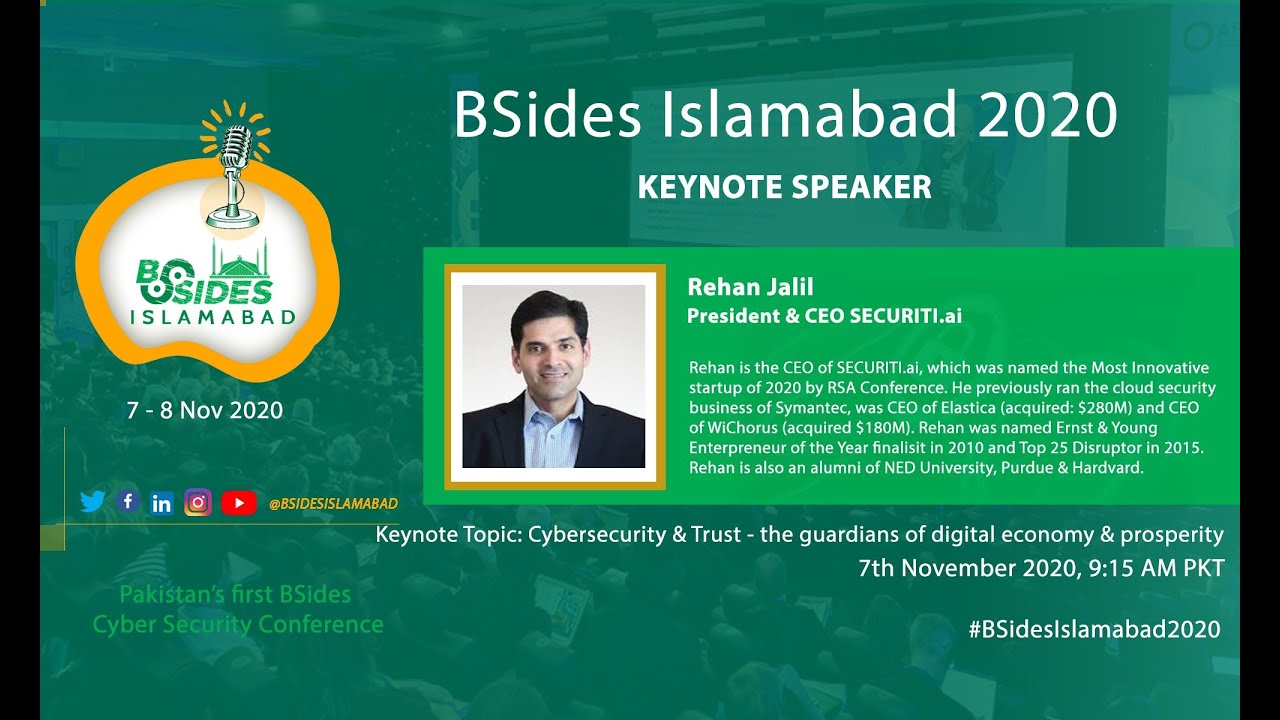
[Music] [Applause] [Music] next up taking more time i would like to introduce our uh keynote speaker so we have our keynote speaker with us a well-known uh personality who doesn't need any introduction rihanna is an entrepreneur and investor it's a privilege for b-side islam but to have him as a keynote speaker uh rihanna is the ceo of security.ai which was named as the most impo innovative startup of 2020 by rsa conference he previously ran the cyber security business of semantic he was the ceo of plastica which was required in uh which was required and also ceo of violations reform was named earnest and young entrepreneur of the year finalists in 2010 and top disruptor in 2015. tehan is also
alumni of nad university purdue university and howard university today is going to highlight the importance of cyber security and trust the guardians of digital economy and prosperity so let's begin i have a very high regard for this community of course it's a global community and i was very happy to see that it's such an organized thing that is going on out of islam about so um the other thing i just want to highlight is that instead of i thought making it more like a one-way keynote or or just uh some statements it'll be great if it can be more of a conversation which means if you have questions uh please do ask so i can give you a little bit of my
view on our purpose as a community a cyber security community in this world and how i see it what inspires me our team our my fellow colleagues and i'm sure you guys but it'll be great actually this could be a conversation in which you can ask questions and i'll be happy to answer to the to the best of my abilities so um before we jump into uh you know cyber security and privacy and so forth it's always good to understand like why why we do the do what we do and what impact it has on the rest of the globe not just in one country not just in one city but actually and things that we do we um it better
have impact across across the globe and i think that let's talk a little bit about that first so a few questions to ask key questions i would say why we should be in cyber security why me my friends and colleagues here and of course this community what is the purpose that we serve within cyber security where we see uh it needs to be more and more innovation needed we can talk a little bit about that and third important topic of course is privacy why this is such an important topic across the globe um where the data of people it needs to be kept private and why it actually has a huge implication on how the world may actually uh may look
different if there's no privacy around this with the three key topics simple we'll keep it to that so let's let's talk about the the y part first so just stare at this um this graph imagine in your mind like what what is this graph about and i use this edge quite a lot um and this simply represents the word gdp in trillions right and this is by economist robin hansen uh one of my favorite plots to look at the few numbers for you to think about the doubling time of world economy uh in the hunter-gatherer society was about a quarter million years right it took about a quarter million years for the world economy double
and of course it's an estimate but simply really mean for prosperity to double uh for people to come out of poverty or people to come out and have a better life that took about a quarter million years just to double that right the farming societies came along it uh dramatically changed to about let's say about a thousand years you know radical shift um but the one of the biggest shifts that has happened is information age where the prosperity or the world gdp can actually double within within a decade and it's even further accelerating as we going towards more automation ai uh all kinds of automation that actually is going on and it does actually have direct impact
on the prosperity um of the people around the globe yeah so what happened um this this graph this line looks of course you know went straight up there's a curve around here so let's zoom in and see what happened in this particular time frame right in this time frame uh imagine your mind what what innovation happened in that time frame the steam engine came along and of course it literally uh changed the way in in which humans could do things could be more productive right and then low and below the electricity and motors came along uh all of a sudden now people are even more uh you know productive um and of course you can see the world
uh world economy and prosperity kind of changing and people living kind of a better lives the fundamental still started happening with the computers uh and even further i would say uh when they got interconnected uh and then you can see the line goes kind of almost like straight up when everything got digitized and everything got you know interconnected uh the world became kind of a completely different place and that's where you see the the gdp kind of doubles every every 10 years because of that the um and this prosperity is which is enabling all this communication that we're doing right now all the commerce that happens in way all communication that happens this way all education that happens this way um
although open source software that gets developed one place and gets you some everywhere else all the collaboration that happens this way um it has of course uh it people who of course you know want to use uh this is more in a malicious way or actually want to attack in a malicious way and that's something that is really under attack there's prosperity this new system uh that has enabled so many people to be living in a different way that is something that that is a stake in all aspects of it and you know better than me and if this community if they can be guardians of having the trust that has been established and uh
in this particular information age and keep it secure um it is a great purpose it's a great cause to be actually in this in this profession and i'm sure it keeps many of you excited about it becomes more like a mission not just a job right i'll give you a little bit of course another example um physical security versus cyber security in a physical security in a traditional sense it used to be a time when you know one person could steal another one person or maybe one person can steal you know a bus maybe you know dozens of people together but when it comes to cyber security we all know the mass uh thefts and mass damage uh can be invoked by
this by the software right so uh having these checks and balances in place to keep the system going and enabling this uh information age i think is something that keeps all us all of us going right so let's let's talk about down all aspects of uh information information age whether it is you know now we talk about cloud computing it's iot it's uh the auto automated cars every aspect of it um wherever there is software running uh that's actually that understated right so the other other thing you we all we all know cyber crime accordingly you you're seeing the cyber crime kind of uh uh growing it literally at even at the most petty levels
to actually at this at the state level um and by one estimate as we know uh that's close to you know half a trillion dollars worth of uh cyber crime economy and of course speculation is uh that this itself is has become bigger than um drug traffic narcotics industry itself um so it's not that um the economic incentive of people actually trying to abuse and of course you know um steal information and actually have ransomware all that is actually the economic incentive is extremely high uh and no wonder you know we see all these incidents that's kind of going on the um i will kind of give you a little bit of data and this is from the
world economic forum just to give you also the what is really at stake and how even the global leaders kind of see this cyber security and some of you may have seen this is actually from this this year from world economic forum um if you see here on this chart is of course the global risk landscape of 2020. like across the globe if there were to be certain risky things what would those be right and according to the world economic forum things of course which humans would not be able to control is climate action failure or extreme weather conditions which will not be able to actually if that happens it's a huge risk for the humanity they put literally
um a natural disaster is right there and cyber security is right around around there you can imagine how it is perceived as such a big risk to the system that has been established because of which all the commerce happens and everything the way of life actually happens uh if this is compromised the global risk is extremely high right and if you can see some other aspects of uh of the cyber risk data fraud dealer theft is all support is is very high uh in terms of likelihood of that happening as well of impact you can see the likelihood of that happening and impact both are extremely high here right literally you can also see that
infrastructure breaking down you know some sort of you know we infrastructure not working likely because of that happening is much much less versus because we know their adversaries are there at the state level and all would would want to be uh you know compromising these things and if you look at the way this trending um you look at the scale of four and the weight is trending uh at the straight at the scale of four cyber attacks the the probability of and the impact of that is actually is going to be even more disastrous literally touching you know are enabled to actually take action on the climate change or action that we would need to be
taking to you know stop uh the climate change from actually having the the impacts it would could have and similarly on the data fraud and dead theft it is clearly you know there is impact of that and the likelihood of that happening is also kind of going up uh in all these studies and service and the what is the reason of it is actually very obvious more and more of data the more immortal life is you know being digitized um and more and more of new ways in terms of you know we know artificial intelligence as much as we want to use the cyber security side uh cyber criminals are also in all aspects uh of course using to
actually make sure that their systems and and are also a much more intelligent energy just not basic scripts but they're also self-learning and they adapt along along the way um so i think that's really is part of the reason as you can you can see it inspires a lot of people to make sure that they're on this side of the equation and they are basically regarding the system uh along the way and that's kind of keeps all of us going and as i said um please feel free to keep posting questions i'm gonna basically after some time i'm gonna stop and you know if you have questions we'll address it and have a conversation um and that'll be a lot more fun than
just me talking and uh feel free to add in comments if you if you don't have actually any specific questions it'll be make it a lot more uh a lot more fun um i think we all know you can you can every piece a piece of thing that we touch whether it is you know now in all the switches and light bulbs uh everything that you use actually it's a software and wherever there is software there is risk there is a risk uh even if there's like a little client piece of software there could be a cyber risk i mean that you can easily assume that that's good that's going to be there um often
you will see that you know we are at rsa all of many of you have been at rsa uh also when you go there it feels like you know there are like thousands of companies uh you know at least a few thousand companies actually show up there uh who have some role to play and often people say look there are too many companies well frankly really think about it uh every aspect of life actually has very different need on cyber security uh if you talk about iot you have a very different stack and you want to secure it in one way if you go towards cloud computing you have sas you have of course you know the is infrastructure within
that there's so many different components like it's such a complex environment if you go towards of course more automated cars um uh and if you go to you know uh healthcare you will see cyber security has so many different specializations hence you will see a lot of innovation actually comes from smaller companies comes from smaller group of people who are experts in their respective areas and they would want to innovate and they you know start something you almost can you can say that almost there is no other landscape in an industry where um a consolidation doesn't happen uh you hear consolidation happen very even if it happens these new issues that pop up there's new way of
uh doing things that pop up um in in in the technology side of things and new need of cyber security kind of come along right and we have that we've seen the transition again and again and again and it is not going to stop uh i think so that's why if you also have aspirations to you know build something on your own start something on your own this is again one of the best places to be not to be too worried about the large companies because not many large companies can continue to innovate in all aspects in all areas of cyber security itself right so um within within of course cyber security in different dimensions
of it uh i think we can we can spend a whole day kind of talking about it uh you know where are the kind of new avenues coming um and many of you of course you know must be engaged with you know many different aspects whether it's from iot to cloud to um healthcare to you know various different things let's talk a little bit about um the fourth industrial revolution what are the biggest things again this data is coming from the world economic forum also by 2025 cloud computing uh is going to be one of the most massive markets and within that of course it all gets bundled in sas you know you get private cloud you get
public clouds within that you have all kinds of storage from networking to compute and all kinds of things uh it simply represents that how central the cloud computing is going to become for all verticals like all kinds of businesses are going to be running on the cloud on the public cloud itself and securing it is going to be you know a amount of innovation that is needed it's just we're not just done uh this is a journey that's going to continue right for quite some time same all the revolution that's happening in autonomous anything instead of saying cars it should be autonomous anything cars are certainly there but also you know how the things get stacked and
shelved in in a in grocery shops to how things get delivered at home uh how maybe the delivery within a restaurant it happens they're all going to be autonomous right also all going to be software running and um that itself is a huge market and there's so many different flavors of this autonomous everything that you you know there's an opportunity there to continue to kind of you know make it secure uh and protect it and medicine uh precision medicine within that there'll be equipment uh there'll be software and equipment uh running um and that's where you know directly you can see uh life and death is going to be at stake and drones as we know where you do not
want the drone to be kind of hijacked and kind of acting against you and if actually are there some adversarial drones out there how do you actually protect even physically how do you actually protect them and this is a whole new area uh which we already know there's a lot going on in that area at the state level um the the key point being that there is not just one thing uh there are so many different specializations and flavors um that you know depending on uh you know what your aspirations are you of course you probably pick your path already on these things right let's talk about a bit about where does the uh the privacy
uh fit into the picture so before we even go and talk about privacy in the digital domain privacy is actually a fundamental basic human right uh and why is that it is not just because internet is there now we talk about privacy even u.s constitution uh you know which was written in you know hundreds of years back is literally is the basic human right it's written that way right and and reason is very simple that you every human being that lives they want to live in a private life they don't want uh interference uh they want freedom uh and and especially from i would say uh more powerful organizations out there which which actually a single human
being has no match to whether it's the government uh which can have too much knowledge uh about your daily life and it can interfere we will talk about that it has happened multiple times many many many times in genocide and all where explicit data collection about humans and how it was used against them and now we know uh it is it can be used by commercial organizations against you in a variety of different ways right um and those ways are very very you know simple there's a fairness if you if you're getting credit or you're trying to get an insurance um you know and if all data is out there it can be used against you to always can be
used it can be biased it can be biased uh you're trying to if you're trying to get you know basic healthcare or basic credit or or basic education where it can be used against you and it's extremely important and no question safety even in physical constructs uh if people who want to be acting as malicious against anyone having uh knowledge about a specific target it could actually put them in in like literally physical physical danger uh if we take that construct and apply it in digital domain is even more dangerous because now um the monitoring upon individuals whether at the state level government level um or if the commercial organization is doing it is so darn easy because
everything that we do the way we live life everything is come you know through our machines through our cell phone or my computer or my car and all this data is collected somewhere by each and not just collected it exchanged it's sold uh okay forget about advertisements it's it's basically used to influence you uh into variety of different ways whether it is influenced in a you know purchasing decisions or you're voting how you vote uh how you pick your preferences you your mind can be played with based on based on this data so privacy uh no no wonder uh the privacy has become one of the hottest topics um in the in the frankly globally
because people are kind of realizing that too much data and too much power it sits with uh commercial new commercial organizations like google's of the world and facebook's of the world and you know uh amazon's of the world um so if you look at the sentiment about privacy global shapers this is again this year's respondents and of course short-term risk outlook loss of privacy and loss of prices to government and loss of privacy to companies both are rated is extremely high you can look at you know which tax it's among amongst top 10 things extreme heat waves and destruction of ecosystem and in that same line you will actually have loss of privacy it's that high and i think it's obvious
why that is the case because you don't want you know control of extremely powerful organizations uh on individuals on how they live their lives right and why is that though if you go back in history the data collection um you know this is a blatant example of using data to then target and and physically harm kill and communities and this this happened uh you know not this is not just one example there are examples after examples there's a huge rule of data collection in genocides where you first have to know exactly who to target and data is collected and then some biases is created whether it is based on your race your gender whether it is based on your
beliefs your religion uh whatever that be you know and and the data uh that collection has uh played a huge role and hence privacies is absolutely one of one of the the most important topics of the times because data is so easy to collect um at this point right uh here you can see this is literally the the sheet where you know this is you know where prior to the holocaust uh how data gathering exercises were were there by the of course by by the governments um and um so and of course we're gonna we can again talk about what needs to be done there how the the people should own the data their own
data rights to the data the rights to go delete the data rights to modify the data and rights to know exactly who's it being shared with and stopping all of that and and if they remove the consent or that that's been given for the user data that that basically data doesn't get used against them or so i think you there's there is definitely a lot of new technology that needs to be built to actually give people the rights on the data not companies and governments actually having unchartered rights on people's data because it literally is their digital life data really means is their digital life and somebody has hats right so i think let me pause here um i know
we we have uh uh sometime we can actually talk a bit about if you have any comments please make any questions um i'll see if i can have the uh the questions here in this or somebody can actually tell me what questions came along uh yes rihanna uh thank you for that we just have one question can you hear me i can hear you yes cool we have just one question about discord channel uh they're mentioning you're a privacy champion so you mentioned about everything is going you know digitizing starting from you know the shopping cart you know after going to the autonomous cars so one thing is like the country specifically where they have
gdpr laws and the privacy laws so definitely you know they try to protect their customers data but the countries where they don't have any privacy laws even not even the cyber security laws are you know applicable so how customers uh should be enforcing you know that uh their information should be protected if banks are asking if telcos asking if are you know the car sharing service asking your their information how they can make sure their information is protected it's actually it's a really good question because if you really think about especially in some countries um the monitoring on individuals is just insane i mean you have to give your fingerprint you go buy you know guy buy a little
small thing or go with something you have to give a fingerprint it's not something you can change very easily if it gets stolen or it gets compromised right um i think the way it has happened gpr didn't come along by itself or ccp didn't come along which government wanted it it came along because people wanted it it was about awareness that people acquired and had understanding of how this data can be misused you should really see a movie on netflix uh called social dilemma it just came along i think it will give you a little bit of a deeper insight of how this data gets used and there's activism that happens where people like yourself and all who
got more who are more educated around how the misuse of this data can happen by the governments and by of course the commercial organizations and frankly commercial organizations often they collect data they have no understanding of how to protect it they'll collect hoards of data and often get compromised and at the end people suffer and activism is the way uh because there is a template established now with gdpr ccpa lgpd what's happening in country after country after country they're looking at these templates they're basically gathering around it and then asking their governments to actually build regulation or they're basically putting these things forward that's the way it's happening in india you're going to see a regulation
uh private uh regulation uh going into their house uh perhaps next next quarter and same can happen in in pakistan also you've seen that happening in of course other middle eastern countries that you have new regulations that are coming along and it's primarily driven by activism it's primarily driven by because people really care and if you do care then you know you should assemble and frankly educate others along the way it's not going to happen automatically otherwise and if it doesn't happen there'll be no rights like nobody would care if it's not a regulation thank you ram uh we have another question as well uh they asked they're asking i see that you have been quite successful in your
infrastructure you have worked in many companies like uh different companies elastica and other companies as well how long you have been in this cyber security game how long it did it take you to take the idea of privacy ops and uh and you know uh ensure you know say you know how you turned into a company yeah so um i think when if you if you look at turning into company is um first look at what problem you're trying to solve right and if that problem that you're trying to solve first of all if it is real um and if it is a broad market if the impact we talked in the earlier slides we talked about
how much impact it could have on the globe uh how many people would actually benefit which literally people talk about the market size but maybe instead of looking at from the market science perspective you say how many people i can actually benefit and if these two things line up and the solution that you can bring into the market if it is differentiated can stand on its feet um then you actually have a chance of making into a commercial enterprise right um and in case of uh security.ai it grew extremely fast uh the company is still very young um but a writer of the gate um within first year you know of course we were able to
launch five six products because the market need was there at that time clearly um and company course got recognized by even by organizations like rsa which is cyber security uh the largest cyber security kind of gathering uh as the most innovative company uh you know this year so um why because it was very simple there's clearly a market name uh a team that was able to pull off and you know build a certain kind of solution i think that's the template that you really could try to solve big problems uh with the differentiated offering uh and if you execute that's a commercial enterprise for you uh there is just no other secret to it it's a straightforward process i would
say thank you we have another question for you looks like questions are coming now quickly uh you mentioned about the cyber crimes they have been acknowledged globally and you know cyber crimes we saw some you know the recent activities in pakistan as well specifically then somewhere other activities against critical infrastructure uh some data loss happened with the banks as well so the question is as we have seen so many data breaches both in the past and the present what are the reasons customer privacy is not seeing as important as other countries uh in pakistan and why it's not taking so seriously and important i think it's clearly um it's clearly the uh awareness um i think
so um first i would say even from the cyber security side there is almost no awareness look you guys are the air specialists in this area so you understand what the kind of damage damages you know one theft you somebody can actually take out millions of peoples of data if the one bank gets compromised here you know millions of peoples of financial data could go out well thank you so very much if they know their questions i really appreciate you inviting me here and good luck with the rest of your conference thank you ryan it was really an influential session and it's definitely important for us and everyone to understand the importance of cyber security and trust to protect our
digital economy and prosperity that was really a very important topic close to our heart and you covered everything in depth and breadth and uh yep it was honor for us to be you know to be you having a keynote speaker in our first b-sides happening in pakistan thank you for taking time out thank you so much
Related talks
 3:19:17
 4:37:44
 50:58
50:58 45:50
45:50 17:26
17:26 23:22
23:22